

Choosing the right skill to learn is a bigger lever than how hard you study. Two people can put in identical effort for a year and end up in completely different positions, because one of them picked a skill the market wanted and they could stand doing.
Most people choose badly for understandable reasons. They follow whatever is loudest online, or whatever their friends are doing, or whatever sounds impressive at a family gathering.
Here is a more reliable way to decide, with a trial period built in so the decision is not permanent.
Start from the role, not the skill
Skills are not valuable in the abstract. They are valuable because someone needs a particular kind of work done.
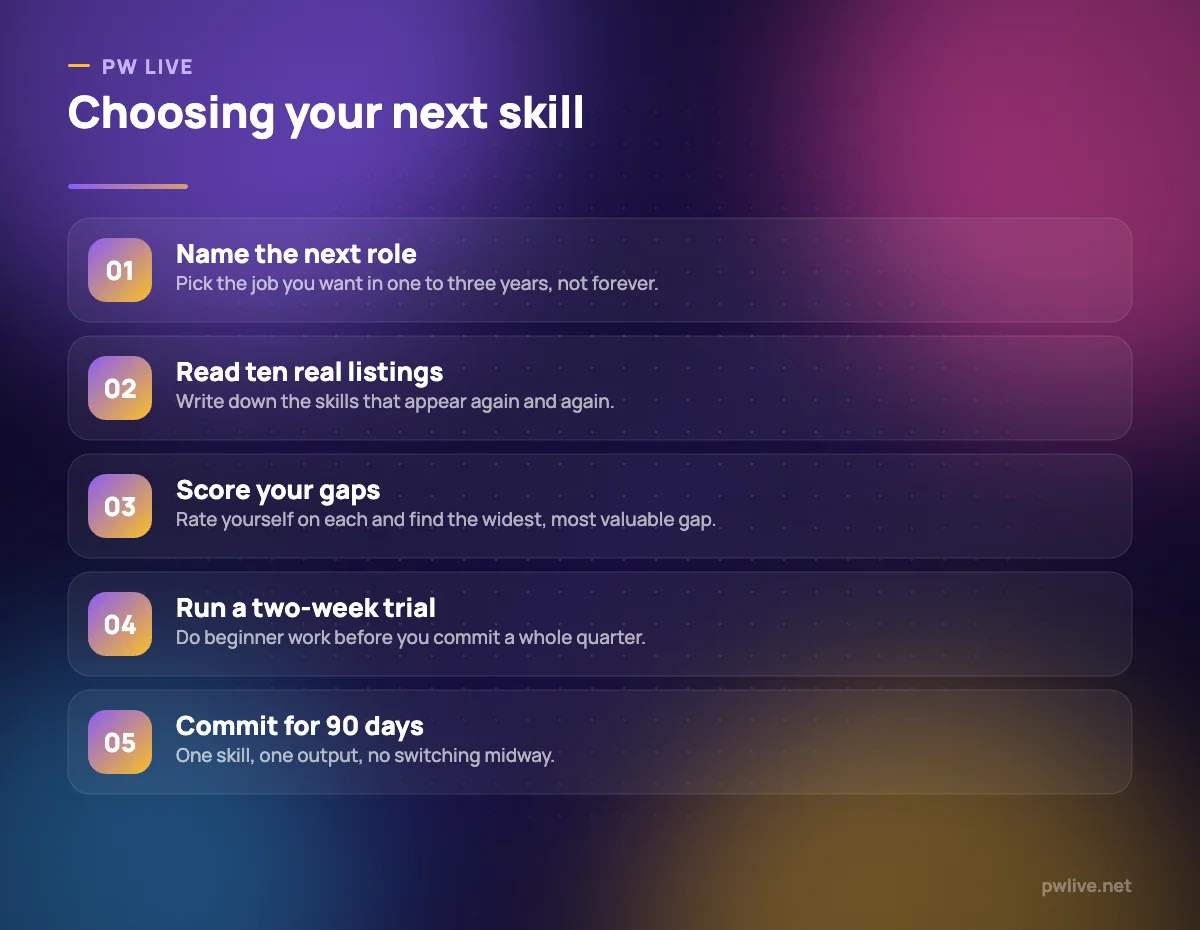
So do not start with “should I learn Python or design?”. Start with the next role you want, one to three years out. Not your final destination, just the next step, which is a far easier question to answer honestly.
Then get concrete:
- Find ten real job listings for that role, from companies you could plausibly apply to.
- Copy the requirements into one document.
- Mark every skill that appears in five or more of them.
- Ignore the aspirational list at the bottom of each ad and focus on the repeated middle.
That repeated middle is your candidate list. It is drawn from actual demand rather than from opinion, which is why it beats any trending list.
The three tests a skill must pass
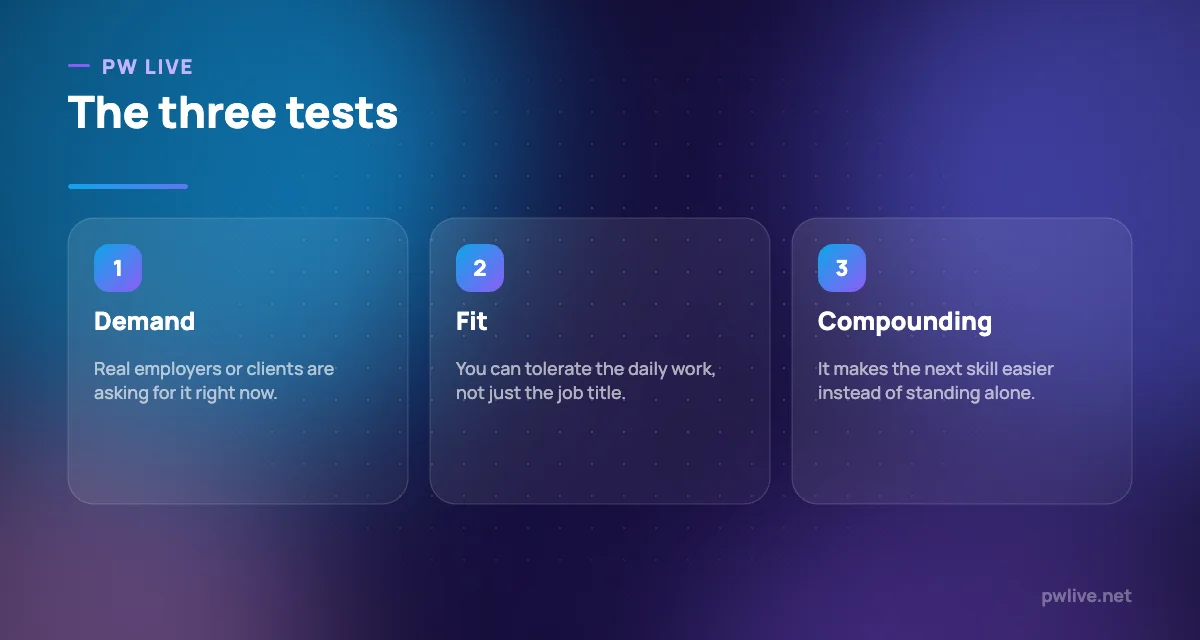
Once you have candidates, run each through three filters. A skill needs all three, and most people only check one.
Demand. Are employers or clients asking for this now, in your city or in remote work you could realistically get? Job listings, freelance marketplaces and the skills your seniors were hired for all answer this.
Fit. Could you do the daily version of this work for years? People fall in love with job titles and then discover the actual day is debugging, or calling strangers, or reconciling spreadsheets. Fit is about the tasks, not the label.
Compounding. Does the skill make your next skill easier? Writing, spreadsheets, basic statistics and clear communication all compound, because almost every future skill uses them. A narrow tool tied to one platform usually does not.
Map your direction to a track
Once you know your direction, the skill choice usually narrows to two or three options. A rough map:
- Building software or working with systems: programming fundamentals first, then one specialisation.
- Working with numbers and evidence: spreadsheets to an advanced level, then SQL and statistics, which is the sequence in the data science and AI track.
- Growing a business or a product: writing, analytics and one acquisition channel, covered in the digital marketing track.
- Design and creative work: visual fundamentals and a portfolio habit, before any specific tool.
- Leading people: delegation, feedback and running meetings, which you can practise long before you have a title.
- Managing your own money and risk: budgeting, tax basics and investing, the ground covered by the personal finance track.
Whatever the direction, the general-purpose skills at the top of our list of ten skills every student should build are worth having in parallel, because they raise the value of everything else.
Run a two-week trial before you commit
Committing a quarter to a skill you have never tried is how people end up quitting in week five and concluding they are “not technical” or “not creative”.
Instead, run a cheap trial:
- Spend six to eight hours over two weeks doing beginner work, not watching introductions
- Produce one tiny finished thing, however crude
- Notice what happens when you get stuck, because that is the real test
- Ask yourself whether you were curious afterwards or relieved it was over
Curiosity after difficulty is the signal to look for. Enjoying the easy parts tells you nothing, since everyone enjoys those.
Bad reasons to pick a skill
Some reasons feel compelling and reliably lead people astray.
- Because it pays well in someone else’s story. Pay follows scarcity and skill level, not the field alone.
- Because it is trending. By the time a skill is unavoidable online, the beginner segment is crowded.
- Because it is easy to start. Low entry barriers usually mean low differentiation later.
- Because you already half know it. Comfort is not a strategy; sometimes the right choice is the harder gap.
- Because a course was on offer. Discounts are marketing, not career advice.
A better filter is to ask what problem you would be able to solve for someone once you had the skill. If you cannot answer that in a sentence, the choice is not clear enough yet.
Depth beats breadth, then breadth beats depth
Early on, depth wins. One skill you can demonstrate at a professional standard gets you hired. Three skills at beginner level get you nothing, because beginner work is easy to find.
Later, the calculation flips. Once you are genuinely good at one thing, adding an adjacent skill multiplies your value: a developer who can write clearly, an analyst who understands the business, a designer who can talk to customers.
The practical sequence is therefore simple. Go deep enough in one skill to be useful, then add adjacent skills deliberately rather than collecting more beginner-level ones. This is also the least painful route when switching careers, since you carry your depth with you rather than restarting.
When to switch and when to push through
Every skill has a valley: the point where the beginner material is finished, the real work is hard, and you are not yet good enough to enjoy it. Most abandonment happens there, and most of it is a mistake.
Push through when you are still curious, when you are stuck on technique rather than on the subject itself, and when you have not yet produced one complete piece of work.
Switch when the daily tasks genuinely repel you, when the demand you assumed turns out not to exist in your market, or when you have finished a real project and still feel nothing. Switching after a completed project is information; switching in week three is just avoidance.
Whatever you choose, give it a defined block of time with a defined output. Our 90-day skill system is built for exactly this, and the skills development hub lists the tracks to choose from. For a wider view of where roles are heading, the career category is the place to start.
Key takeaways
- Choose the next role first, then let real job listings tell you which skills to learn.
- Every candidate skill must pass three tests: demand, fit and compounding.
- Run a two-week trial doing beginner work before committing a whole quarter.
- Curiosity after difficulty is the signal that the fit is right.
- Go deep in one skill first; add adjacent skills only once you are genuinely useful.
- Switch after finishing a project, not in the valley three weeks in.
Frequently asked questions
How do I know if a skill will still be in demand in five years?
You cannot know precisely, so favour skills that compound, such as writing, analysis and programming fundamentals. These survive tool changes because they are about thinking rather than a specific interface.
Should I learn what my college teaches or something different?
Both, in different modes. Treat coursework as the foundation and build one self-directed skill alongside it, because that second one is usually what differentiates you in interviews.
Is it bad to change my mind about a skill?
Only if you change before producing anything. One completed project gives you real information about fit; three abandoned starts give you none.
How many skills should I be learning at once?
One primary skill, plus one small supporting skill that feeds it. Beyond that, attention splits and nothing reaches a usable level.
Keep learning with PW Live
Browse every guide in Skills Development, or pick a skill track and follow the roadmap step by step.





Leave a Reply