

Most people asking how to switch careers assume the answer involves throwing away everything they have built and beginning again as a beginner. That belief keeps a lot of people in jobs they have outgrown.
The reality is that very little of your experience is actually specific to your industry. Managing a project, handling difficult clients, writing clearly, reading a spreadsheet, working to a deadline and understanding how a business makes money all carry across almost any move you might make.
A good career switch is not a restart. It is a re-labelling of what you already have, plus a small number of genuinely new skills, plus one credible piece of proof.
Get specific about where you are going
“I want to move into tech” is not a plan. It is a direction, and it will keep you busy for months without producing an application.
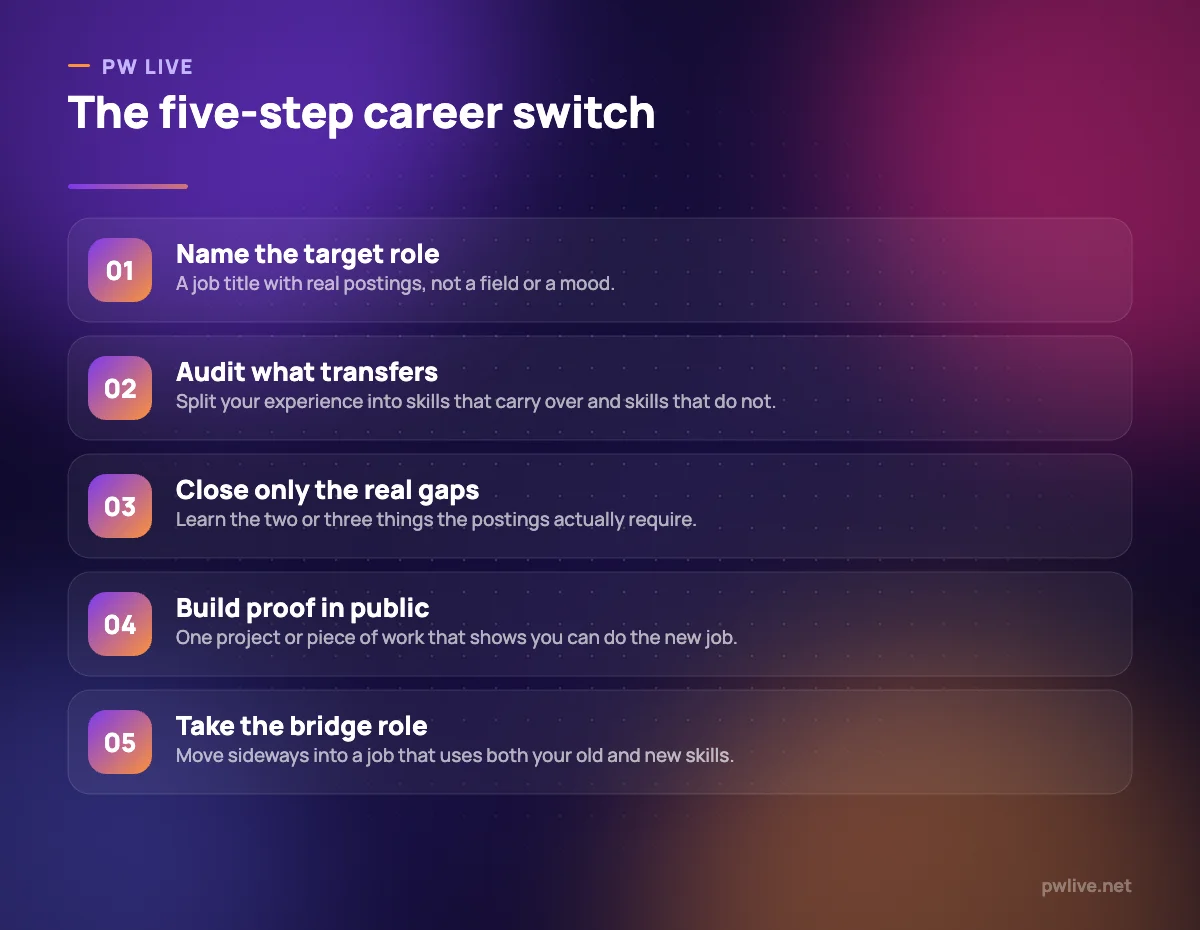
Narrow until you have a job title that appears in real postings. Not “something in data” but “junior data analyst in a mid-size company, working with SQL and dashboards”. The narrower it gets, the more obvious the next step becomes.
Do this to find it:
- Collect ten to fifteen job postings that make you think “I would like that job”.
- Read them for what they have in common: the title, the tools, the level, the type of company.
- Speak to two or three people currently doing that job about what the work actually involves day to day.
That last step prevents the most expensive mistake in career switching, which is spending a year retraining for a job you would not enjoy. The conversation approach in our guide to finding a job through networking works exactly the same way here.
Also be honest about the push. If you are running away from a bad manager rather than towards different work, a switch may not solve anything. A change of employer might.
Audit what transfers
Now separate your experience into three piles.
- Transfers directly. Communication, project coordination, client handling, budgeting, negotiation, writing, presenting, working with data, and the discipline of shipping on a deadline. Most of these are the things people find hardest to teach.
- Transfers with translation. Domain knowledge from your current field is valuable in your new field if you point it at the same domain. A teacher moving into product work is unusually well placed at an education company. A pharmacy graduate moving into sales has an advantage selling to hospitals.
- Does not transfer. The tool-specific and process-specific parts. These are the only real gaps, and there are usually fewer than you fear.
Write this out as an actual list. Most people discover that two thirds of what they do is portable, which changes how the switch feels.
Our guide to hard skills versus soft skills is useful here, because the switchable half of your experience is mostly on the durable side of that divide.
Close only the gaps that matter
The instinct after an audit is to enrol in a long course covering everything. That is slow and mostly unnecessary.
Instead, take the ten job postings you collected and list every tool and skill they mention. Rank by how often each appears. The top two or three are your syllabus. Everything below that is noise for now.
Then learn those in the shortest credible way:
- Pick one structured resource per skill rather than five half-finished ones. Our guide to choosing an online course you will actually finish covers how to pick.
- Learn by building rather than watching. Apply each concept to something real within a day of learning it.
- Give yourself a defined window. The approach in learning any new skill in 90 days works well for a switch, because it forces an end date.
Certificates help less than people expect. They open a door slightly; work you have produced pushes it open.
Build one piece of proof
Employers hiring a switcher have one worry: can this person actually do the new job, or do they just want to?
One concrete piece of work answers that better than any cover letter. Build it deliberately at the intersection of your old field and your new one, because that is where you are more credible than a fresh graduate.
Examples of what that looks like:
- A schoolteacher moving into instructional design builds a short online module, complete with assessment and a written rationale.
- An accountant moving into data analysis builds a dashboard analysing publicly available financial statements.
- A civil engineer moving into product management writes a detailed teardown of a construction management app, including what they would change and why.
- A customer support executive moving into marketing writes a set of help articles and a content plan based on the questions customers actually asked.
Publish it. A public link is worth more than a private file, and it gives people a reason to talk to you. Our guide to building a portfolio when you have no work experience covers how to present it, and teaching yourself with projects instead of tutorials covers how to choose the project.
Use a bridge role instead of a leap
The fastest switches are rarely a single jump. They are two moves.
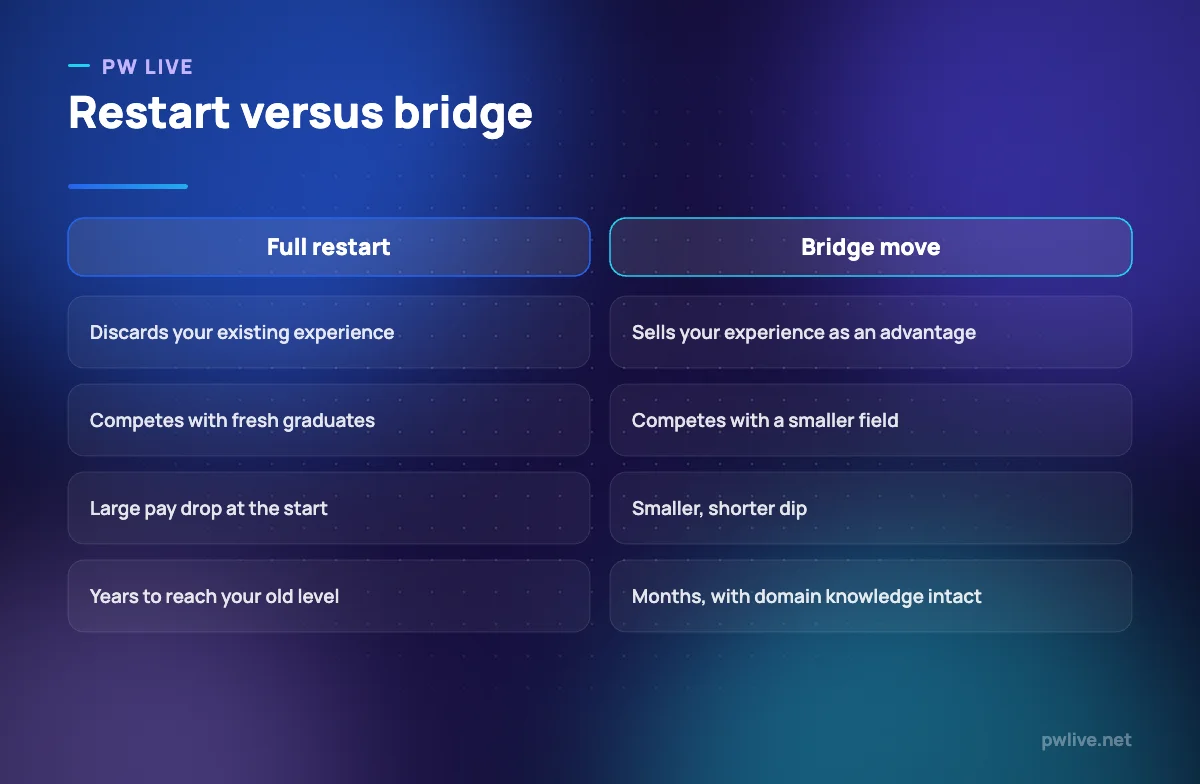
A bridge role is a job that uses most of your existing experience plus a little of the new skill. It is far easier to get than the target role, and after a year in it you are an internal candidate for the job you actually want.
Three common bridge patterns:
- Change function, keep the industry. You already understand the domain, the customers and the vocabulary. Only the job changes.
- Change industry, keep the function. You already know how to do the job. Only the context changes.
- Move internally first. Ask your current employer for a project, a secondment or a transfer into the team you want to join. This is the cheapest switch available and the most underused.
Trying to change function and industry and level all at once is what makes a switch feel like starting from zero. Change one or two at a time.
Tell the story so it sounds deliberate
Every interview will include some version of “why are you changing?” A weak answer sounds like escape. A strong answer sounds like a decision.
Use three beats: what you did, what pulled you towards this, and what you have already done about it.
“I spent three years in operations at a logistics firm, and the part I kept gravitating towards was the reporting side, working out why the same delays kept recurring. I taught myself SQL and dashboarding over the last several months and rebuilt our team’s weekly report as a project on my own time. I am applying for analyst roles because I want to do that work full time, and the operations background means I already understand the data I would be analysing.”
Keep it honest. Do not restyle a small side interest into years of hidden expertise, and do not list a tool you have only read about. Interviewers probe switchers harder than other candidates precisely because they are checking commitment, and a claim that does not survive a follow-up question ends the conversation.
Update your resume and your online profiles to lead with the new direction. Reorder your bullets so the transferable and relevant items sit at the top, and cut detail from unrelated responsibilities without deleting the roles themselves. Our LinkedIn personal branding playbook covers how to reposition a profile mid-switch.
Plan the money and the timeline
A switch usually costs something in the short term. Plan for it rather than being surprised by it.
- Expect a possible dip in pay or seniority, especially on a full restart. A bridge move usually keeps the dip small and short.
- Build a cushion before you resign. Our guide to building an emergency fund on a small income covers how, and having one is what lets you decline a bad offer.
- Prefer switching while employed. Learning at 6am for six months is unpleasant but far less risky than a gap with no income.
- Set a review date, six months out, where you honestly assess progress and adjust rather than drifting.
For more on the wider hiring landscape and how employers assess candidates, browse our career and jobs section or work through the career readiness track.
Key takeaways
- Narrow your target until it is a job title with real postings, not a field or a feeling.
- Audit your experience into what transfers directly, what transfers with translation, and what genuinely does not.
- Learn only the two or three skills the postings actually repeat, not an entire syllabus.
- Build one public piece of work at the intersection of your old field and your new one.
- Use a bridge role and change one variable at a time, so you keep the value of your experience.
Frequently asked questions
Am I too old to change careers?
Experience is an asset in a switch, not a liability, provided you position it as domain knowledge rather than starting again as a beginner. The bridge approach matters more the more experience you have.
Do I need a degree in the new field?
Usually not, unless the field is licensed or regulated, such as medicine or law. For most commercial roles, demonstrated work and a clear story matter more than another qualification.
Should I quit before I start learning?
Rarely. Switching while employed removes financial pressure, lets you take the right offer rather than the first one, and looks better to employers than an unexplained gap.
How long does a career switch usually take?
It depends on the size of the gap, but plan in months rather than weeks, and expect the job search itself to take longer than a search within your current field.
Keep learning with PW Live
Browse every guide in Career & Jobs, or pick a skill track and follow the roadmap step by step.





Leave a Reply