

Knowing how to find an internship matters more than knowing how to do one well, because most students never get past the search. They apply to a portal, hear nothing, and conclude that internships go to people with connections.
Some do. Many do not. The students who land good internships are usually the ones who applied in a targeted way, had something small to show, and asked directly rather than waiting for a posting.
This guide covers both halves: how to find an internship worth doing, and how to turn those weeks into something that actually helps your career instead of a line on your resume.
Decide what the internship is for
Before you apply anywhere, answer one question: what are you trying to find out?
An internship is a low-cost experiment. It lets you test a field for a few weeks before committing years to it. Being clear about the experiment changes what you apply for.
Common goals, each pointing at a different search:
- Test a field. You think you might want product, or data, or design, and you want to know what the work actually feels like day to day.
- Build proof. You need real work you can show and discuss in later interviews.
- Get a conversion offer. You want a full-time role at that company, so brand and team matter more.
- Earn while learning. You need a stipend, so paid roles and remote options come first.
Write your goal down in one sentence. It will stop you from taking the first thing offered and then resenting it.
If you are still deciding which direction to explore, our guide to choosing the right skill to learn for your career is a useful step before the search itself.
Build one piece of proof before you apply
The most common reason applications go unanswered is that there is nothing in them to look at. Grades and course names are hard to distinguish across a thousand applicants.
Something you made is not.
You do not need anything elaborate. Aim for one artefact you can link in a single line of your application:
- Coding: a small working project with a readable README, or a few merged contributions to an open-source repository.
- Design: three cleaned-up pieces, including one redesign of something real with your reasoning written out.
- Marketing or content: a handful of published posts, a keyword plan for a real site, or a short campaign teardown.
- Data: an analysis of a public dataset with a clear question, a chart and a conclusion.
- Business or operations: a short written breakdown of how a company you admire actually makes money.
Our guide to building a portfolio when you have no work experience walks through this in more detail, and teaching yourself with projects instead of tutorials explains how to pick projects that teach you something along the way.
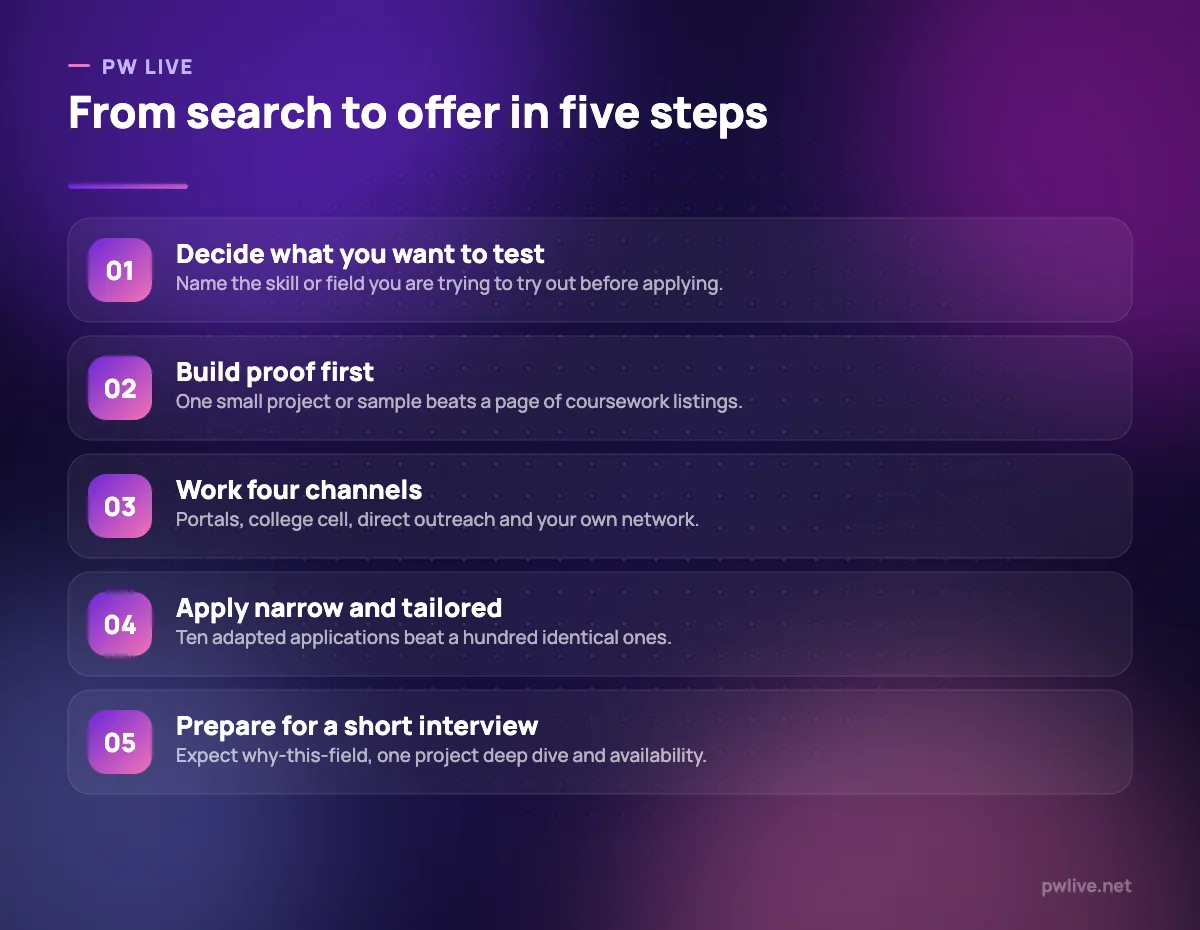
Work all four channels, not just one
Most students use exactly one channel and then conclude the market is closed. There are four, and they work at different speeds.
- Internship portals and job boards. High volume, high competition, but genuinely useful for discovering which companies hire interns at all. Set alerts and apply early, since many close on a rolling basis.
- Your college placement cell. Underused by students who assume it only handles final placements. Ask directly what internship listings exist and which companies hired from your college last year.
- Direct outreach. Email or message a small company that has never advertised an internship. Small teams often want help but never get around to posting a listing. This channel has the least competition by a wide margin.
- Your existing network. Seniors one or two years ahead, alumni, professors with industry projects, and family contacts. Our guide to finding a job through networking applies directly, and internships are the easiest thing to ask about because the ask is small.
Give each channel a slot in your week. Two hours on portals, one hour writing three direct outreach emails, one hour on follow-ups.
What a direct outreach email looks like
Keep it short. Under a hundred words, one link, one clear ask.
“Hi Rahul, I am a second-year computer science student and I have been using your app for a few months. I built a small tool that does something similar for college timetables, here is the link. I am looking for a summer internship and would be glad to work on anything useful for four to eight weeks, paid or unpaid. Would you be open to a short call?”
Adapt it honestly. If you have not used their product, do not say you have. Find a different true reason you are writing to them.
Apply in a way that gets replies
Ten tailored applications will beat a hundred identical ones. Tailoring does not take long once you have a base version.
For each application, change three things:
- The opening line of your cover note, naming the company and one specific reason
- The order of skills on your resume so the most relevant sits at the top
- The one project you highlight, choosing the one closest to their work
Everything on the application must be accurate. Do not upgrade a class assignment into a “client project”, and do not list a tool you have only watched a tutorial about. If you are learning something, say you are learning it. Recruiters read a lot of applications and they notice inflation quickly, usually at the interview stage where it costs you the most.
Our guides to writing a resume with no experience and writing a cover letter that gets read cover the mechanics of both documents.
Evaluate an offer before you accept it
Not every internship is worth your weeks. Before saying yes, get answers to four things in writing or on a call.
- What will I actually work on? If the answer is vague, the work will be too. A specific answer, even a boring one, is a good sign.
- Who will I report to, and how often? An intern with no assigned mentor usually drifts.
- Is it paid, and how much? Ask plainly. If it is unpaid, weigh what you are getting in exchange, and be honest with yourself about whether you can afford it.
- What are the hours, and is it remote or in office? This determines whether you can combine it with classes.
Be alert to a few warning signs: an offer that asks you to pay a fee, a role that is entirely unstructured sales with no training, or a company that will not tell you what team you will sit with. A genuine internship costs you time, not money.
Make the weeks count once you are in
An internship becomes valuable at the point you can describe a specific outcome you produced. That takes deliberate effort, because most internships will happily let you drift through them.
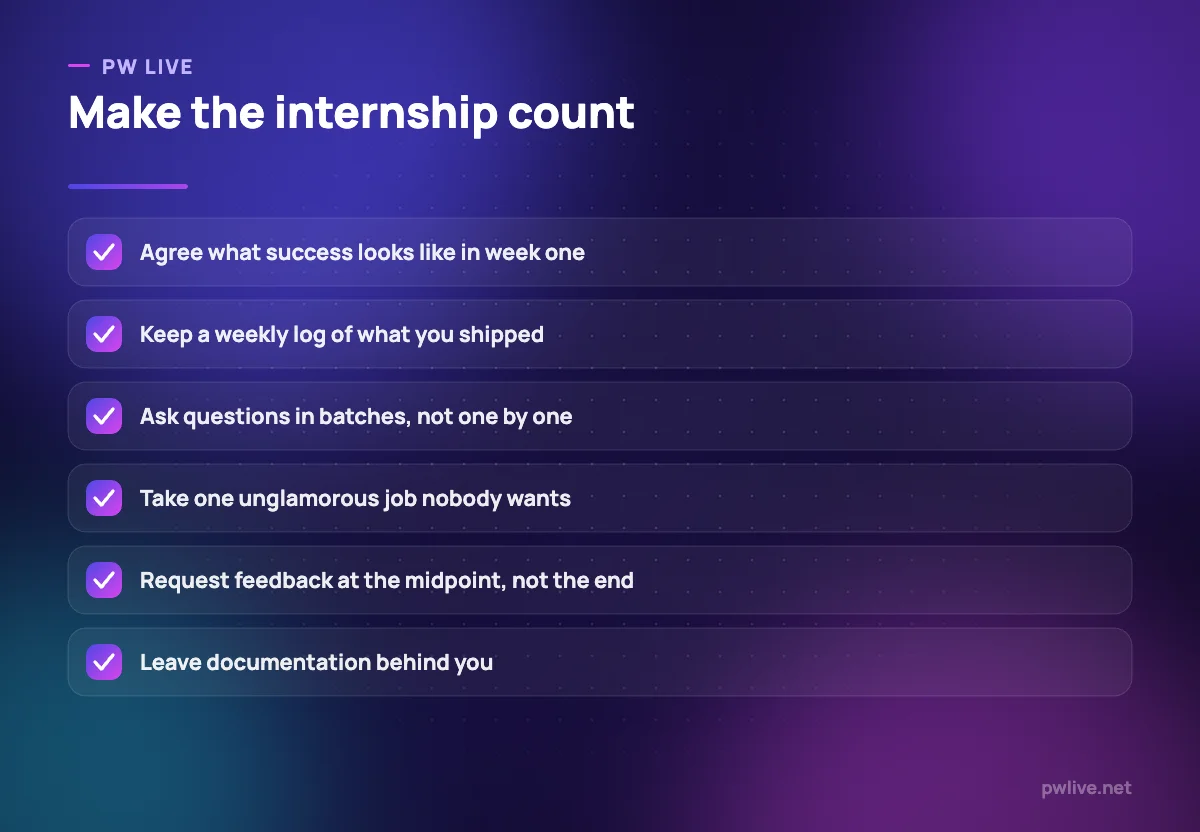
In week one, ask your manager one question: “What would make you say this internship went well?” Write the answer down. Now you have a target instead of a vague hope.
Then build these habits:
- Keep a weekly log. One line per week on what you shipped, what you learned, and any numbers attached. This becomes your resume bullets and your interview stories later, and you will not remember the details otherwise.
- Batch your questions. Save small doubts and ask five at once rather than interrupting five times. Try to arrive with an attempted answer.
- Volunteer for the unglamorous task. The documentation nobody wants to write, the messy data nobody wants to clean. It is the fastest way to become useful and to be remembered.
- Ask for feedback at the midpoint. Halfway through, ask what you should do differently for the rest of the internship. Feedback on the last day is useless to you.
- Leave something behind. A document, a process, a working tool. Interns who leave artefacts get referred later.
In the final week, ask two things: whether they would be willing to be a reference, and whether they know anyone else you should speak to. Both are small asks that pay off for years.
For more on how internships fit into the wider hiring picture, browse our career and jobs articles or work through the structured career readiness track.
Key takeaways
- Decide what the internship is meant to test before you start applying anywhere.
- Build one piece of showable proof first, because it makes every application stronger.
- Use all four channels, and remember that direct outreach to small companies has the least competition.
- Never inflate a project or a skill on an application; it fails at the interview stage.
- Agree what success looks like in week one and keep a weekly log of what you shipped.
Frequently asked questions
Should I accept an unpaid internship?
Only if the learning and the mentorship are genuinely worth the time, and only if you can afford it. Be sceptical of any arrangement where you pay a fee, since that is training being sold to you rather than work experience.
When should I start applying for a summer internship?
Begin your search several months ahead, because large structured programmes open and close early while smaller companies hire closer to the date. Applying early costs nothing and applying late removes options.
How many internships do I need before graduating?
One meaningful internship you can talk about in depth beats three you drifted through. Depth of contribution matters far more than count.
Can I do an internship remotely and still get value from it?
Yes, if the role has clear deliverables and a regular check-in with a named person. Remote internships fail when nobody is responsible for your work, so confirm that before accepting.
Keep learning with PW Live
Browse every guide in Career & Jobs, or pick a skill track and follow the roadmap step by step.





Leave a Reply