

The blank Experience section is the most intimidating part of a first resume. Recruiters hiring for entry-level roles do not read it that way: they are not expecting a work history, they are looking for evidence that you learn quickly, show up reliably and finish what you start.
This guide shows how to build that evidence from projects, coursework, internships and clubs, with a structure that survives a ten-second scan and a tailoring method that does not mean rewriting everything each time.
What recruiters look for in an entry-level resume
For a first job, a recruiter’s questions are simple:
- Can this person do the basic tasks, or learn them fast?
- Have they finished anything difficult on their own initiative?
- Do they communicate clearly?
- Will they fit the team and stay long enough to be worth training?
Every line should answer one of these. If it does not, cut it. A resume is not a diary; it is an argument that you are worth a conversation.
Choose a structure that leads with your strengths
A standard resume puts experience first. Yours should not. Use this order:
- Header: name, city, phone, a professional email, and portfolio or LinkedIn links if they are presentable.
- Summary: two or three lines on what you can do and what you are aiming for.
- Education: degree, institution, expected graduation year, and relevant coursework or grades if they help.
- Projects: academic, personal or freelance work with real outputs.
- Experience: internships, part-time jobs, volunteering, campus roles, even if unpaid.
- Skills and certifications: grouped logically, relevant ones only.
Keep it to one page.
Write a summary that describes ability, not ambition
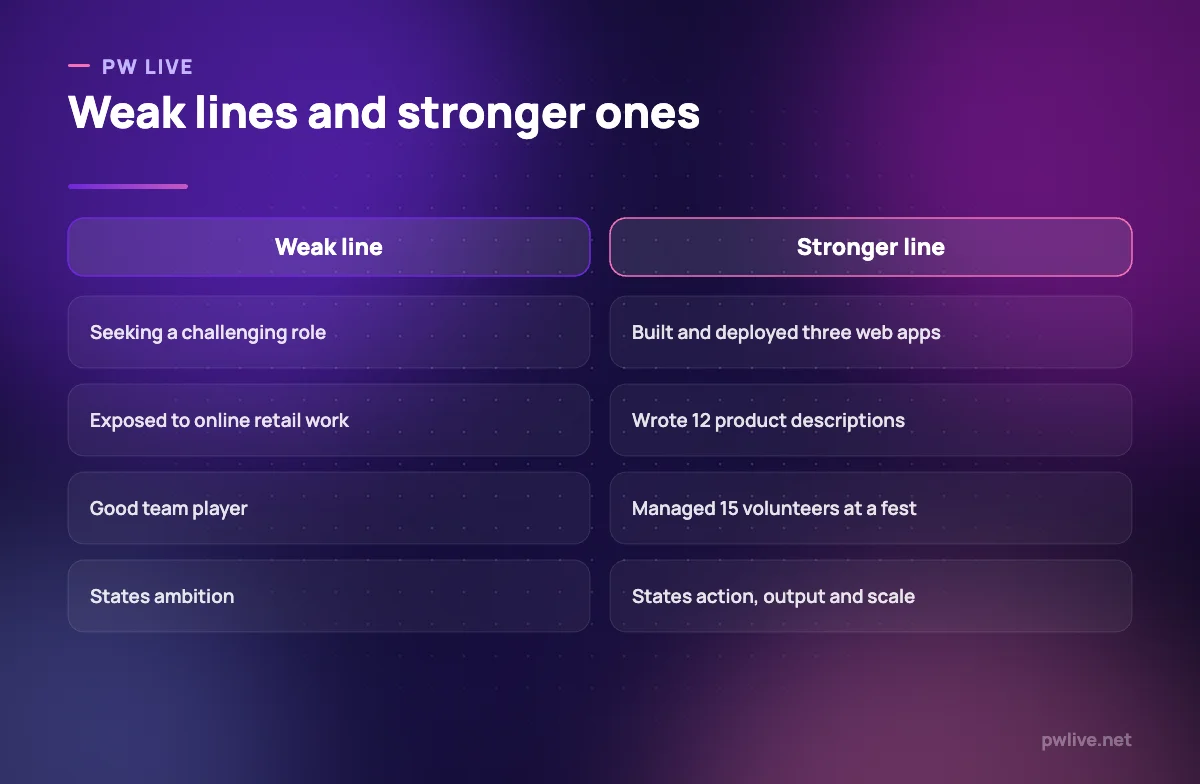
Most beginner summaries read like a wish list: “Seeking a challenging role where I can grow.” That tells the reader nothing. A better summary states what you have done and can do:
- Weak: “Motivated computer science student looking for an opportunity to learn and contribute.”
- Stronger: “Final-year computer science student who has built and deployed three web applications, including an event-booking tool used across campus. Comfortable with Python, SQL and Git. Seeking a junior developer or QA role.”
Turn projects, coursework and activities into experience
This is where a no-experience resume is won or lost. Every bullet follows one formula: action verb + what you did + result or scale.
Academic and personal projects
Treat serious projects like jobs: a title, a one-line description, and two or three bullets.
- “Built a personal finance tracker in Python that categorises expenses from bank statements; used daily by four family members.”
Internships, part-time and freelance work
A short internship or a few weeks of tutoring counts. Focus on what you produced, not what you were “exposed to.”
- “Wrote 12 product descriptions for a local retailer’s online store and organised its image library.”
Clubs, competitions and volunteering
Campus roles show initiative and teamwork. Quantify where honest numbers exist.
- “Coordinated logistics for a departmental fest attended by roughly 400 students, managing 15 volunteers.”
If you have none of these, spend two weekends building a small project related to the role. It fills the gap and gives you something real to discuss.
Match your skills section to the job description
Many companies use screening software that searches for keywords before a human reads anything. Your skills section is where those terms belong.
- List the tools, methods and qualities the job description names.
- Include the ones you honestly have, using the employer’s wording.
- Never list a skill you cannot demonstrate in an interview.
If the role involves clients or writing, state communication skills explicitly; the communication skills page covers how to build and evidence them.
Formatting rules that keep you out of the reject pile
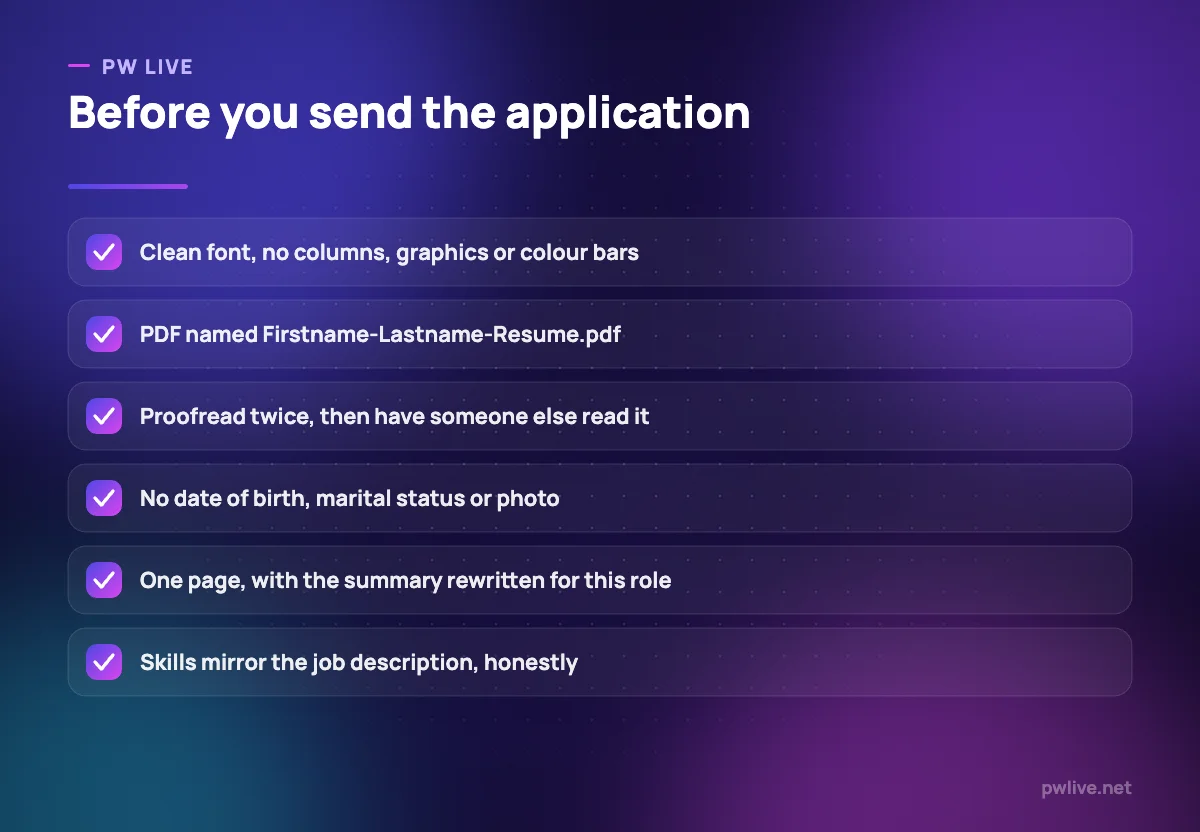
- Use a clean standard font and consistent spacing; avoid columns, graphics and colour bars that confuse screening software.
- Save as a PDF unless asked otherwise, and name the file professionally: “Firstname-Lastname-Resume.pdf.”
- Proofread twice, then have someone else read it. One typo can undo a strong page.
- Leave out date of birth, marital status and a photo unless the application asks.
Tailor every application without rewriting everything
Sending one identical resume everywhere is the most common reason capable students hear nothing back.
- Keep a master resume with every project, role and skill you have ever listed.
- For each application, copy it and remove what is irrelevant.
- Rewrite the summary to name the role and what the employer cares about most.
- Reorder bullets so the most relevant appear first.
This takes about twenty minutes per application once the master exists. The career readiness page covers the rest of the process, from cover notes to interviews, and the career category has more on early-career decisions.
Key takeaways
- Entry-level recruiters look for learning ability and evidence of finishing things, not job titles.
- Lead with a concrete summary, then education and projects; experience comes after.
- Write every bullet as action + what + result, with honest numbers.
- Mirror the job description’s keywords, but never claim what you cannot show.
- Keep it plain, one page, PDF, and proofread by a second person.
- Maintain a master resume and tailor a copy for every application.
Frequently asked questions
Should I include my grades or exam scores?
Include them if they are strong or if the employer asks. If they are average, leave them out and let projects carry the weight.
Can I list a project I did for a course?
Yes, as long as you describe what you personally built or decided, and can explain it in detail at interview.
How do I handle a gap after graduation with no job?
Fill it with something real: a course with a finished project, freelance work, volunteering or a self-directed build, described like any other experience.
Keep learning with PW Live
Browse every guide in Career & Jobs, or pick a skill track and follow the roadmap step by step.





Leave a Reply