

Income tax feels intimidating mostly because of vocabulary. Once you know what a financial year is, what tax deducted at source means and how a return differs from a payment, the process becomes clerical rather than frightening.
This guide covers the structure of income tax in India for someone earning for the first time, whether from a salary, freelance work or a mix. It deliberately avoids quoting rates, slabs, limits and deadlines, because those are revised regularly and an out-of-date number is worse than no number.
This is general educational information, not personalised financial advice or tax advice. Check the current rules on the income tax department’s official portal, and consult a qualified adviser or chartered accountant for your own situation.
The vocabulary you need first
Five terms carry most of the meaning.
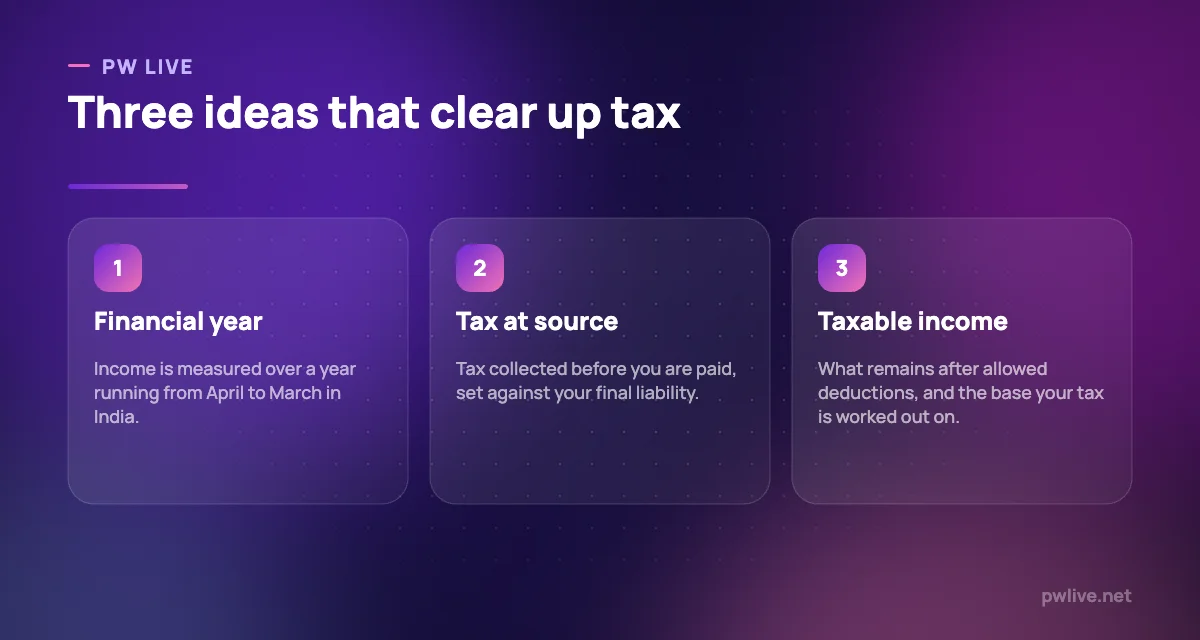
- Financial year. The twelve months your income is measured over, running from April to March in India. The assessment year is the following year, in which that income is assessed and the return is filed.
- Gross total income. Everything you earned in the year, added up across all sources.
- Deductions and exemptions. Specific amounts the law allows you to subtract, subject to conditions.
- Taxable income. What is left after those subtractions, and the figure your tax is actually calculated on.
- Tax deducted at source, usually shortened to TDS. Tax collected by whoever pays you, before the money reaches you, and credited against your final bill.
Two more are worth adding. PAN is your permanent tax identifier and is required for almost everything. A return is the annual statement of your income and tax, which is separate from the tax payment itself.
Where your income comes from changes how it is treated
Tax law does not treat all income identically. It groups income into heads, and the head determines which rules apply.
- Salary. Your employer usually deducts tax through the year and issues an annual certificate summarising it.
- Income from business or profession. This is where freelance and consulting earnings usually sit, with its own rules about expenses, record keeping and, in some cases, simplified schemes.
- Capital gains. Profit from selling assets such as shares, mutual fund units or property, where the holding period often matters.
- Income from house property. Typically rent you receive.
- Income from other sources. Interest on savings accounts and deposits, and various one-off receipts.
Salaried people often assume their employer has handled everything. It has not, if you also earn interest, freelance on the side or sold investments. Those are yours to declare. If freelance income is part of your picture, our guide to freelancing for beginners covers the record keeping that makes this much easier.
Tax at source is an advance, not a final settlement
TDS is one of the most misunderstood parts of the system. When an employer, a client or a bank deducts tax before paying you, that money is deposited against your PAN. It is a prepayment, not a closing of accounts.
At the end of the year you work out what you actually owe on your total income. If more was deducted than you owed, you claim a refund. If less was deducted, you pay the balance.
This is why people with multiple income sources sometimes face an unexpected bill. Each payer deducted based only on what it paid you, with no view of the total. Similarly, freelancers often find tax has been deducted from client payments and can only recover any excess by filing.
Your annual tax statement on the official portal shows the tax credited against your PAN. Reconciling it against your own records before filing is the single most useful habit in this whole process, and it pairs naturally with knowing how to read your salary slip.
Regimes, deductions and why nobody can answer for you
India offers more than one way of computing tax, broadly a structure with lower rates and fewer deductions, and one with higher rates but more deductions available. Which works out better depends entirely on your own numbers: how much you earn, what you actually spend on deductible items, and whether you can evidence them.
Two things follow. First, do not copy a colleague’s choice, because their rent, loans and investments are not yours. Second, do not invest in something purely because it is described as tax-saving. A poor investment with a tax benefit is still a poor investment, and the point is covered further in our comparison of mutual funds and fixed deposits.
The rates, the options available and the deductions permitted under each are changed periodically in the annual budget. Verify the current position on the official portal or with a qualified professional before choosing.
What to collect before you file
Gather these before you open the filing portal:
- PAN, Aadhaar and your bank account details, including the account you want any refund paid into.
- The annual salary certificate from every employer you worked for during the year.
- Your annual tax statement and information summary from the official portal.
- Interest certificates or statements from banks, including savings interest and deposit interest.
- Capital gains statements from your broker or fund house if you sold anything.
- Records of freelance income and the expenses you intend to claim against it.
- Proofs for any deductions you plan to claim, such as premium receipts or loan certificates.
Keeping these in one folder through the year turns filing from a weekend into an hour. A simple sheet updated monthly works well, as covered in using spreadsheets for planning and budgeting.
Filing, verifying and keeping the record
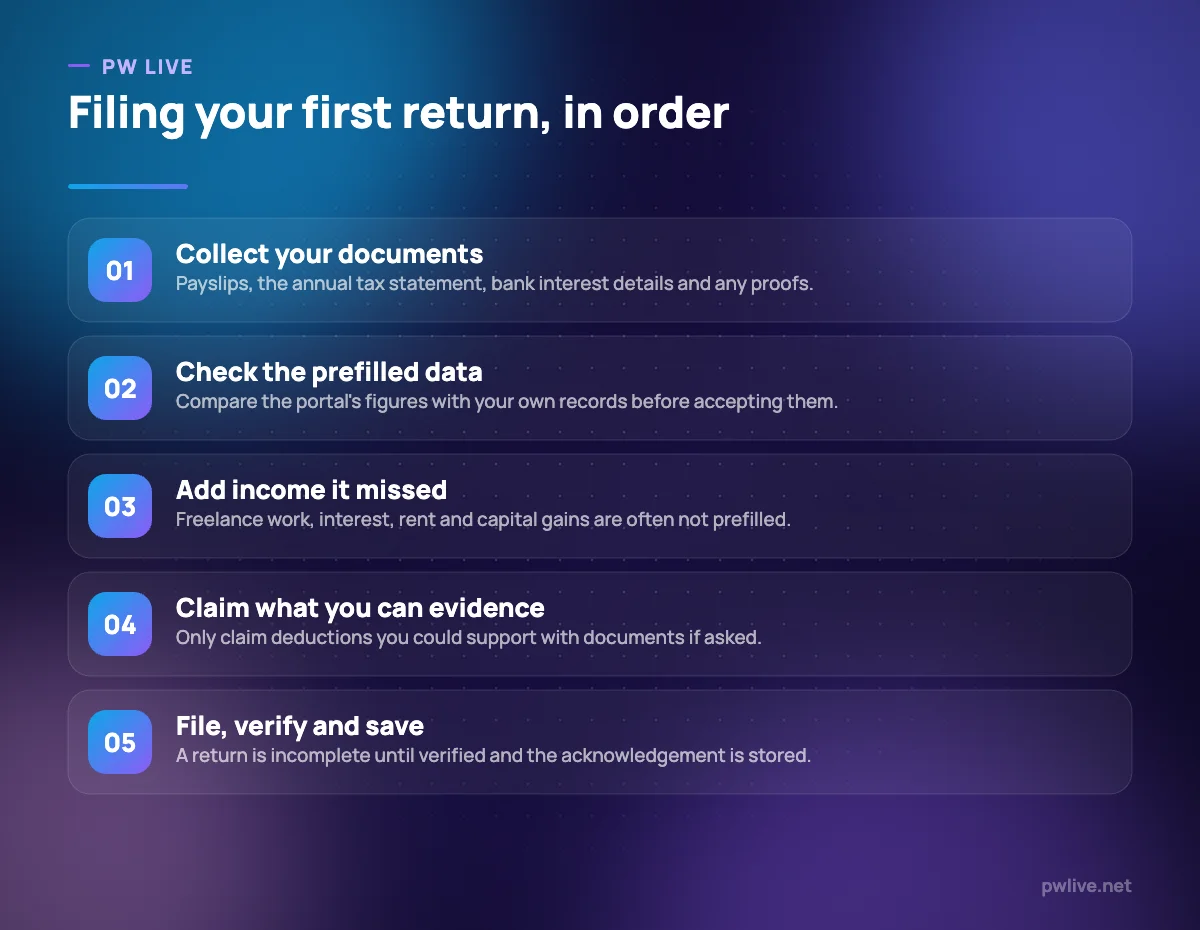
Filing happens on the income tax department’s official portal. Much of the data arrives prefilled from what employers and banks have reported, which is a starting point to check rather than a finished return.
Three rules matter more than the mechanics. Choose the correct return form for your income types, because using the wrong one causes problems later. Complete the verification step, since an unverified return is treated as not filed. And save the acknowledgement along with your supporting documents, because you may be asked to substantiate a claim well after the year has closed.
Deadlines, late filing consequences and the forms themselves change from year to year. Confirm them on the official portal rather than from any article, including this one.
Common first-year mistakes
- Assuming that because tax was deducted, no return is needed.
- Forgetting savings account and deposit interest, which is reported to the department anyway.
- Claiming deductions without documents to back them up.
- Filing and then never verifying.
- Leaving everything to March and making rushed decisions about investments purely for tax reasons.
- Ignoring income from a previous employer after switching jobs mid-year.
Getting the routine right in year one makes every later year easier. If you also sell online or run a small business, the compliance picture widens, and GST and compliance basics for online sellers is the companion piece. The rest of the money basics sit in the finance category and the personal finance skill track.
Key takeaways
- Income in India is measured over a financial year running April to March and assessed in the following year.
- Tax law groups income by source, and the source determines which rules apply.
- Tax deducted at source is an advance against your final liability, not a settlement of it.
- Which tax computation option suits you depends on your own numbers, so do not copy someone else’s choice.
- Rates, limits, forms and deadlines change every year, so verify them on the official portal.
- File, verify and store the acknowledgement with your supporting documents.
Frequently asked questions
Do I need to file a return if tax was already deducted from my salary?
Deduction and filing are separate obligations, and whether you must file depends on rules that change. Filing is also how you claim a refund if more tax was deducted than you owed, so it is often worth doing regardless.
How do I know how much tax has already been paid on my behalf?
The annual tax statement and information summary on the official income tax portal show the tax credited against your PAN by employers, clients and banks. Reconcile it against your own records before filing.
Are freelance earnings taxed differently from salary?
They usually fall under income from business or profession, which has its own rules on claimable expenses and record keeping, and clients may deduct tax at source. Because the treatment is different, it is worth getting professional guidance in your first year.
Which tax regime should I choose?
That depends on your income, the deductions you can actually evidence and your spending patterns, and the options change with each budget. Compare both using your own figures on the official portal or with a qualified adviser.
Keep learning with PW Live
Browse every guide in Finance & Investing, or pick a skill track and follow the roadmap step by step.





Leave a Reply