

Product-market fit is the point where the market pulls the product out of you instead of you pushing it into the market. It is easy to describe and much harder to recognise from the inside, because early enthusiasm looks a lot like traction.
Most founders overestimate how close they are. Polite interest, signups from friends and a busy launch week can all feel like fit and mean almost nothing a month later.
This guide covers what fit actually looks like in behaviour, which measurements are worth watching, and what to change when the signals are missing.
What product-market fit really means
Fit is not a feature milestone or a revenue number. It is a relationship between a specific product and a specific group of people who have a specific problem.
Three things are true when it exists.
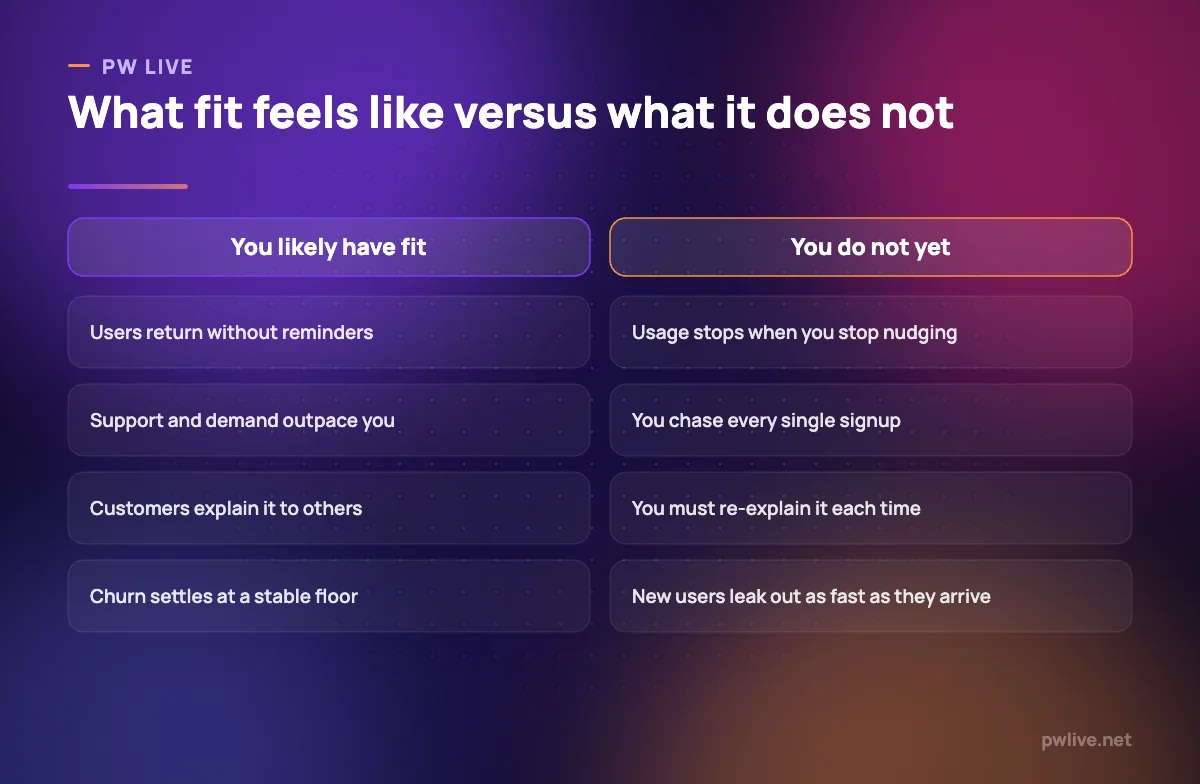
- People keep using it. Retention is the core of the definition. A product people try once is not a product people need.
- They would miss it. If you disappeared tomorrow, they would have to go and solve the problem some other way, and that would annoy them.
- Growth stops depending entirely on your effort. Some of it starts arriving on its own, through referrals, repeat purchases or search.
Notice that none of these is about how good the product is in absolute terms. Plenty of rough products have fit, and plenty of polished ones do not.
Retention is the signal that matters most
If you track only one thing, track whether people come back.
Plot the percentage of a group of users who are still active one week, one month and three months after they joined. Then look at the shape of the curve.
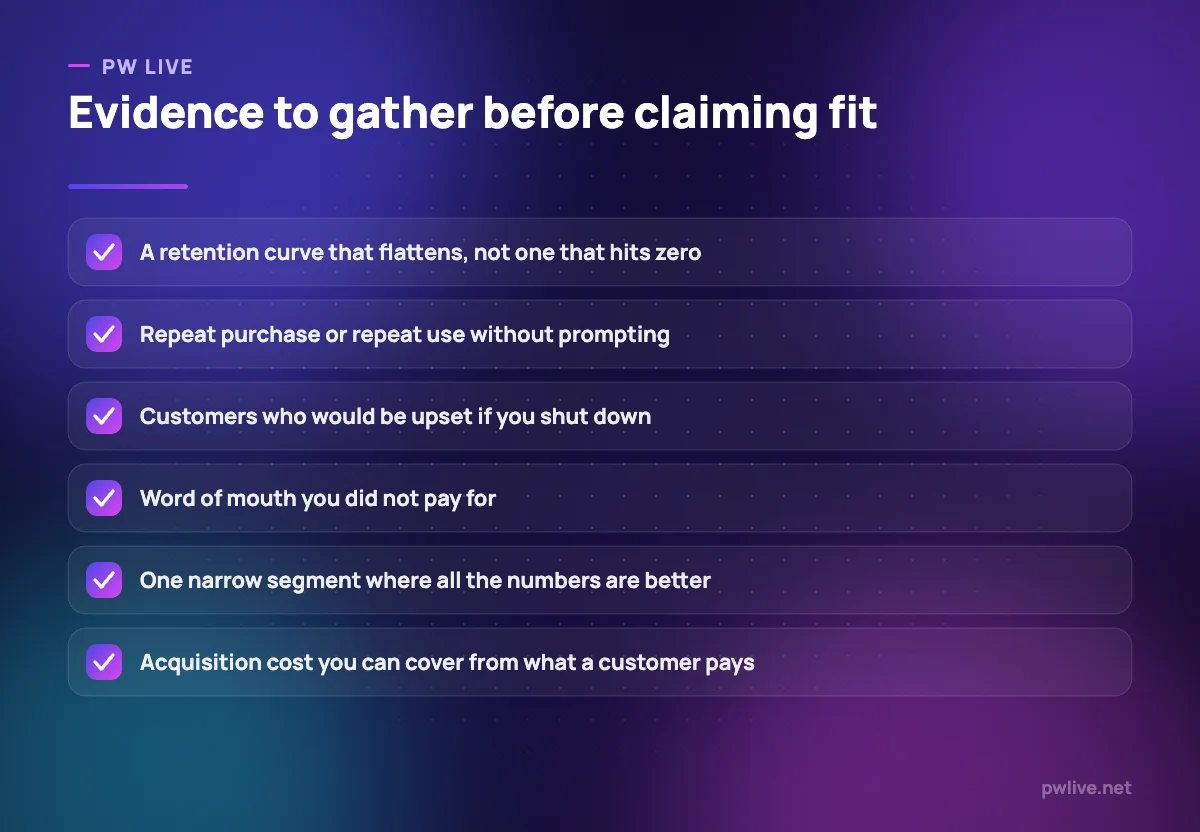
- A flattening curve means some stable share of users keeps returning. That flat portion is your real product.
- A curve that decays to zero means you have a leaky product, no matter how many signups you add.
- A curve that rises again after flattening is unusual and strongly positive.
Define “active” as the action that delivers your value, not as opening the app. For a study tool that might be completing a session; for a marketplace, a completed transaction.
Two practical cautions. Look at groups by joining month rather than at one blended number, because rapid signup growth hides poor retention. And be careful about the natural rhythm of your product: something used once a term should not be measured weekly.
The qualitative signals that come before the data
Early on you will not have enough users for clean charts. Behaviour still tells you a lot.
Watch for these:
- Users adapting their routine around your product, or asking for it to fit their workflow more exactly.
- Unprompted complaints. People only complain about things they intend to keep using.
- Requests for things that imply commitment: invoices, team access, exports, integrations.
- Referrals you did not ask for. Someone bringing a colleague is a stronger vote than any survey response.
- Reluctance to stop. When you propose ending a pilot and they push back, pay attention.
The counter-signal is equally clear. If people are warm in conversation but their usage requires constant nudging from you, you are seeing politeness, not demand. Our guide to talking to users and finding problems worth solving covers how to ask questions that avoid this trap.
Find the segment where it already works
Fit rarely arrives across a whole market at once. It usually shows up in a narrow slice first, and that slice is often hidden inside your averages.
Split your users by anything meaningful: role, city, company size, how they found you, which feature they used first. Then compare retention and revenue between the groups.
You are looking for a segment where the numbers are visibly better. When you find one, resist the instinct to broaden. Serve that group better, learn why it works there, and let expansion come later.
This is where marketing and product start to reinforce each other. Once you know exactly who works, the message writes itself, and channels get cheaper. The metrics that matter in marketing and our guide to finding your first ten customers both help you sharpen that focus.
Check the economics, not just the enthusiasm
A product people love but cannot be sold profitably is not fit. It is a hobby with a fan base.
Look at four numbers together.
- Cost to acquire a customer, including your own time at a realistic rate.
- What a customer is worth over the period they typically stay.
- Gross margin, particularly if you deliver anything manually.
- Payback period: how long before a customer repays what it cost to win them.
If acquisition cost keeps rising as you grow, that usually means you exhausted a small, unusually receptive group. That is useful information, not a failure. Our explainer on unit economics and the practicalities in how to price your product or service are the right next reading here.
What to do when you do not have fit
Most companies spend a long time before fit, and the work is a loop rather than a leap.
Work through the possibilities in this order.
- Wrong audience, right product. Try the same product with a different, narrower group before you change anything else. This is the cheapest fix and surprisingly often the correct one.
- Right audience, wrong problem. Go back to interviews and check whether you are solving the third-most-painful problem instead of the first.
- Right problem, weak solution. Watch someone use it. Onboarding friction, not the core idea, kills more products than founders think.
- Right everything, wrong pricing or packaging. Sometimes the change needed is how it is sold, not what it does.
Set a time box for each attempt and write down in advance what result would count as progress. Without that you will drift, which is one of the recurring patterns in why most startups fail.
Keep testing after you think you have it
Fit is not permanent. Competitors arrive, behaviour changes, and the segment that loved you can move on. Companies that stay healthy keep a small set of habits.
- Review retention by cohort every month, not just topline growth.
- Keep talking to users who churned, not only to happy ones.
- Watch whether acquisition cost is climbing faster than customer value.
- Notice when the product starts serving a different group than it was built for.
If you are building these habits from scratch, the digital marketing track covers measurement fundamentals, and the marketing and sales archive has practical guides on channels and messaging.
Key takeaways
- Product-market fit is defined by retention and pull, not by launch buzz or signups.
- Measure whether users come back, in cohorts, using the action that delivers value.
- Before you have data, watch for unprompted complaints, referrals and workflow changes.
- Fit usually appears in one narrow segment first; find it and serve it harder.
- Enthusiasm without workable economics is not fit.
- Re-check fit regularly, because it can be lost as markets and competitors shift.
Frequently asked questions
How many customers do I need before I can judge fit?
There is no fixed number, but you need enough repeat behaviour to see a pattern rather than a few enthusiastic individuals. Look for consistency across groups who joined at different times.
Can a business be profitable without product-market fit?
It can be profitable for a while through hard selling, but growth stays expensive and effortful. Fit is what makes growth cheaper over time.
Does a waiting list prove product-market fit?
No. A waiting list measures curiosity about a promise. Fit is measured after people use the product and decide whether to come back.
Should I add features to reach fit faster?
Usually not. Missing fit is more often a problem of audience, positioning or onboarding than of missing features, and extra features make those problems harder to diagnose.
Keep learning with PW Live
Browse every guide in Startups & Innovation, or pick a skill track and follow the roadmap step by step.





Leave a Reply