

Freelancing for beginners usually stalls at the same point: you have a skill, you have signed up on a platform, and nothing happens. The gap between being able to do the work and being paid for it is not talent. It is packaging, pricing and asking.
The first client is by far the hardest. The second is easier, the fifth is much easier, and by then referrals do some of the work for you. So the whole task is getting to one.
This guide covers how to define what you sell, how to price it without guessing, where the first client realistically comes from, and how to protect yourself so you actually get paid.
Decide what you actually sell
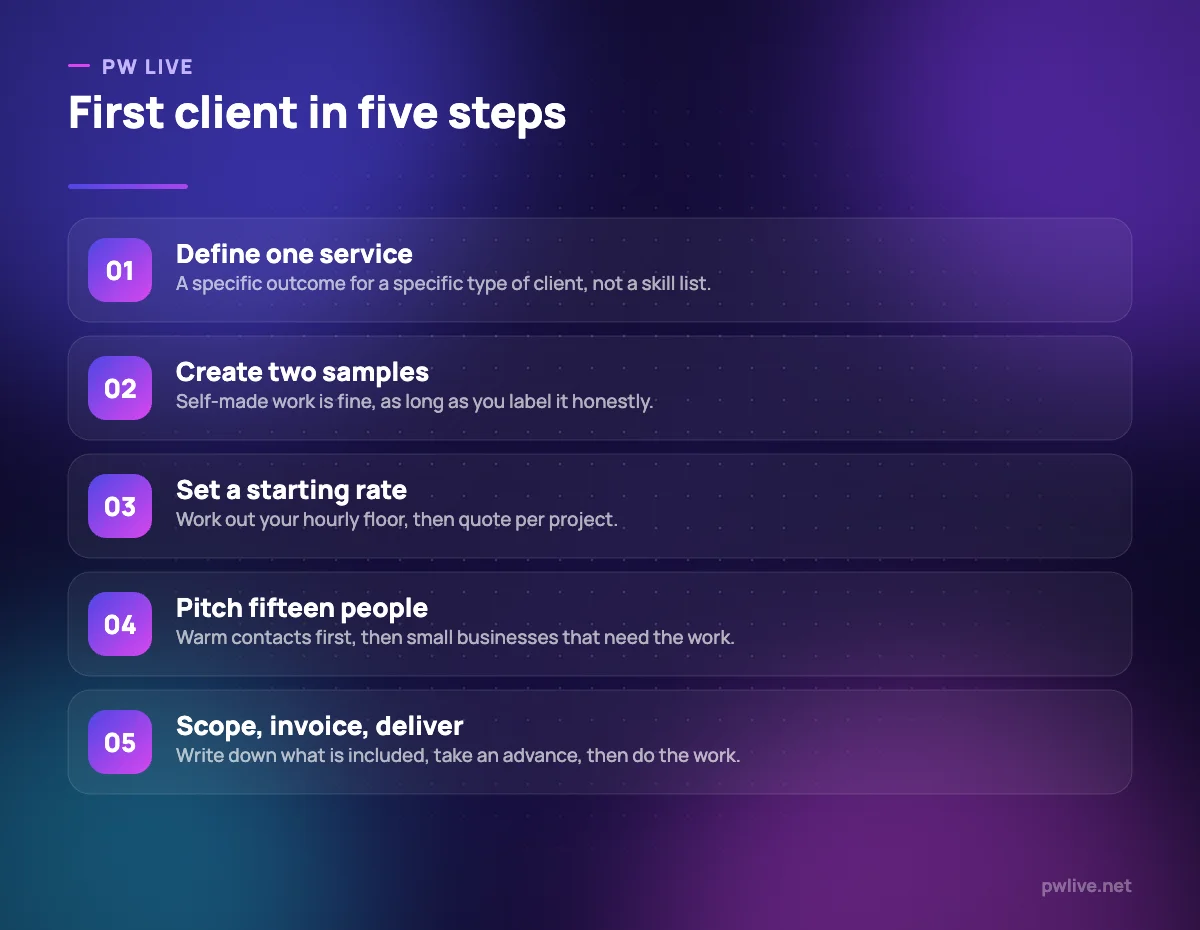
“I do design” is not a service. It is a category, and it forces the client to work out how you could help them. Most will not bother.
A service is a specific outcome for a specific type of buyer. Compare:
- Weak: “I am a content writer.”
- Strong: “I write blog articles for small software companies that want to be found on Google.”
- Weak: “I do video editing.”
- Strong: “I turn long podcast recordings into short clips for social media.”
Specificity feels limiting and does the opposite. It makes you the obvious choice for a smaller group instead of a forgettable option for everyone.
Pick your service by looking at three things at once: what you can already do at a professional standard, what people pay for, and what you would not mind doing repeatedly. If you are unsure which skill to build the service on, our guide to choosing the right skill to learn for your career is a useful filter.
Build proof before you have clients
Clients hire evidence, not intentions. Without a single past client, you can still show work.
Legitimate ways to build samples:
- Make speculative work. Redesign a real local business’s menu, rewrite a confusing product page, edit a public video into a shorter cut. Label it clearly as an unsolicited concept, never as client work.
- Do one or two free or cheap projects deliberately. For a local shop, an NGO, a college society. Agree it is limited in scope and that you may use it as a sample.
- Solve your own problem publicly. Build the website, write the newsletter, edit the videos for something you actually run.
The one rule that matters: never present speculative work as a paid engagement, and never claim a client you did not have. It is easy to check, and a freelance reputation is small and slow to rebuild.
Two or three strong samples are enough. Our guide to building a portfolio when you have no work experience covers how to present them so a client can judge you in thirty seconds.
Set a rate you can defend
Beginners either quote so low they resent the work, or freeze because they have no idea what to charge.
Work it out from your side first, then check it against the market.
- Find your hourly floor. Add up what you need to earn in a month. Divide by the hours you can realistically bill, which is far fewer than the hours you work, because admin, pitching and revisions are unpaid. That gives you a minimum. It is a floor, not a target.
- Research what similar work sells for. Look at what freelancers with comparable samples list on platforms, ask in communities for your field, and ask anyone you know who hires freelancers what they have paid. Look for a range, not a single number.
- Quote per project, not per hour. Estimate the hours, apply your rate, add a buffer of around 20 percent for revisions, then present one total figure. Per-project pricing protects you from being punished for working quickly.
- Raise it deliberately. Set a rule such as increasing your rate after every third completed project. Existing clients keep their rate; new ones pay the new one.
Do not compete on being the cheapest. The clients who choose purely on price are also the ones most likely to expand the scope and pay late.
Our guide to pricing your product or service without guessing goes deeper into the mechanics, and cash flow basics explains why timing of payment matters as much as the amount.
Find the first client
Platforms are the obvious answer and the slowest one for a beginner with no reviews. Use them, but do not rely on them.
Work these channels in order of likely success:
- People who already know you. Former colleagues, classmates, teachers, family contacts, anyone who runs a business. Tell them plainly what you now do and who it is for. Most first clients come from here.
- Small local businesses. Clinics, gyms, coaching centres, boutiques, restaurants. Many have obvious, fixable problems with their website, menu, photos or social presence. Point at the specific problem, not at your skills.
- Communities in your field. Discord servers, subreddits, WhatsApp and Telegram groups, local meetups. Be useful in them for weeks before you pitch anything.
- Agencies as subcontractors. Small agencies frequently need overflow help. One good relationship can supply months of steady work.
- Freelance platforms. Worth setting up, but apply early to new postings and write specific proposals rather than templates.
Aim for fifteen genuine pitches before you judge whether the approach is working. Volume matters at the start because reply rates are naturally low.
A pitch that works
Keep it short, lead with their problem, and make one clear ask.
“Hi, I noticed your booking page asks customers to email you rather than pick a slot, which probably costs you a few bookings a week. I build simple booking flows for small clinics; here are two examples. If it is useful, I could put together a version for you in about a week for a fixed price. Happy to send a quick outline first.”
That message names a real problem, shows proof, gives a scope and a timeline, and asks for something small.
Protect yourself before you start work
Freelancers lose money on scope and on payment, almost never on the work itself.
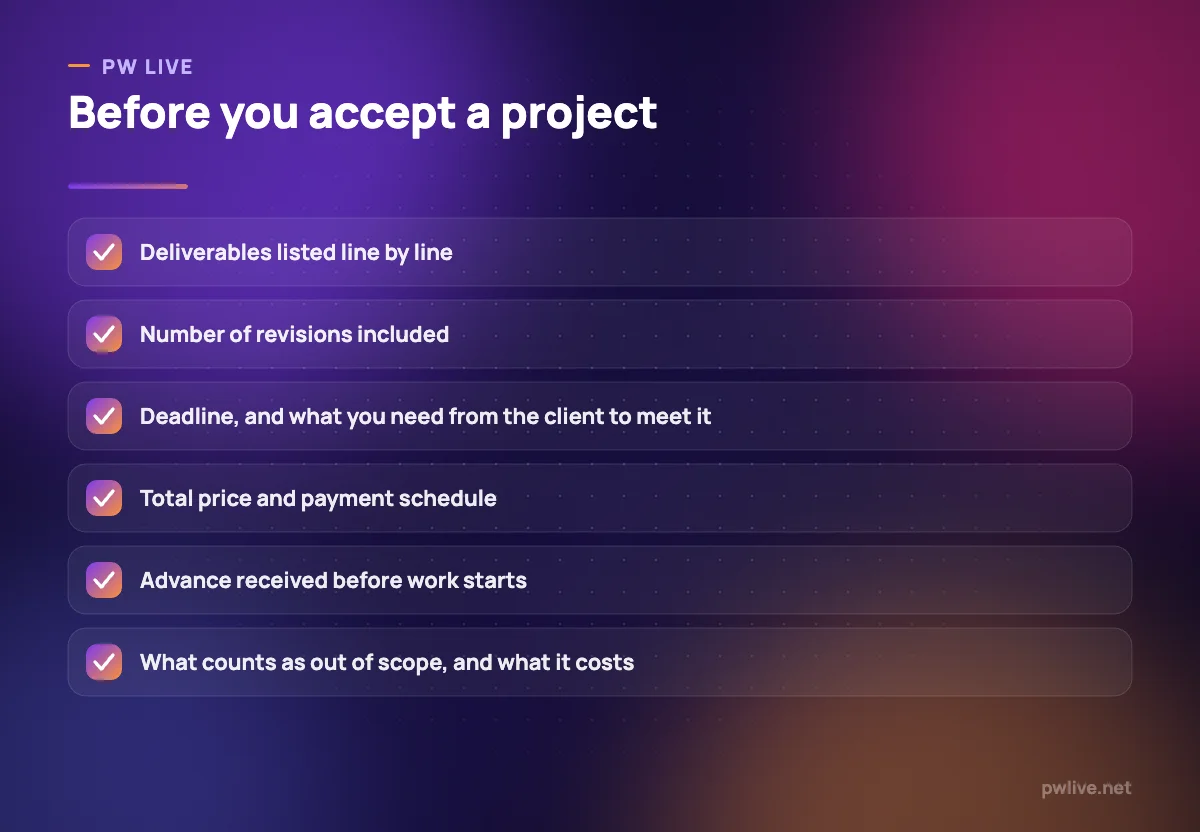
Before any project begins, put these in writing, even in an email:
- Exactly what you will deliver, listed line by line
- How many rounds of revision are included, and what happens after that
- The deadline, and what you need from the client and by when
- The total price and the payment schedule
- What is explicitly not included
Take an advance. A common structure is part before starting and the balance on delivery, or thirds across start, midpoint and completion. An advance is normal professional practice and a client who refuses one entirely is telling you something.
Send a proper invoice with a number, date, description, amount, your payment details and any tax details that apply to you. Our guide to invoices, quotes and contracts covers the basics that protect you, and GST basics for online sellers is a useful starting point if you need to understand Indian tax registration thresholds for services.
If a payment is late, follow up once politely at the due date, then again a week later with a firmer note. Do not hand over final files or transfer accounts until the balance is settled.
Turn one client into a pipeline
The first project is the beginning of the system, not the goal.
At the end of every project, do three things:
- Ask for a testimonial. Do it the day you deliver, while they are happy. Two sentences is enough.
- Ask for a referral. “If you know anyone else who needs something similar, I would appreciate an introduction.” Most people say yes and forget, so ask specifically.
- Propose the next piece of work. You now understand their business better than any stranger does. Suggest one concrete next step.
Track everything simply. A spreadsheet with client, project, price, dates and payment status is enough for the first year, and our guide to using spreadsheets for planning and budgeting covers the setup.
Freelance income is irregular by nature, so treat the money differently from a salary. Set aside a portion of every payment for tax, and build a buffer during good months. The personal finance skill track covers the habits, and you will find more on independent work in our career and jobs section.
Key takeaways
- Sell one specific outcome to one type of client, not a general list of skills.
- Build two or three samples before pitching, and label speculative work honestly as speculative.
- Calculate an hourly floor from your own costs, research the market range, then quote per project.
- Your first client will most likely come from people who already know you, not from a platform.
- Put scope, revisions, price and payment terms in writing, and take an advance before starting.
Frequently asked questions
Should I work for free to build a portfolio?
One or two limited free projects can be worth it early on, provided the scope is capped and you can use the work as a sample. Ongoing free work with vague promises of future paid projects is not.
How do I set my rate with no experience?
Start from your own numbers: the monthly income you need divided by realistically billable hours gives your floor. Then check that against what comparable freelancers charge and adjust upwards as your samples improve.
Do I need to register a business to freelance in India?
You can begin as an individual, but once your income grows you should understand registration and tax obligations, including any GST thresholds that apply to services. Speaking to a qualified accountant early is cheaper than fixing it later.
What do I do if a client refuses to pay?
Follow up in writing with the agreed scope and invoice attached, and withhold final deliverables or account access. This is exactly why an advance and a written scope matter before work begins.
Keep learning with PW Live
Browse every guide in Career & Jobs, or pick a skill track and follow the roadmap step by step.





Leave a Reply