

Choosing between JEE, NEET and other career paths after Class 12 is the first genuinely large decision most Indian students make, and it usually gets made in the worst possible conditions: under time pressure, with loud opinions from every direction, and with very little real information about what these careers involve day to day.
The good news is that this decision is far less final than it feels at seventeen. Careers change lanes constantly, and almost nothing you choose now closes doors permanently.
What this guide gives you is a way to think clearly: how to evaluate any path, what the main routes actually involve, and how to test a choice before you commit two years to it.
Separate the three questions people mash together
Most confusion at this stage comes from treating one big question as unanswerable, when it is really three smaller ones.
- What subject or field do I want to work in? Engineering, medicine, commerce, design, law, humanities, computing, and so on.
- What qualification route gets me there? An entrance exam, a university degree, a diploma, a professional qualification, or direct skill-building.
- What do I do in the next twelve months? Which exam to prepare for, which course to apply to, or which skill to build.
Answering question one badly ruins the other two, and it is the one students spend the least time on. Fields are chosen from prestige, parental preference and school reputation far more often than from any real look at the work.
Judge a path by the daily work, not the job title
The single most useful exercise available to you is to find out what people in a field actually do on a Tuesday.
Ask three people already doing the work, or a few years into training for it. Ask what fills their hours, what the least enjoyable part is, and what they would tell a seventeen-year-old considering it.
Also read the syllabus of the course, not the brochure. If a medical degree involves years of memorisation, long clinical hours and postgraduate exams after that, you want to know it now. If an engineering degree involves more mathematics and less building than you imagine, that matters too.
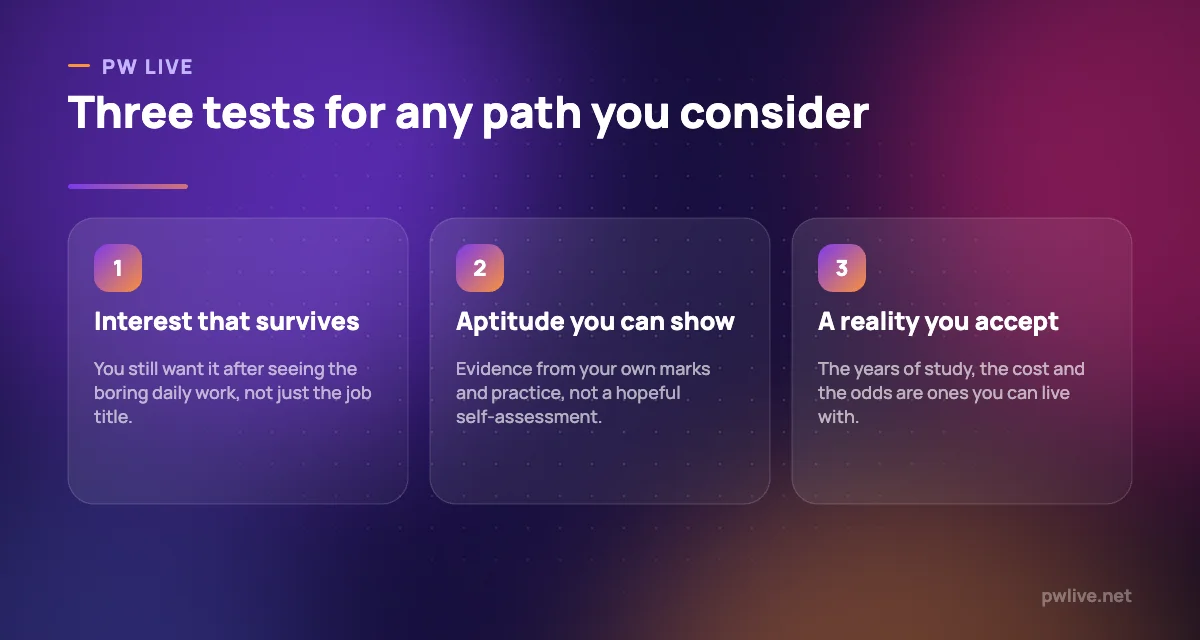
A path passes the interest test when the boring parts still seem acceptable. Enthusiasm for the title is common; tolerance for the daily work is what actually predicts sticking with it.
Be honest about aptitude, using evidence
Aptitude is not fixed and it is not destiny, but it is information. Use evidence you already have rather than a feeling.
Look at your marks by subject over the last two years, your performance in any mock or aptitude test, and which homework you find absorbing versus which you avoid. If mathematics has been a two-year struggle despite honest effort, a mathematics-heavy route will be harder for you than for others, and pretending otherwise costs years.
The reverse is equally important. Students underestimate themselves constantly because a subject was taught badly at school. Test it properly: give a subject four focused weeks with good material and see what happens before concluding you cannot do it.
If a whole subject feels lost rather than difficult, our guide to catching up in a subject is a better starting point than abandoning the path.
Understand what each route generally demands
Without getting into numbers that change every year, here is the shape of the main options.
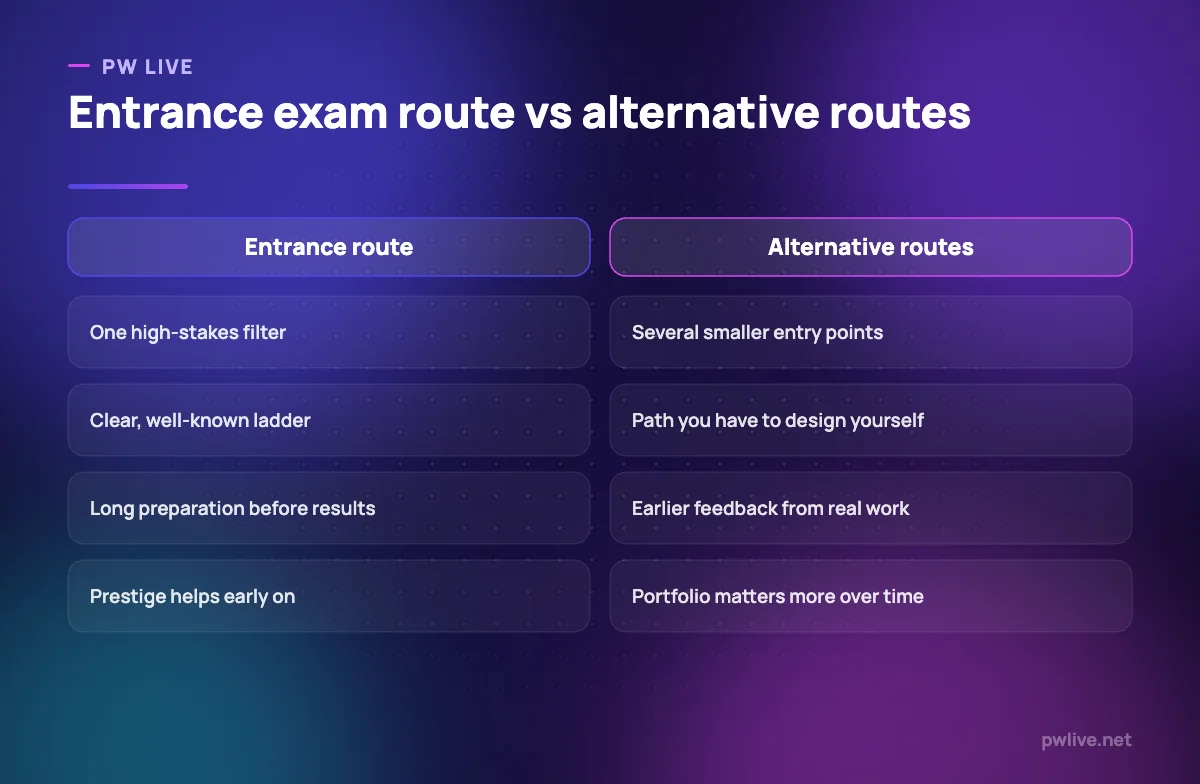
Engineering entrance exams (such as JEE). A physics, chemistry and mathematics route, with entrance tests that reward problem-solving speed as much as knowledge. Preparation usually runs across Classes 11 and 12. Competition is heavy, and the degree afterwards is broad enough to lead into software, core engineering, management, research or business.
Medical entrance exams (such as NEET). A biology-led route with heavy factual load, a long qualification timeline including postgraduate study for most specialisations, and a strong service element to the work. Competition is intense and the commitment is longer than in most other fields.
University admission tests and degree courses. Routes into commerce, economics, humanities, science, law, design and computer applications through university-level entrance tests or board-mark-based admission. Our CUET preparation guide covers one of the common routes into central universities.
Professional qualifications. Accountancy, company secretaryship, actuarial work and similar routes that run as staged professional exams, often alongside or instead of a conventional degree.
Skill-first and vocational routes. Design, software development, digital marketing, hospitality, media, trades and similar fields where a portfolio, certification or apprenticeship can matter more than a competitive entrance rank.
Eligibility, exam structures, seat availability, fees and reservation rules vary by institution and change between admission cycles. Confirm every specific on the official exam authority’s or university’s own website before you plan around it, and be wary of forwarded messages, as our guide to spotting exam misinformation explains.
Test a choice cheaply before you commit two years
You do not have to decide from imagination. Almost any path can be sampled for a few weeks at very low cost.
- Sample the study. Spend three weeks preparing seriously for the relevant entrance exam and take a mock. How it feels to study, not just how you score, is real information.
- Sample the work. Do a short online course, shadow someone for a day, or build a small project in the field.
- Sample the output. Design something, write something, code something, or solve a real problem. Skill-first fields reveal themselves fastest this way.
- Talk to the people who left. Someone who switched out of a field will tell you things nobody still inside it will.
A month of sampling before a two-year commitment is the highest-return time you can spend right now. Our guide to choosing the right skill to learn for your career applies the same testing logic to skills specifically.
Handle money, family and pressure openly
Cost is a legitimate factor and pretending it is not causes damage later. Coaching, tuition, hostel expenses and course fees vary enormously between routes and institutions, and a plan the family cannot sustain for the full duration is not a plan.
Have that conversation early and concretely. Ask what is affordable across the whole qualification, not just the first year, and check what scholarships, aid and state-supported institutions exist for the routes you are considering.
Family pressure is the other hard part. Parents usually want security rather than a specific profession, so arguments go better when you address the underlying worry with evidence: what the work involves, what people who do it end up doing, and how you plan to build a fallback. Our guide for parents on supporting a student without adding pressure is worth sharing with them.
Build a plan with a second door
Whatever you choose, design it so that one bad day does not end everything.
A sound plan has a primary target, a secondary route that shares most of the preparation, and a floor you would genuinely accept. Many entrance routes overlap enough that preparing for one keeps another open, and most degree paths allow a change of direction after the first year.
Set a review point too. Six months in, ask whether the study still fits and whether your mock performance is improving. Changing course after six honest months is far cheaper than persisting for four unhappy years.
More on planning the transition into work sits in our career readiness track, and the wider career section covers what happens after the degree.
Key takeaways
- Split the decision into field, route and next twelve months; the field question deserves most of your time.
- Judge a path by the daily work and the course syllabus, not the job title.
- Use marks, mocks and honest effort as aptitude evidence, and retest a subject before writing it off.
- Sample any path for a few weeks before committing years to it.
- Discuss the full cost of a route with your family early, not just the first year.
- Choose a primary target with an overlapping second option and a six-month review point.
Frequently asked questions
What if I genuinely do not know what I want to do?
Choose the route that keeps the most doors open and start sampling. A broad degree plus deliberate skill-building beats waiting for certainty that rarely arrives at seventeen.
Can I prepare for both JEE and NEET at the same time?
It is possible but demanding, since the syllabuses overlap only partly and both reward depth. Most students do better choosing one primary target and keeping a second option that shares more of the preparation.
Is dropping a year to reattempt an entrance exam worth it?
It can be, if your analysis shows a specific, fixable gap and you can sustain another year of structured study. It rarely works as a reaction to disappointment without a changed plan.
Where should I check eligibility, fees and admission details?
On the official exam authority’s or university’s own website for the current admission cycle. These change between years and vary by institution, so verify rather than relying on last year’s information.
Keep learning with PW Live
Browse every guide in Exams & Admissions, or pick a skill track and follow the roadmap step by step.





Leave a Reply