

Understanding what employers want from graduates is easier than it looks, because they tell you repeatedly. Job postings, interview questions and campus recruitment briefings keep circling the same small set of qualities, described in slightly different words each time.
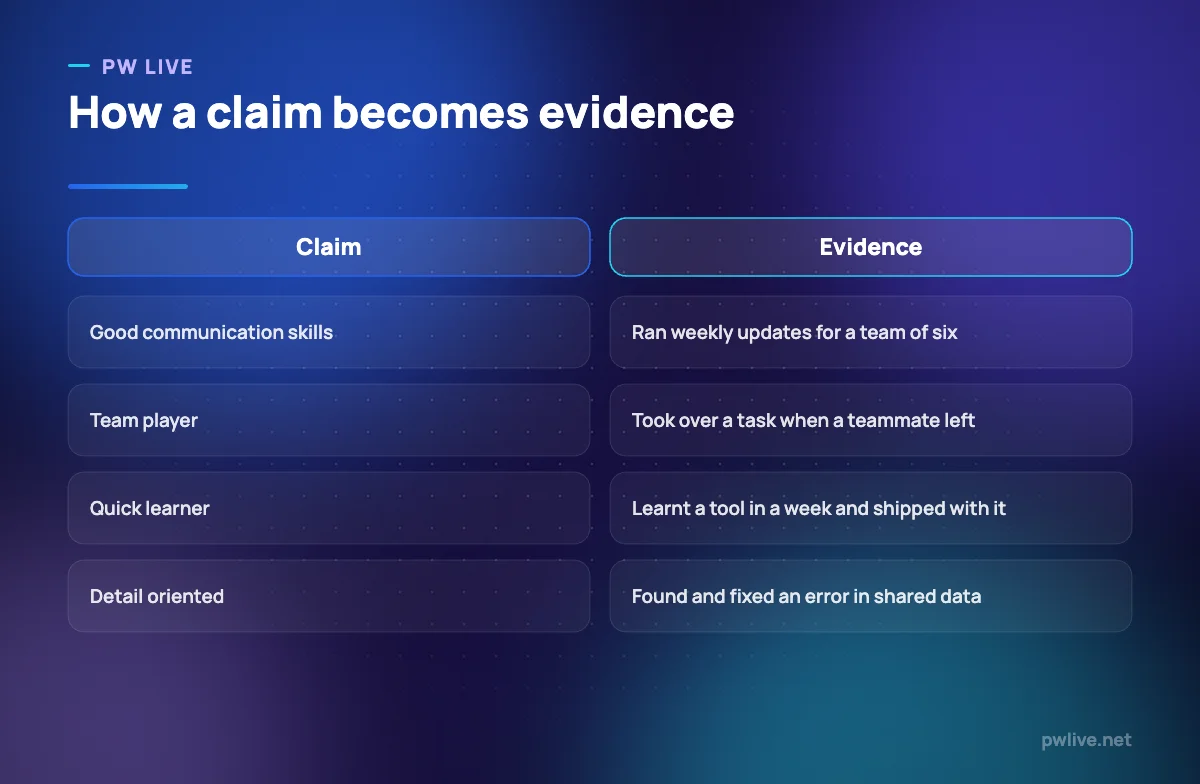
The difficulty is not knowing what they want. It is that most students can only claim these qualities, not demonstrate them, and claims carry almost no weight against a large pile of similar applications.
This guide sets out the qualities that recur, why employers care about each one, and how to build genuine evidence for them before you start applying. The specifics always vary by employer, so read the actual postings for the roles you want rather than any general list, including this one.
Read the postings, not the advice
Before anything else, do this: open ten job postings for roles you would genuinely apply to and read them properly.
Write down every skill, tool and quality that appears more than twice. That list is more accurate than any general article, because it is drawn from the employers you are actually targeting, in the year you are actually applying.
Do it again a few months later, since the vocabulary shifts. And when a specific employer is involved, read their own careers page rather than a summary of it.
The patterns below are what usually shows up in that exercise, regardless of field.
Doing what you said you would do
Reliability sounds unglamorous and is the quality most often described as missing. It means finishing tasks, meeting agreed dates, and telling someone early when a date is going to slip.
Employers care because most work is interdependent. A missed deadline nobody warned them about costs a whole team a day.
You can prove this. A record of finishing things you started, including small things, is evidence. Someone who supervised you and will say you were dependable is stronger evidence.
Communicating clearly, especially in writing
Almost every role now involves explaining something to someone who was not there. Writing a clear update, a clear email or a clear summary is a daily activity in most jobs.
What employers look for is not elegance. It is clarity: the conclusion first, the reason next, the request stated plainly, and no ambiguity about who does what.
Practise by writing short summaries of things you have done and having someone outside your subject read them. If they can restate your point accurately, it was clear. Our communication skills track covers this systematically, and it improves your interviews as a side effect.
Solving problems without being told each step
The complaint behind this one is specific: a graduate who can execute clearly defined instructions but stalls the moment the instructions run out.
What employers want to see is the sequence: understand the actual problem, break it into parts, try something sensible, notice when it is not working, and ask for help before wasting a week.
Notice that asking for help is part of the skill, not the opposite of it. Struggling in silence is not initiative.
The best way to build this is to work on things that were not assigned to you, where nobody has defined the steps. Our list of the 10 skills every student should build before graduating covers where to find that kind of work while you are still studying.
Working with people who are not like you
Teamwork on a CV usually means “was in a group project”. What employers are actually assessing is whether you can disagree without souring a relationship, share credit, and pick up the unglamorous part of a job when someone has to.
Situations that demonstrate this are more common than students think: a club that had to organise something, a project where a member dropped out, a part-time job with difficult customers, a family responsibility that required coordination.
Our comparison of hard skills and soft skills explains how employers weigh these against technical ability, which is usually less lopsided than students expect.
Enough technical ability to be useful early
Employers rarely expect a graduate to arrive fully formed. They do expect enough grounding that you can contribute to something real within a few weeks rather than a few quarters.
The practical version of this:
- Know the core tools of your field well enough to work unsupervised on simple tasks.
- Have built at least one thing end to end, including the boring middle part.
- Understand the fundamentals under the tools, so a version change does not strand you.
- Be able to explain a technical choice you made and why you made it.
- Know what you do not know, and say so plainly.
That last one is assessed constantly in interviews. Confidently wrong is worse than honestly uncertain.
Willingness to learn, demonstrated rather than declared
Every candidate says they are a fast learner. It means nothing without a record.
A record looks like this: something you learnt that nobody made you learn, over a period long enough to be real, with an outcome you can point to.
- Name the skill and the reason you chose it.
- Say how long you spent and what your routine was.
- Show what you produced, however small.
- Describe what was harder than you expected.
Four sentences of that beat any adjective. Our guide to answering the tell me about yourself question shows how to fold this into the opening of an interview.
Putting it together before you apply
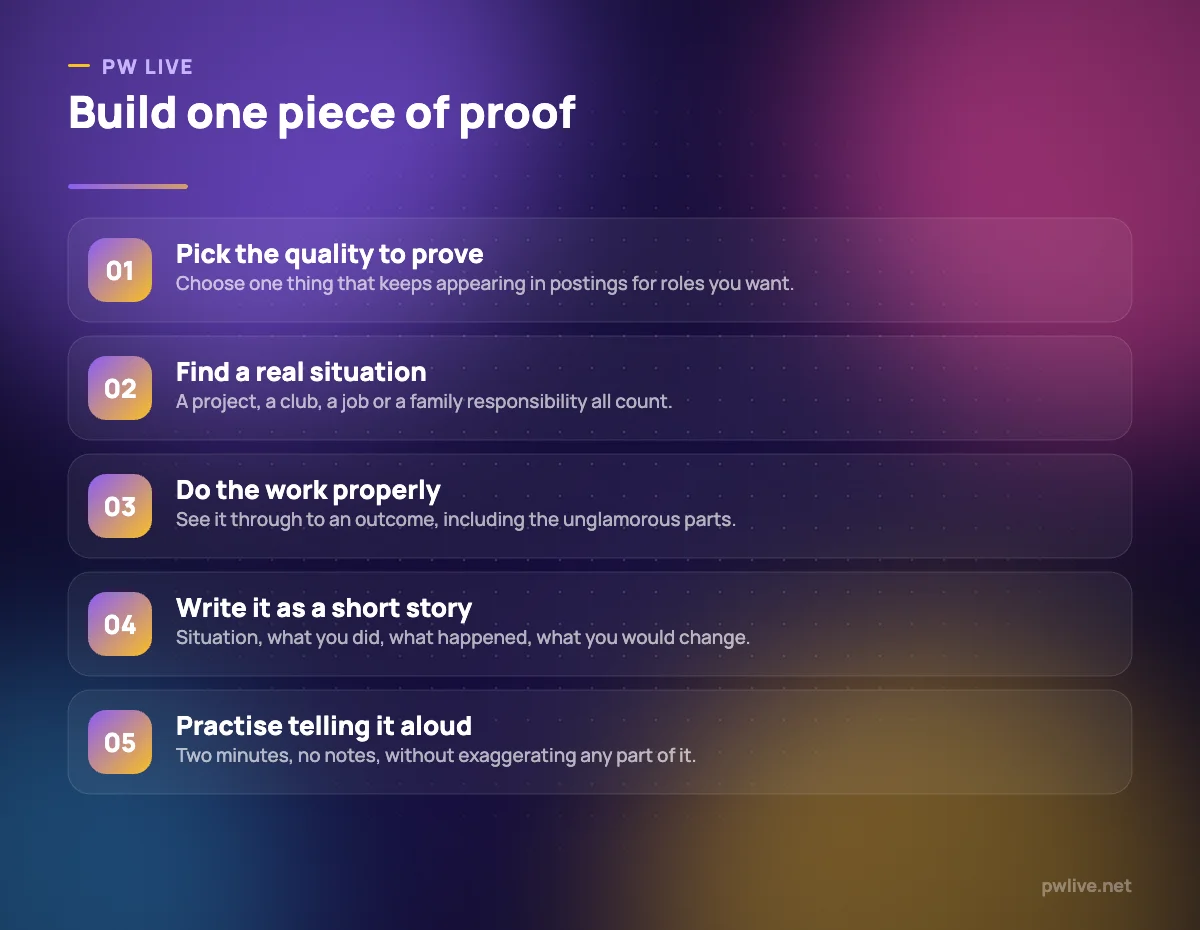
None of this needs to be done in the final semester. It is easier and more convincing when built gradually.
Start a running document of things you have done, one paragraph each, updated whenever something finishes. When applications open, that document becomes your CV, your cover letter material and your interview stories at once.
Our guides to writing a cover letter that gets read and preparing for campus placements a year in advance cover the timeline, and the career and jobs category has stage-by-stage guidance for everything after that.
Key takeaways
- Read ten real job postings in your field; that list is more reliable than any general advice.
- Reliability, clear writing, independent problem solving and teamwork recur across almost every role.
- Employers want enough technical grounding to contribute early, not a finished expert.
- Replace adjectives with short, specific stories you can tell in two minutes without notes.
- Keep a running record of what you have done, updated as it happens rather than reconstructed later.
Frequently asked questions
Do marks still matter to employers?
They matter most as an early filter in some processes and much less once you reach an interview. Strong marks help you get read; evidence of real work is what gets you hired.
What if I have no internships or work experience?
Use projects, club responsibilities, part-time work, volunteering and self-directed learning. What matters is that the situation was real and that you can describe what you actually did in it.
How many interview stories should I prepare?
Around six flexible ones is usually enough, covering a success, a failure, a conflict, a deadline, something you learnt quickly and something you led. Most questions can be answered from that set.
How do I find out what a specific employer values?
Read their own job postings and careers page closely, and ask the recruiter what the role’s first six months look like. Avoid relying on second-hand claims about any company’s expectations.
Keep learning with PW Live
Browse every guide in News & Updates, or pick a skill track and follow the roadmap step by step.





Leave a Reply