

Campus placement preparation goes wrong for a simple reason: most students begin in the month the companies arrive. By then the only thing you can change is your nerves.
Starting a year ahead changes what is possible. You have time to build real projects, fix weak subjects, get comfortable with aptitude tests, and rehearse interviews properly instead of learning what a group discussion is on the morning of one.
This guide gives you a month-by-month plan, what to prioritise at each stage, and how to handle the season itself without burning out after the first rejection.
Understand how the process actually works
Before planning, know the stages you are preparing for. Most campus processes run in a similar sequence, though details vary by college and company.
- Eligibility filter. Usually based on marks, backlogs and branch. Some companies set a cut-off you cannot argue with, which is why your academic record matters even if you dislike that fact.
- Aptitude or online test. Quantitative aptitude, logical reasoning, verbal ability, and for technical roles a coding section. This stage eliminates the largest number of candidates.
- Group discussion or written round. Not every company runs one, but many still do.
- Technical interview. Core subjects, your projects, and problem solving.
- HR interview. Fit, motivation, communication, and whether you will actually join.
Find out early which of these your target companies use. Your placement cell knows which companies visited last year and what their process looked like. Ask them in your third year, not your final one.
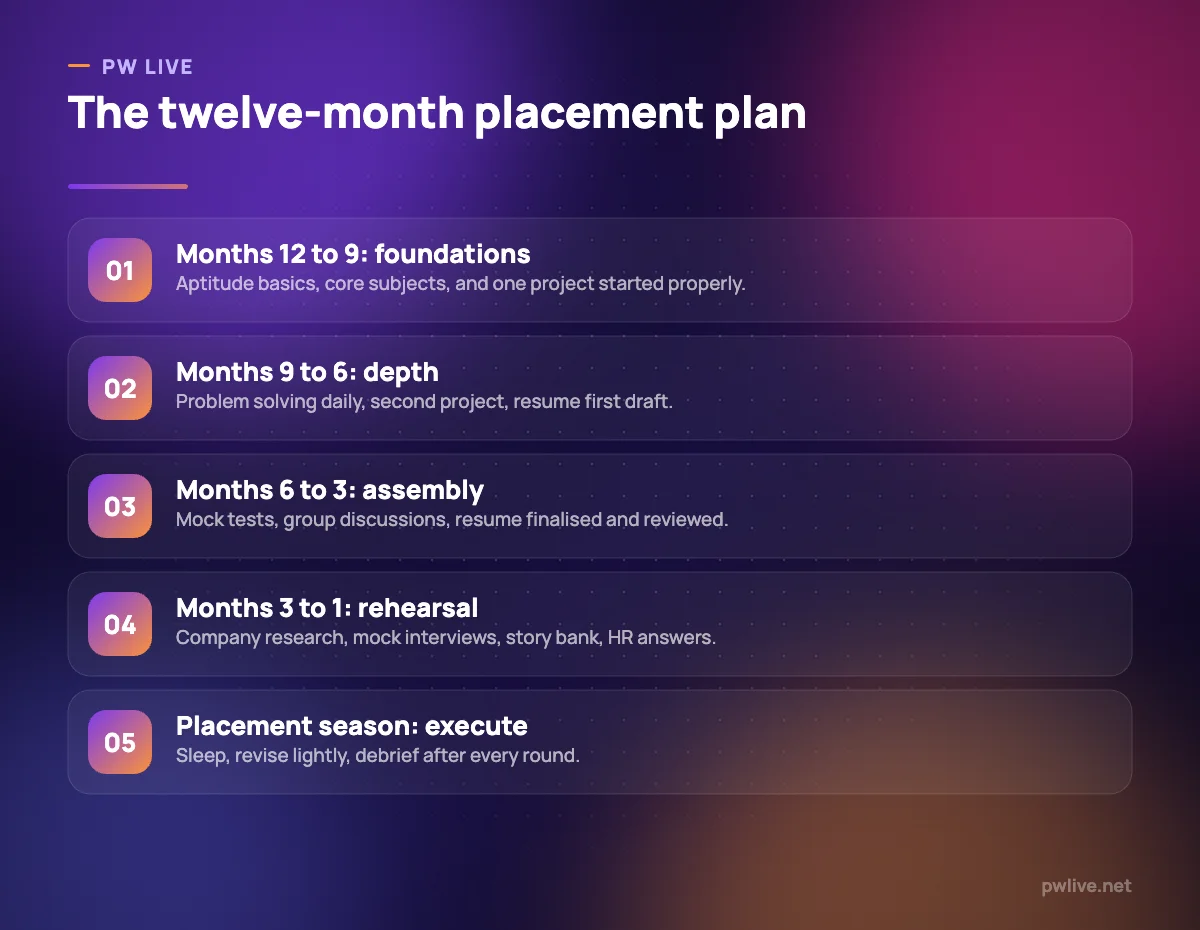
Months 12 to 9: build the foundation
This is the phase with the least pressure and the most leverage.
- Fix your aptitude basics. Percentages, ratios, time and work, probability, permutations, number systems, and the standard reasoning patterns. Twenty minutes a day for a few months removes this obstacle permanently.
- Get your core subjects genuinely solid. For engineering, that means data structures, algorithms, databases, operating systems and networks. For other streams, the equivalent fundamentals that interviewers actually ask about.
- Start one real project. Not a tutorial you followed. Something with a genuine problem behind it, even a small one. Our guide to teaching yourself with projects instead of tutorials covers how to pick one.
- Address backlogs now. They are the most common reason for being filtered out before anyone reads your resume, and they get harder to clear later.
If you have fallen behind in a subject that will be tested, our guide to catching up when you have fallen behind has a workable method.
Months 9 to 6: build depth
Now the routine matters more than any single burst of effort.
- Solve problems daily. For technical roles, a small number of problems every day beats forty on a Sunday. Aim for consistency over volume, and revisit the ones you got wrong rather than only chasing new ones.
- Start a second project. Ideally one that shows a different skill from the first. Two projects you can defend in depth beat five you barely remember.
- Write your first resume draft. Early, and badly, so you can see the gaps while there is still time to fill them. Our guide to writing a resume that gets interviews when you have no experience covers the structure.
- Do a summer internship if you can. It is the single strongest addition to a placement resume, and our guide to finding an internship and making it count covers how to get one.
Track what you are doing. A simple log of problems solved, topics covered and projects progressed keeps you honest, and our guide to tracking your skill progress explains why visible progress sustains effort.
Months 6 to 3: assemble everything
The focus shifts from learning to performing under conditions that resemble the real thing.
- Take full-length mock tests under time pressure. Speed is a separate skill from knowledge. Most aptitude sections are lost to time, not difficulty. Our guide to analysing a mock test properly applies directly here, since reviewing the paper matters more than taking it.
- Practise group discussions with friends. Take a topic, set fifteen minutes, and record it. What you learn from watching yourself once is worth ten pieces of advice.
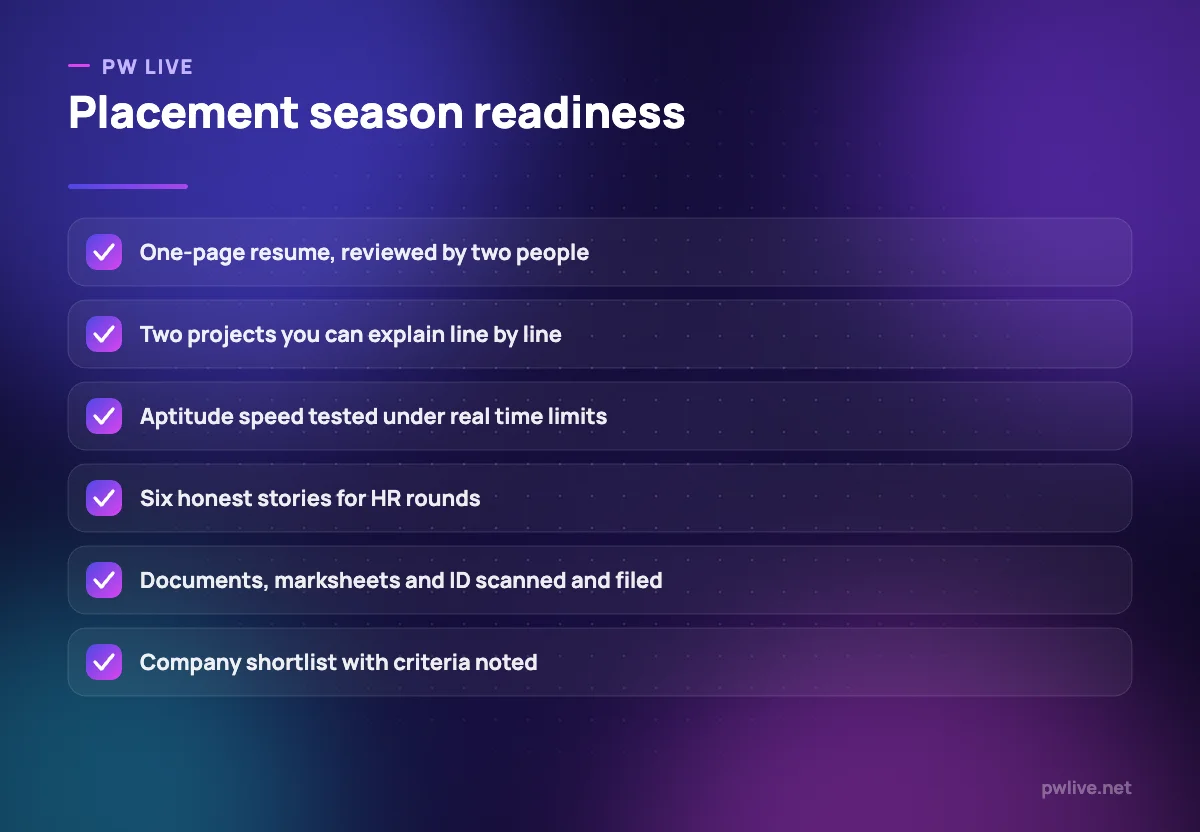
- Finalise your resume. One page. Get it reviewed by a senior who has already been placed and by a faculty member.
- Prepare your project explanations. For each project, be ready to explain what problem it solved, why you made each design choice, what broke, and what you would do differently. Interviewers probe until they find the edge of your understanding, and the honest answer at that edge is “I have not looked at that yet”.
Everything in your resume and your answers must be true. Listing a technology you touched once, or claiming a project role you did not have, fails at exactly the moment it costs the most, in a technical interview where a follow-up question exposes it in front of the person deciding.
Months 3 to 1: rehearse
Now you are preparing for specific companies rather than for placements in general.
- Research your shortlist. For each company likely to visit, note what they do, what roles they hire for, their process, and their eligibility criteria.
- Build a story bank. Six honest examples covering teamwork, conflict, failure, leadership, learning something quickly, and something you are proud of. These carry the HR round.
- Prepare the standard answers. Tell me about yourself, why this company, your strengths, a weakness you are working on, and where you see yourself. Our guide to answering the tell me about yourself question covers the opener, which sets the tone for everything after it.
- Do at least three mock interviews. With a senior, with your placement cell, with a friend from another branch. The discomfort of the first one is the point.
- Sort your documents. Marksheets, ID, certificates, photographs, all scanned and in one folder. Missing paperwork on the day is an avoidable disaster.
The full sequence is covered in our complete interview preparation checklist.
Handle the season itself
Placement season is a few intense weeks, and how you manage yourself matters as much as what you know.
- Protect your sleep. Studying until 3am before a test that starts at 9am is a net loss. Our guide to sleep and study performance explains the trade-off.
- Do not revise heavily on the day. Light review only. Cramming raises anxiety and displaces the calm you need.
- Debrief after every round. Write down the questions asked and what you fumbled, within an hour while it is fresh. This is the fastest improvement loop available and almost nobody uses it.
- Expect rejections and plan for them. Strong candidates get rejected for reasons unrelated to ability: headcount changes, a full slate, a bad interviewer day. Our guide to recovering after a result that did not go your way is worth reading before you need it.
- Talk to someone. Comparing offers with your batch is unavoidable and corrosive. Keep one person you can be honest with, and read our guide to managing exam stress and burnout if the pressure builds.
Remember that a campus offer is a first job, not a verdict on your career. Plenty of people who go unplaced find better roles off campus a few months later, and the search skills in our guide to finding a job through networking work whether or not a company visits your college.
If you do receive an offer, understand the full structure before signing, including any bond or training-repayment clause. Our guide to negotiating your first salary explains where campus offers are flexible and where they are genuinely fixed.
For more on the whole hiring journey, browse our career and jobs section or work through the structured career readiness track.
Key takeaways
- Find out which companies visited your college last year and what their process was, in your third year.
- Spend the first phase on aptitude fundamentals, core subjects, backlogs and one real project.
- Speed under time pressure is a separate skill from knowledge, so take full-length mocks and review them.
- Everything on your resume must survive a follow-up question, so never list a skill or a role you cannot defend.
- Debrief after every round within an hour, and protect sleep during the season itself.
Frequently asked questions
When should I start preparing for campus placements?
A year ahead is comfortable and gives you time to build projects and fix weak areas. Six months is workable if you are consistent; one month leaves you only able to manage nerves.
How much do academic marks matter?
They mainly matter at the eligibility filter, where many companies set a cut-off you cannot negotiate. Once you clear that stage, projects, problem solving and communication usually carry more weight.
What if I do not get placed on campus?
Off-campus hiring continues throughout the year, and many roles never come to campus at all. Keep building projects, apply directly, and use networking and referrals rather than only job portals.
How many companies should I apply to?
Apply to every one you are eligible for and would genuinely join, but research the few you most want properly. Broad applications plus deep preparation for your shortlist is the practical balance.
Keep learning with PW Live
Browse every guide in Career & Jobs, or pick a skill track and follow the roadmap step by step.





Leave a Reply