

The hard skills vs soft skills debate usually gets settled badly: someone declares that one matters more, and job seekers spend their time on the wrong half. In practice the two are used at different moments in hiring, which is exactly why you need both.
Hard skills are the ones you can name, test and put on a certificate. Soft skills are the ones a manager notices in your third week and remembers at appraisal time.
Here is how each is actually judged, and what to do about it if you are still building your first CV.
What each term actually means
Hard skills are specific, teachable abilities tied to tools, methods or subject knowledge. Writing SQL queries, reading a balance sheet, operating a lab instrument, editing video, drafting a contract, running a paid ad campaign.
Soft skills are how you work: communication, ownership, judgement under pressure, giving and taking feedback, working with people who disagree with you.
The unhelpful part of the label “soft” is that it sounds optional. A better way to think about it is that hard skills are what you produce, and soft skills are what makes your work usable by other people.
Why hard skills get you shortlisted
Early screening is a filtering problem. A recruiter with 300 applications needs a fast way to reduce the pile, so the first cut is almost always made on concrete, checkable things.
That is why hard skills dominate the top of the funnel:
- Job descriptions list them explicitly, so applicant systems and human screeners search for them
- They can be verified quickly through a test, a task or a portfolio
- They are comparable across candidates in a way that “good team player” is not
This is also the logic behind the shift towards skill-based hiring in India, where a work sample or an assessment carries more weight than the name of your college.
If your CV is thin, the fix is not more adjectives. It is one demonstrable hard skill with proof attached, which our guide to writing a resume with no experience walks through line by line.
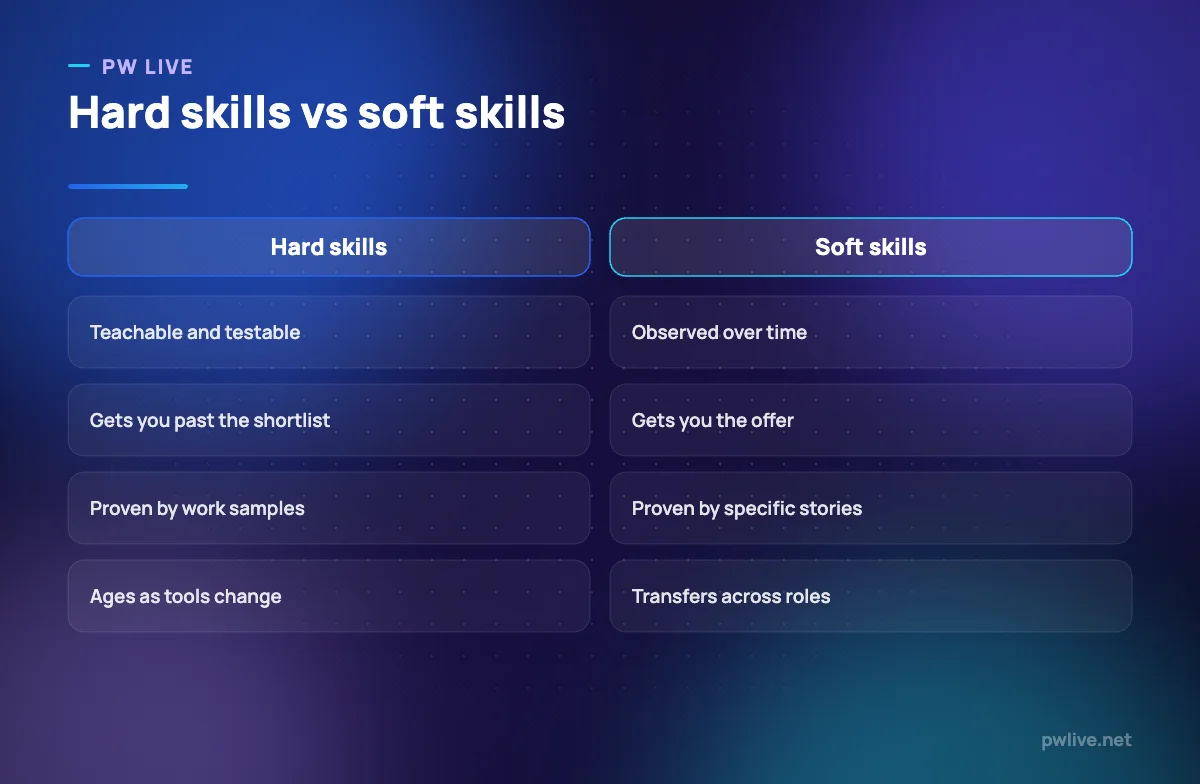
Why soft skills decide who gets the offer
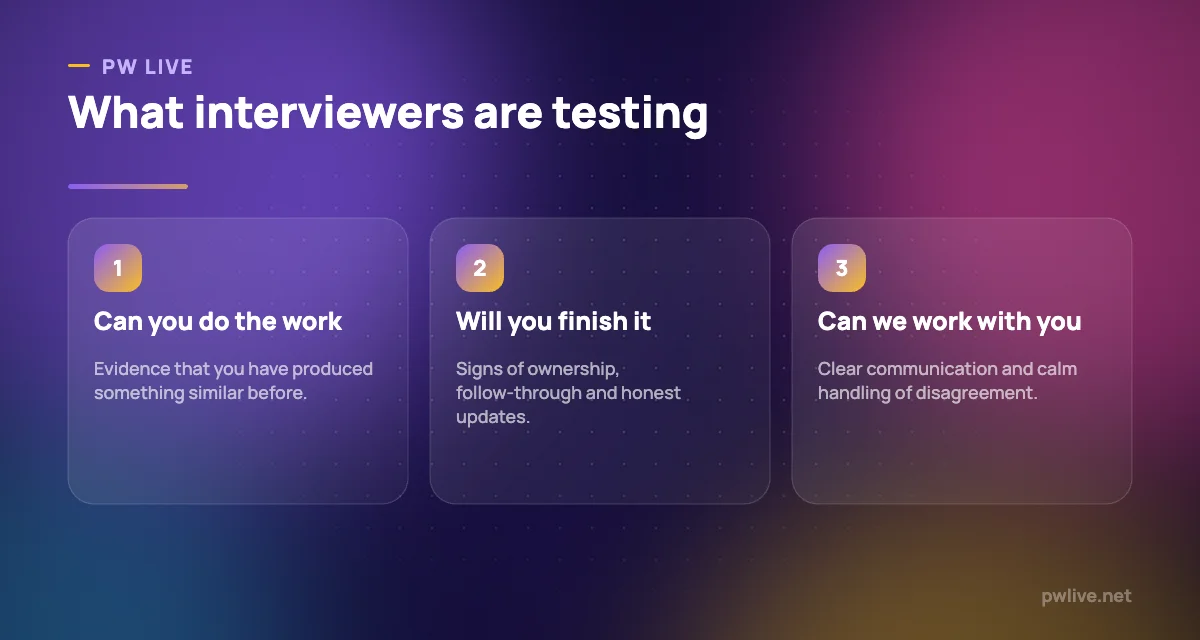
Once candidates clear the technical bar, they tend to cluster. Three people can all write acceptable code or build an acceptable model. The decision then moves to a different question: which of these three do we want in the room for the next two years?
At that point interviewers are watching for things like:
- Whether you explain your work in a way a non-expert can follow
- Whether you say “I do not know” cleanly instead of bluffing
- Whether you describe past teammates fairly, including in conflicts
- Whether you ask questions that show you understood the business, not just the task
The same soft skills also drive what happens after you join. Promotions rarely go to the most technically able person in a team. They go to the person whose work needs the least translation, chasing and repair.
The hard skills worth building first
You do not need many. Depth in one or two beats a list of ten you touched once.
Pick based on the work you want, then go deep enough to produce real output:
- Technical roles: one language and its ecosystem, version control, and the ability to debug someone else’s code. Start with the coding and programming track.
- Analytics roles: spreadsheets to an advanced level, SQL, and one visualisation tool.
- Marketing roles: writing, basic analytics, and one paid or search channel.
- Any business role: spreadsheets, clear written documents, and enough numeracy to sanity-check a claim.
Whatever you choose, the standard is the same. You should be able to show something you made, not something you attended.
The soft skills employers actually test
Four come up repeatedly, and each is tested in a specific way.
- Communication. Tested by asking you to explain a project. If the interviewer has to ask three clarifying questions, you have failed the test quietly. Build this deliberately through the communication skills track.
- Ownership. Tested by asking what went wrong on a project. Candidates who describe only external causes lose ground here.
- Collaboration. Tested by asking about disagreement. They want evidence you can hold a position and still change your mind.
- Learning speed. Tested by asking about something you picked up recently and how you did it. Vague answers suggest you have never learned anything on purpose.
How to prove soft skills without sounding vague
Nobody believes “excellent communication skills” on a CV. Claims about soft skills are only credible when they are attached to a situation and an outcome.
Use a simple three-part structure when you answer:
- The situation, in one sentence, with enough context to matter
- What you specifically did, using “I” rather than “we”
- What changed as a result, and what you would do differently now
Prepare four such stories in advance: one about a conflict, one about a deadline you nearly missed, one about feedback that stung, and one about explaining something complicated to someone outside your field. That set covers most behavioural questions you will face, and pairs well with the rest of our job interview preparation checklist.
How the balance changes with career stage
The mix is not fixed. It shifts as your responsibilities change.
- Student or first job: heavily weighted towards hard skills, because you have no track record to judge. Your job is to become verifiably capable at one thing.
- Two to five years in: the balance evens out. You are now expected to manage your own work, communicate upwards and handle ambiguity.
- Team lead and beyond: soft skills dominate. Your output is your team’s output, which is a different discipline entirely and the focus of the leadership and management track.
The people who stall usually do so because they kept optimising the half that got them their first job. What employers say they want from graduates is consistent on this point: the technical bar is table stakes, and everything above it is behaviour.
Key takeaways
- Hard skills get you shortlisted; soft skills usually decide who gets the offer.
- Depth in one or two hard skills beats a long list of superficial ones.
- Soft skills are only credible when attached to a specific story with an outcome.
- Prepare four behavioural stories covering conflict, deadlines, feedback and explaining complexity.
- The hard-to-soft balance shifts as you move from first job to leading people.
- Work samples now carry more weight than credentials in many hiring processes.
Frequently asked questions
Which matters more, hard skills or soft skills?
Neither in isolation. Hard skills get you into the process, soft skills get you through it, and missing either one stops you at a predictable point.
Can soft skills really be learned?
Yes, though they are learned through repetition and feedback rather than courses. Volunteering to present, running a small team project and asking for blunt feedback all build them faster than reading about them.
How do I show soft skills if I have never had a job?
Use college projects, group assignments, event organising, tutoring or freelance work. The setting matters far less than your ability to describe what you did and what changed.
Do certificates prove hard skills?
Only weakly. A certificate shows you completed something; a work sample shows you can do it. Browse the career category for ways to build evidence that stands on its own.
Keep learning with PW Live
Browse every guide in Skills Development, or pick a skill track and follow the roadmap step by step.





Leave a Reply