
You can build an MVP without a technical co-founder, and plenty of founders do. The blocker is rarely the code. It is the belief that a first version has to be software at all.
A minimum viable product is not a small version of your final app. It is the smallest thing that lets you learn whether people want the outcome you are promising. Sometimes that is a landing page and a WhatsApp number.
This guide covers how to scope a first version, what to fake, which categories of tool to use, and when hiring a developer actually makes sense.
Decide what you are trying to learn
Before choosing any tool, write the one question your MVP must answer. Vague goals produce bloated products.
Useful questions look like this.
- Will people pay for this outcome at all?
- Will they use it a second time without being reminded?
- Can I deliver the result reliably enough to charge for it?
- Which of two audiences responds better?
One question at a time. If you are testing whether anyone wants a service, you do not need accounts, dashboards, notifications or a mobile app. You need a way to take a request and deliver a result.
If you have not settled the underlying problem yet, work through how to find a startup idea worth working on first. Building before that is expensive guessing.
Strip the product down to a single job
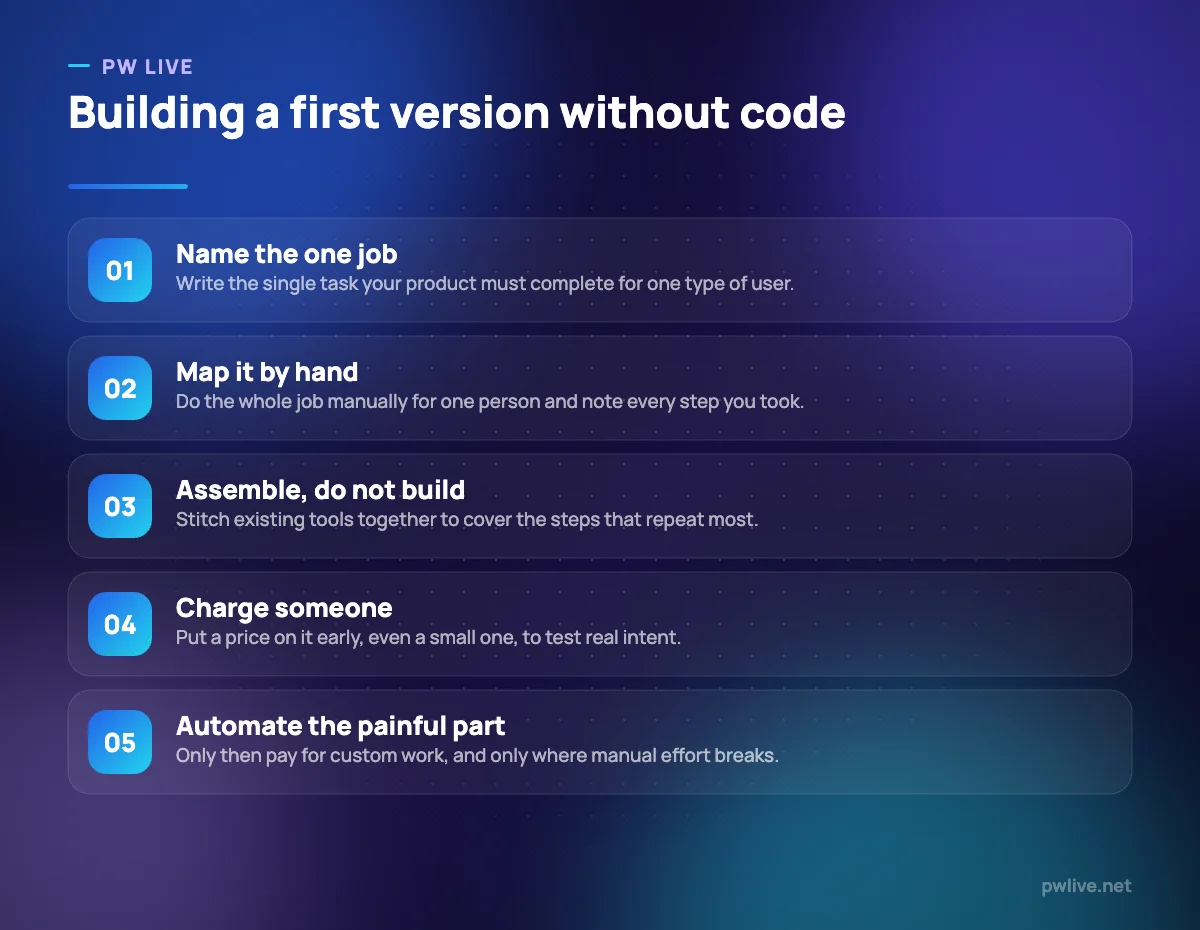
Write your product as a single sentence with a verb: “helps a tuition teacher collect monthly fees without chasing parents”. That is one job.
Then list everything you imagined building and mark each item as required, later or never. Most founders find that only two or three items are truly required.
Things that almost always belong in “later”:
- User accounts and login, if you can serve users manually at first
- Payments inside the product, when a payment link works
- Admin panels, when a spreadsheet works
- Mobile apps, when a mobile-friendly web page works
- Anything that exists only because competitors have it
The point is not to be minimal for its own sake. It is that every feature you add before you have users is a guess you will probably have to undo.
Do it manually before you automate it
The most underrated MVP is a human doing the work behind a simple front door. It looks unscalable because it is, and that is fine at ten users.
Run it like this.
- Put up a one-page description of the outcome, with a way to request it.
- Take requests through a form, email or a messaging app.
- Deliver the result yourself, however slowly.
- Record every step you performed and how long it took.
- Look for the steps that repeat identically every time. Those are your first automation candidates.
This does two things at once. It proves demand, and it produces the exact specification you would otherwise pay a developer to guess at.
Assemble tools instead of building software
Most early products are a chain of simple actions: capture something, store it, notify someone, produce a document, take a payment. Existing tool categories cover all of that.
Look for these categories rather than specific brands:
- A form or survey builder to capture requests and structured data.
- A spreadsheet or lightweight database as your storage and admin view.
- A website or landing-page builder for the front door and payment link.
- An automation tool that connects apps when something happens.
- A scheduling tool if your service involves booking time.
- A document generator if the output is a report, plan or certificate.
Judge each tool on three things: can you export your data, can you change things yourself, and does the cost stay sane as usage grows. Our guide to automation for non-programmers explains how to chain these tools together, and free tools for presentations, posters and documents covers the output side. For anything visual, free design tools for students and small businesses will get you to a presentable first version without a designer.
Make it look trustworthy, because that is being tested too
A rough product can still feel safe to buy from. When people abandon an early MVP, the reason is often that they were not sure it was real.
Cover the basics.
- A clear name and one-line description of what you do
- A real contact route with a person’s name behind it
- Honest pricing, or an honest “free while we test this”
- A short note on what happens after they submit something
- Any legal or compliance basics your category requires
You do not need a polished brand. You need to look like someone who will actually reply.
Learn just enough technical judgement
You do not have to become a developer, but you should be able to have an informed conversation. A few concepts do most of the work: what a database row is, what an API does, what hosting costs, and why some changes are cheap while others are not.
Start with our plain-English explainer on what an API is and the basics in cloud computing for students and small businesses. If you decide you want to build more yourself, the coding and programming track is a reasonable next step, and the wider apps and tools archive covers the software you will assemble along the way.
This knowledge protects you later, when you are scoping paid work and need to tell an ambitious quote from a realistic one.
Know when to hire, and how to hire safely
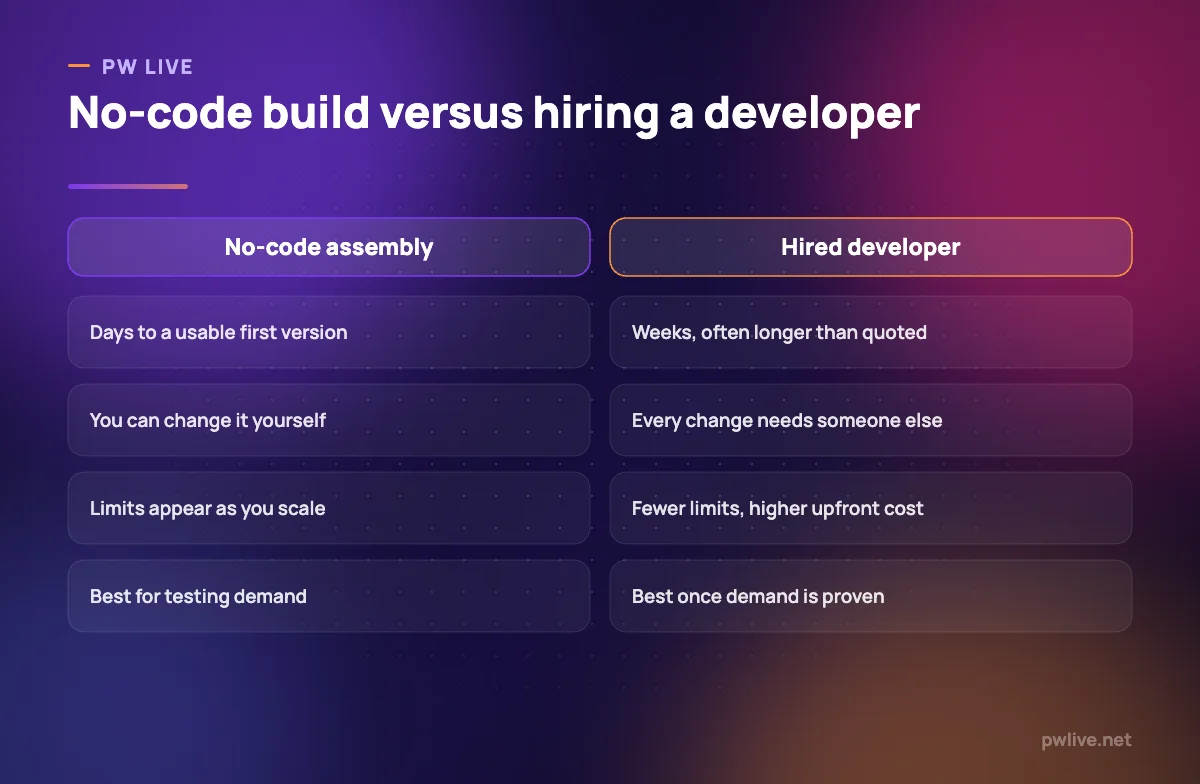
Bring in paid technical help when manual work is genuinely capping growth, or when the thing you need cannot be assembled from existing tools. Not before.
When you do hire:
- Scope one small, finished, testable piece of work first. Never start with the whole product.
- Agree in writing who owns the code and the accounts. Everything should be registered in your company’s name, not a freelancer’s.
- Insist on access to the hosting, domain and repository from day one.
- Pay in stages tied to working deliverables, not hours promised.
- Expect the first estimate to be optimistic, and plan around that.
If you eventually want a technical co-founder rather than a contractor, treat that as a partnership decision, not a hiring one. Sort out roles, expectations and vesting before writing any code together, as covered in our guide to equity and co-founder agreements.
Key takeaways
- An MVP exists to answer one question, not to be a small version of the final product.
- Manual delivery is a legitimate first version, and it writes your specification for you.
- Assemble existing tool categories instead of commissioning custom software early.
- Trust signals matter as much as features when people decide whether to try you.
- Learn enough technical vocabulary to scope work and judge estimates.
- Hire only when manual effort blocks growth, and always own the accounts and code.
Frequently asked questions
Is a landing page enough to count as an MVP?
It can be, if it tests a real decision. A page that collects payment or a firm commitment teaches you something; a page that only collects email addresses usually does not.
What if my idea genuinely needs custom software?
Then test the outcome manually first and use that evidence to justify the build. Even complex products usually have a slow, human version that proves demand.
Should I give equity to a developer instead of paying them?
Be careful. Equity is for long-term partners with shared risk, not for a defined piece of work. If you do go that route, use vesting and put it in writing.
How do I know when to stop patching and rebuild properly?
When manual steps or tool limits are costing you customers or hours every week, and you have enough revenue or evidence to justify the investment.
Keep learning with PW Live
Browse every guide in Startups & Innovation, or pick a skill track and follow the roadmap step by step.





Leave a Reply