

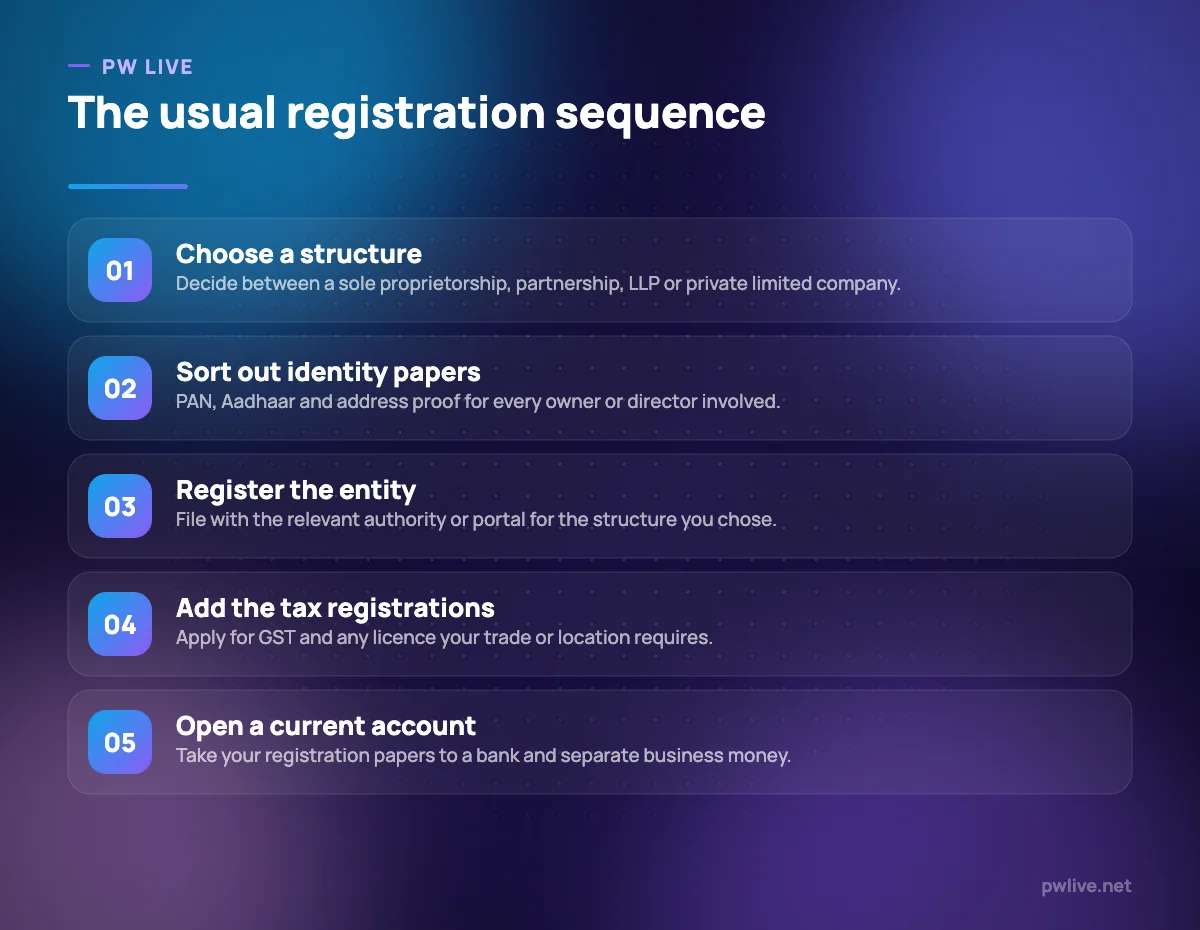
If you want to register a small business in India, the process is less mysterious than it looks from outside. It is a sequence: pick a structure, get your identity documents in order, register the entity, add the tax registrations your trade needs, and open a bank account in the business name.
What makes it feel complicated is that the exact forms, fees and thresholds change, and they differ by state and by trade. So this guide explains the shape of the process and the vocabulary, not the fine print.
This article is general information, not legal, tax or accounting advice. Rules, fees and thresholds change and vary by state and industry. Confirm anything specific with a qualified chartered accountant or company secretary, or on the relevant official government portal, before you act.
First decide whether you need to register at all
Many small ventures begin by simply trading, and that is often legal for a sole proprietor. Registration becomes necessary or sensible when one of these is true:
- You need a current account in the business name, which banks generally ask for proof of business to open.
- You want to bill business customers who require a formal invoice with a tax registration number.
- You are crossing, or expect to cross, the point where a tax registration such as GST becomes compulsory for your trade.
- You are taking on partners, investors or a business loan.
- Your trade or premises needs a specific licence, such as a food, shop or professional licence.
If none of these apply yet, you may have time to focus on customers first. Our guide to validating a business idea before you spend a rupee is a better use of your first month than paperwork.
Understand the main business structures
The structure decides your paperwork, your tax treatment and how exposed your personal assets are. In broad terms:
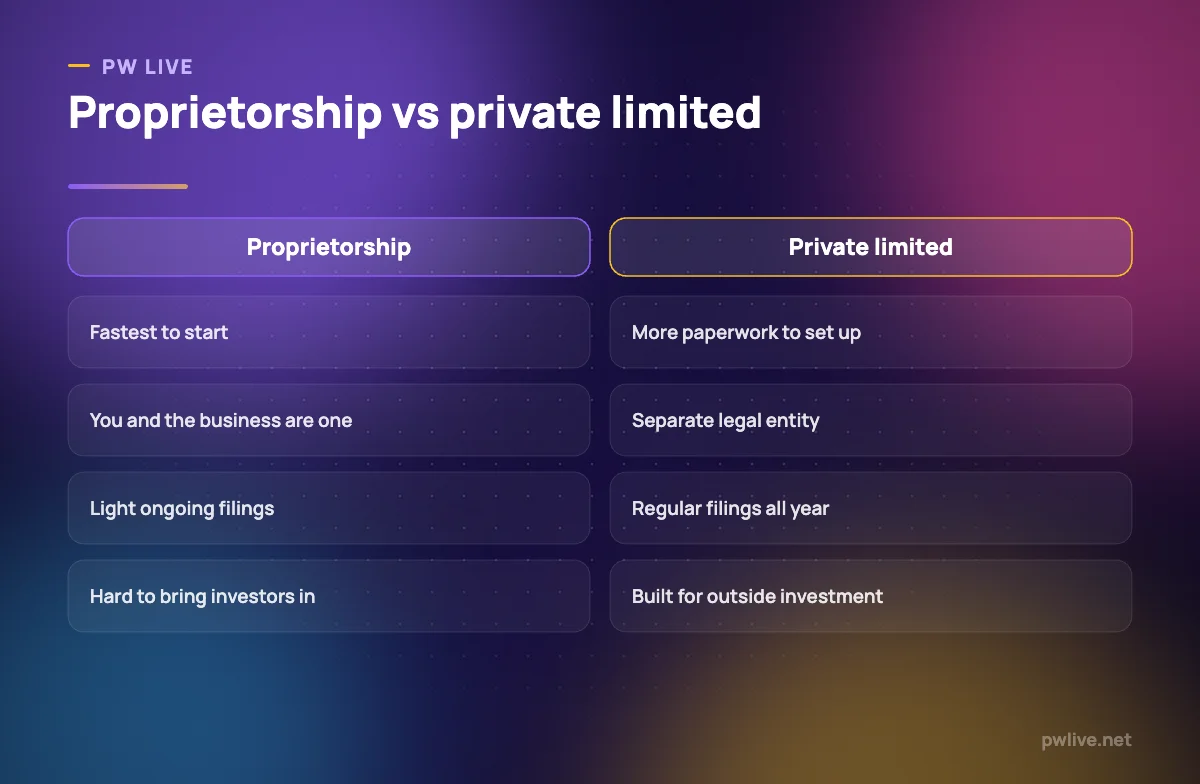
- Sole proprietorship. One owner. The simplest to begin. There is no separate registration of the entity itself in the way a company has; you establish it through the registrations your trade requires, such as GST or a shop licence. Legally you and the business are the same, so business debts are your debts.
- Partnership firm. Two or more owners under a partnership deed. Registration of the firm is possible and usually advisable. Partners generally carry personal liability.
- Limited liability partnership (LLP). A separate legal entity with partners whose liability is limited. More filings than a partnership, fewer than a company.
- Private limited company. A separate legal entity with directors and shareholders, incorporated through the central corporate affairs process. The most paperwork, and the structure outside investors normally expect.
- One person company (OPC). A company structure designed for a single founder who wants a separate entity.
A simple way to choose: if you are testing an idea alone with low risk, a proprietorship keeps you moving. If you are building something with co-founders, outside money or meaningful liability, look seriously at an LLP or a private limited company and take professional advice on the trade-offs.
Founders planning to raise money should also read what investors actually look for in an early-stage startup, because structure decisions are easier once you know where you are heading.
Get your documents ready before you start any form
Almost every registration route asks for the same base set. Collecting these first saves repeated trips:
- PAN for each owner, partner or director, and later a PAN for the entity where the structure requires one.
- Aadhaar or another accepted identity proof, usually linked to a mobile number for one-time passwords.
- Address proof for the business premises, which may be a utility bill plus a rent agreement and, where the premises are rented, a no-objection letter from the owner.
- Photographs and specimen signatures in the formats the portal specifies.
- A digital signature where the structure requires electronic filing by directors or partners.
Scan everything once, at good quality, and keep it in one clearly named folder with a backup. You will upload the same files many times, and a missing scan is the most common cause of a stalled application.
Register the entity
For a company or an LLP, incorporation happens through the central corporate affairs system: you reserve a name, file the incorporation forms with the required documents, and receive a certificate of incorporation along with the entity’s identification number and PAN.
For a partnership, you draw up a deed setting out shares, roles and how the partnership ends, and register it with the relevant registrar of firms where applicable.
For a proprietorship, there is no incorporation certificate. You establish the business through registrations such as GST, a shop and establishment registration with your local authority, or a professional licence, depending on your trade.
Name choice deserves a moment. Check that the name is not already taken on the relevant registry, that the domain is available, and that no obvious trademark conflict exists. Changing a name after you have printed signage and invoices is expensive.
Add the tax and trade registrations
The registrations that matter to most small businesses are:
- GST registration. Compulsory in some situations and voluntary in others, depending on turnover, the nature of your supply and whether you sell across state lines or through certain platforms. The thresholds and conditions change, so confirm your position on the official GST portal or with an accountant rather than relying on what a competitor tells you. Online sellers can start with our overview of GST and compliance basics for online sellers.
- Udyam registration for micro, small and medium enterprises, which is how a business gets formally recognised as an MSME.
- Professional tax, where your state levies it.
- Trade or premises licences, such as a shop and establishment registration, a food business licence, or a trade licence from your municipal body.
- Import or export codes, if you plan to trade across borders.
Employers take on a further set of registrations connected to provident fund, state insurance and payroll deductions once they cross the relevant staff numbers. If hiring is close, read how to hire your first employee without costly mistakes before you make an offer.
Open a current account and separate your money
Once you have your registration papers, open a current account in the business name. This is the single most useful practical step in the whole process.
Mixing personal and business money is the most common bookkeeping problem small businesses have, and it is entirely avoidable. From day one:
- Route every business payment in and out of the business account.
- Pay yourself by a regular transfer to your personal account, and treat that as your income.
- Keep a card or payment handle used only for business expenses.
- Save every bill, even small ones, in a monthly folder.
Clean separation makes tax filing far less painful and makes it possible to see whether the business is actually working. To understand your own tax position as an owner, our guide to income tax basics for first-time earners in India covers the vocabulary.
Build a simple compliance calendar
Registration is a one-off. Compliance is a rhythm. On the day you register, put the recurring dates in a calendar with a reminder a week before each one.
Depending on your structure and registrations, that calendar may include periodic GST returns, income tax filings, annual filings for companies and LLPs, payroll-related deposits, and licence renewals. Ask your accountant to write out your specific list once, then keep it in a single sheet you review monthly.
Two habits prevent most penalties: file even when the return is nil, and never leave a filing to the person who is busiest that week without a named backup.
Getting your paperwork right also affects what you can promise customers in writing. Read invoices, quotes and contracts: the basics that protect you next, and browse the business and entrepreneurship archive or the personal finance skill track for the surrounding money skills.
Key takeaways
- Structure first: proprietorship for speed and simplicity, LLP or private limited for separate liability and outside investment.
- Collect PAN, identity, address proof and premises documents before opening any portal.
- Companies and LLPs are incorporated centrally; a proprietorship is established through its tax and trade registrations.
- GST, Udyam, professional tax and trade licences are the registrations most small businesses encounter.
- Open a current account and stop mixing personal and business money immediately.
- Rules and thresholds change, so confirm your specific case with a qualified professional or the official portal.
Frequently asked questions
Can I start selling before I register anything?
In many small proprietorship situations you can begin trading and register as the requirements apply to you, but this depends entirely on your trade, your location and the platforms you sell through. Check your specific position with an accountant before assuming you are exempt.
Do I need a GST number to sell online?
Marketplaces and payment platforms often set their own requirements, and the legal position depends on turnover, the type of supply and whether you sell across state lines. Confirm the current rules on the official GST portal or with a professional rather than from forum advice.
Should I hire a professional or do it myself?
A straightforward proprietorship registration is often manageable alone. For a company or an LLP, and for anything involving employees or cross-state trade, a chartered accountant or company secretary usually saves more than they cost in avoided mistakes.
How long does registration take?
It varies widely by structure, state and how complete your documents are. The realistic way to plan is to assume delays, keep your documents ready in advance, and not commit to a launch date that depends on a certificate arriving by a particular day.
Keep learning with PW Live
Browse every guide in Business & Entrepreneurship, or pick a skill track and follow the roadmap step by step.





Leave a Reply