
Debt traps rarely begin with a large loan. They usually begin with a small, easy, well-designed transaction: a one-tap instalment plan at checkout, a minimum payment that felt manageable, a card limit increase you did not ask for.
The trap is not borrowing itself. Borrowing to buy a home or fund an education can be a sensible decision. A trap is any arrangement where the cost of servicing what you owe grows faster than your ability to repay it, so each month you start further behind.
This article is general educational information, not personalised financial advice. Interest rates, fees and product terms change and vary between lenders, so read your own agreement and consult a qualified adviser if your debts are already causing difficulty.
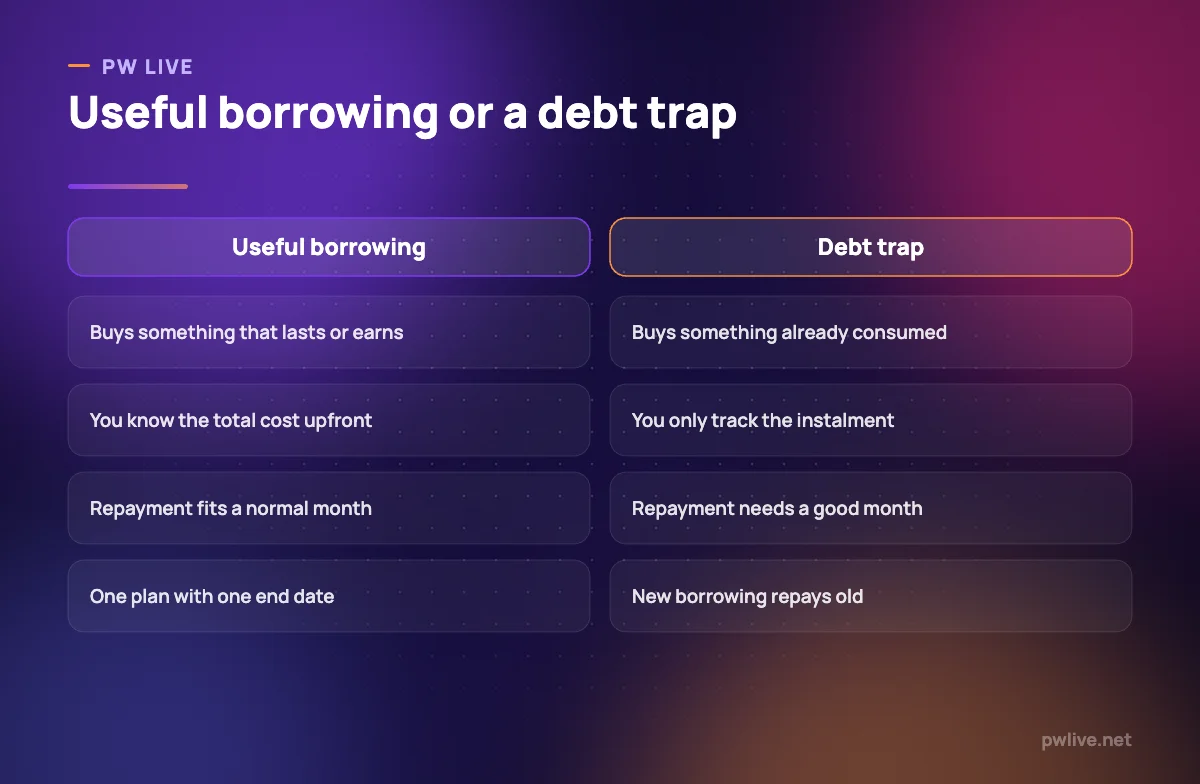
What separates useful borrowing from a trap
Three questions usually settle it.
What does the money buy? Borrowing for something that lasts, earns or protects you sits differently from borrowing for something consumed within the week. An education loan and an instalment plan on a takeaway order are not the same decision.
Do you know the total cost? Healthy borrowing has a number you can say out loud: what you will have paid by the end. If you only know the monthly figure, you do not know the price.
Does the repayment fit an ordinary month? Not a good month, not a month with a bonus. If it only works when something goes right, it will fail when something goes wrong.
The most reliable protection against all three is having a cushion so that a small shock does not require credit at all, which is the whole argument for building an emergency fund even on a small income.
Credit card mechanics people miss
Credit cards are not inherently dangerous. Used as a payment tool and cleared in full each month, they cost nothing and build your credit record. The danger sits in a few specific mechanics.
- The interest-free period is conditional. It usually applies only if you pay the full statement balance by the due date. Pay less and the concession typically disappears, often applying interest from the transaction date.
- The minimum due is a floor, not a plan. Paying it keeps your account in good standing while barely touching the principal, which is precisely why it is offered so prominently.
- Card interest is generally among the most expensive borrowing available to individuals. Check the rate on your own statement rather than assuming, and note that it is often quoted monthly.
- Cash withdrawals are treated differently. They commonly attract a fee and start accruing interest immediately with no interest-free window.
- Converting a purchase to EMI has a cost. Read the interest and processing charges, and check whether the amount continues to block your credit limit.
The rule that avoids nearly all of this is simple: only spend on the card what is already in your bank account for the purpose.
Buy now pay later is credit, however it is presented
The convenience of splitting a purchase into instalments at checkout is real. So is the fact that it is borrowing, with the same consequences as any other borrowing.
Things to be clear about before you use it:
- Late fees. Many arrangements are cheap only if every instalment is paid on time, and expensive the moment one is not.
- Reporting. Some providers report to credit bureaus, so missed instalments can affect your record, as explained in our guide on how a credit score is built.
- Stacking. Several small plans across different apps are easy to lose track of, and together they can consume a large share of your monthly income.
- Behaviour. Splitting a price into four pieces makes it feel smaller, and that is the point of the design.
Before accepting an instalment plan, ask whether you would buy the item outright today at the full price. If the honest answer is no, the plan has changed your decision rather than your affordability.
Personal loans and the instalment illusion
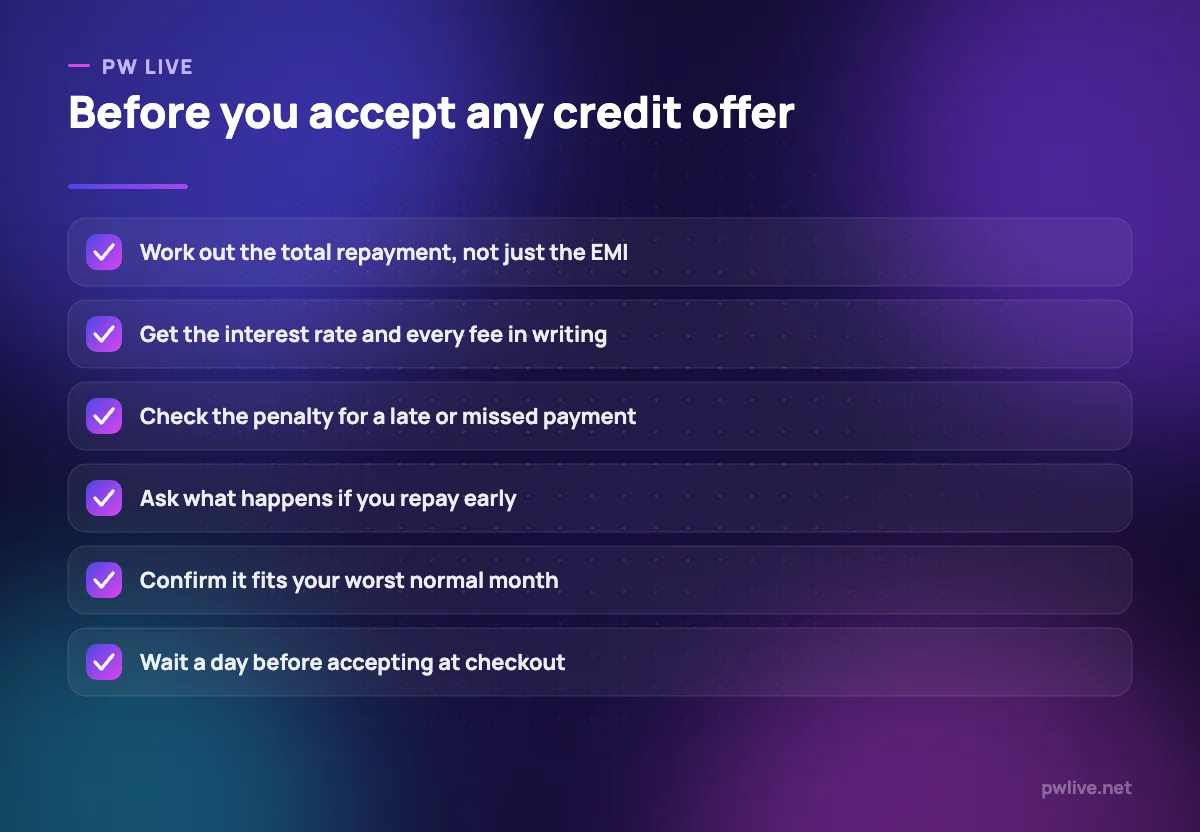
Personal loans are often marketed by their EMI rather than their cost. A longer tenure produces a comfortable monthly figure and a much larger total repayment.
Whenever you compare loan offers, look at four things together: the interest rate and how it is calculated, the processing fee and any insurance bundled in, the total amount repayable over the full tenure, and the charges for prepayment or foreclosure.
The most dangerous version is borrowing to repay other borrowing without changing anything else. Consolidating debt can genuinely help if it lowers the overall cost and comes with a plan to stop adding new debt. Without that second part, it simply resets the clock at a higher total.
Early warning signs
Most people can name the month things turned, in hindsight. These are the signals worth acting on immediately:
- You pay the minimum due on a card more than occasionally.
- You use one credit source to pay another.
- You do not know your total outstanding balance without checking.
- A missed instalment would happen if your income arrived a week late.
- You have taken a new instalment plan while an old one is still running.
- You avoid opening statements or banking apps.
Seeing two or three of these is not a moral failing. It is information, and it is far more useful early than late.
Two workable ways out
Both methods start the same way: list every debt with its outstanding balance, interest rate, minimum payment and due date on a single page. A sheet works well, and our guide to using spreadsheets for planning and budgeting covers the setup.
Then pay the minimum on everything and direct every spare rupee at one target.
- Highest rate first. Clear the most expensive debt first. This costs the least in total interest and is the mathematically efficient route.
- Smallest balance first. Clear the smallest debt first for a visible win, then roll that payment into the next. It costs slightly more, and it keeps more people going.
Choose based on which one you will actually finish. Alongside it, do three things: stop adding new debt, talk to lenders early if a payment will be missed since restructuring is easier before a default, and keep a small cushion so an unexpected expense does not restart the cycle. Sustaining the routine is the hard part, and building habits that stick applies here directly.
If the debt is beyond what your income can service, speak to a qualified adviser or a legitimate credit counselling service rather than to anyone promising a quick fix for a fee.
Borrowing safely when you genuinely need to
Deal with regulated lenders and read the sanction letter, not the advertisement. Borrow the amount you need rather than the amount you are offered. Set up automatic payment for at least the minimum so a busy month cannot cause a default, and keep the total of all your monthly repayments at a level that still leaves room to save.
For the wider picture of budgeting, saving and investing around your borrowing, start with personal finance for students and first earners, browse the finance category, or work through the personal finance skill track in order.
Key takeaways
- Borrowing becomes a trap when servicing it outgrows your ability to repay, not because credit itself is bad.
- Judge any offer by the total repayment and the fit with an ordinary month, never by the EMI alone.
- Credit cards are cheap when cleared in full and expensive the moment you pay only the minimum.
- Buy now pay later is credit, can be reported to bureaus, and is easy to stack across apps.
- List every debt on one page, then attack either the highest rate or the smallest balance consistently.
- Talk to lenders before you miss a payment, and avoid anyone promising to erase debt for a fee.
Frequently asked questions
Is it bad to pay only the minimum due on a credit card?
It keeps the account current but barely reduces the principal, and it usually removes the interest-free period on new purchases. Doing it repeatedly is one of the most common ways a manageable balance becomes an unmanageable one.
Does using buy now pay later affect my credit score?
It can, because some providers report to credit bureaus, particularly when instalments are missed. Check whether your provider reports, and treat every instalment as seriously as a loan payment.
Should I take a new loan to clear my credit card debt?
Consolidation can reduce the overall cost if the new borrowing is genuinely cheaper and you stop adding new debt. Without that second condition it usually increases the total repaid, so it is worth reviewing with a qualified adviser.
What should I do if I am about to miss a payment?
Contact the lender before the due date rather than after. Options such as restructuring or a revised schedule are far easier to arrange before an account is marked in default.
Keep learning with PW Live
Browse every guide in Finance & Investing, or pick a skill track and follow the roadmap step by step.





Leave a Reply