

The most confusing lesson in small business is this: you can be profitable on paper and still be unable to pay your rent. Understanding cash flow basics is what stops that from happening to you.
Profit is an accounting story about a period of time. Cash is the money sitting in your account today. They move on different clocks, and businesses die from the gap between them.
This guide explains why the gap exists, how to see it coming, and the practical habits that keep a growing business solvent.
Profit and cash are two different measurements
Profit answers: over this period, did the value of what I sold exceed the cost of producing it? Cash answers: on this date, do I have money?
Three ordinary things push the two apart:
- Timing of payment. You record the sale when you invoice. The customer pays later, sometimes much later. Profit went up in June; cash arrives in August.
- Big one-off purchases. Buy a machine or a year of stock, and accounting spreads that cost across future periods. Your bank account paid the whole amount on the day.
- Money that never appears on the profit statement. Loan principal repayments, tax deposits, deposits you place with suppliers, and money you draw for yourself all reduce cash without reducing profit in the same way.
A simple illustration. Say you invoice 5 lakh rupees in a month with costs of 3.5 lakh, so profit is 1.5 lakh. But customers pay 60 days later, you paid suppliers upfront, and you repaid a loan instalment. Cash for that month can easily be negative. Those numbers are made up, but the pattern is completely normal.
Why growth makes it worse, not better
This is the trap that surprises people most. The faster you grow, the more cash you consume, at least at first.
Each new order means paying for materials, labour or stock before the customer pays you. Double your orders and you double the money tied up in that gap, while the incoming payments still arrive on the old delay.
This is why healthy-looking businesses fail after their best quarter. They took on more work than their cash could carry.
Two protections matter here:
- Know how much cash each new order consumes before it returns any. If an order needs 40,000 rupees of stock and pays 60,000 in 45 days, you cannot run ten of them at once on a 100,000 rupee balance.
- Grow in steps you can fund, and turn down or stage work you cannot pay for. Saying “I can start this in three weeks” is far better than saying it now and failing later.

The cash conversion cycle in plain terms
There is a simple mental model for where your cash is trapped. Money leaves you, sits somewhere, and comes back. Three places hold it up:
- Stock. Goods you have paid for but not sold yet.
- Receivables. Work you have delivered and invoiced but not been paid for.
- Payables. Money you owe suppliers but have not paid yet, which works in your favour.
Your cycle is roughly: how long stock sits, plus how long customers take to pay, minus how long you take to pay suppliers. The shorter that number, the less cash your business needs to run.
Every improvement to it releases money you already earned:
- Sell or return slow-moving stock rather than admiring it on the shelf. Our guide to inventory management for small online businesses covers this in detail.
- Shorten payment terms on new customers, or take a deposit upfront.
- Negotiate longer terms with suppliers, honestly and in advance rather than by paying late.
Build a 13-week cash forecast
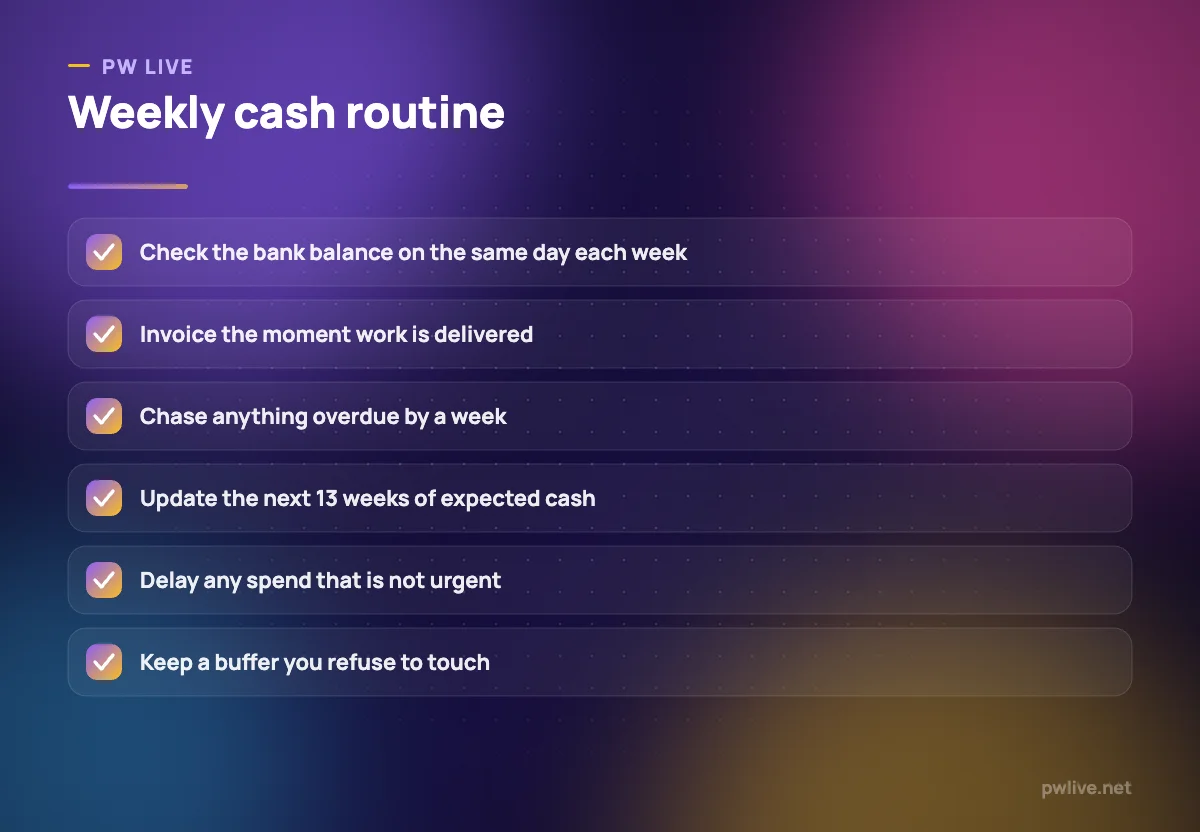
The single most useful tool in a small business is a rolling 13-week forecast. It is a spreadsheet with weeks as columns and three sections as rows: opening balance, money in, money out.
Build it once, in about an hour:
- Start with today’s actual bank balance.
- List every expected receipt by the week you realistically expect it, not the week it is due. Customers who always pay late should be entered late.
- List every expected payment: rent, salaries, suppliers, loan instalments, tax deposits, subscriptions, your own drawings.
- Calculate the closing balance for each week, which becomes the next week’s opening balance.
- Update it every week with what actually happened.
Thirteen weeks is long enough to see a problem forming and short enough that you can still act. When a week turns red, you have options: chase invoices, delay a purchase, stage a payment, or arrange finance calmly instead of desperately.
If spreadsheets are not yet a comfortable tool for you, our guide to using spreadsheets for planning and budgeting will get you to the level this needs in an afternoon.
Get paid faster without annoying customers
Most cash problems in small businesses are collection problems. These changes cost nothing:
- Invoice immediately. An invoice sent the day work is delivered gets paid sooner than one sent at month end, simply because the clock starts earlier.
- Make the invoice easy to pay. Correct details, a clear due date, a purchase order reference if the customer uses them, and a payment link or UPI handle on the document.
- Take deposits. An advance on new customers or large jobs funds the work and filters out people who were never going to pay.
- Agree terms in writing before you start. Payment timing belongs in the quote, not in a later argument. Our guide to invoices, quotes and contracts covers what to include.
- Chase on a schedule, politely. A short reminder a few days before the due date, another on the day, then a phone call. Most late payment is disorganisation, not refusal.
- Escalate early with a real person. Getting the name and number of whoever approves payments is worth more than ten emails to a generic address.
Control the outflow side
Cash discipline is mostly about postponing and shrinking what leaves.
- Separate spending into keeps the lights on, earns money soon and nice to have, then freeze the third category whenever your forecast tightens.
- Prefer variable costs to fixed ones early. A freelancer you use monthly is easier to survive than a salaried role you cannot fund.
- Review subscriptions quarterly and cancel what you have not opened.
- Time large purchases for weeks where your forecast shows a cushion.
- Be careful with short-term credit. It solves a week and can cost a year. Our guide on avoiding debt traps explains the traps.
Keep a buffer and know your runway
Two numbers should live in your head.
The buffer is a fixed amount you refuse to spend, sized around your regular monthly outgoings. Build it slowly by moving a small fixed sum out of the operating account after every good week. Treat it as if it were not there.
Your runway is how many months you could keep operating with no new sales. Divide your available cash by your average monthly cash outflow. If the answer is under two, your first priority is not growth, it is collections and cost control.
Both numbers change monthly, so recalculate them when you update the forecast. Reading your business through unit-level numbers helps too, so pair this with unit economics explained and browse the finance and investing archive or the personal finance skill track to build the underlying money habits.
Key takeaways
- Profit is measured when you invoice; cash is measured when you are paid, and the gap is where businesses fail.
- Growth consumes cash before it produces it, so fund expansion in steps you can afford.
- Your cash is trapped in stock and unpaid invoices, and released by supplier terms.
- A rolling 13-week forecast, updated weekly, gives you weeks of warning instead of days.
- Invoicing immediately and chasing on a schedule fixes most small-business cash problems.
- Track your buffer and your runway, and stop chasing growth when runway drops below two months.
Frequently asked questions
How often should I update a cash forecast?
Weekly, on the same day, taking about fifteen minutes once it is set up. The value comes from the routine, because a forecast you update occasionally is out of date exactly when you need it.
What is a reasonable cash buffer for a small business?
There is no universal figure, but a common approach is to hold enough to cover your normal fixed outgoings for a set number of months and to build it up gradually. Choose a target based on how predictable your income is, and treat that money as untouchable.
Should I offer a discount for early payment?
Only if the discount costs you less than the cash is worth. Work out the cost of the discount against the value of getting paid weeks earlier, and consider asking for deposits instead, since they cost nothing.
Does this apply to a service business with no stock?
Yes, and the receivables side matters even more. With no inventory to manage, almost all of your trapped cash sits in delivered work that has not been paid for, so invoicing speed and collection discipline are the whole game.
Keep learning with PW Live
Browse every guide in Business & Entrepreneurship, or pick a skill track and follow the roadmap step by step.





Leave a Reply