

An emergency fund is the money that stops one bad week from turning into a year of debt. It is not an investment and it is not meant to grow impressively. It exists so that a hospital bill, a broken phone you need for work, or a two-month gap between jobs does not push you towards a credit card or a loan from a relative.
The usual advice is to save several months of expenses, which sounds impossible when your income is small and already spoken for. It is not impossible. It is just slower, and it starts smaller than most articles admit.
This article is general educational information, not personalised financial advice, and you should speak to a qualified adviser before making decisions about your own money.
Why a cushion matters more when income is small
People with higher incomes absorb shocks without noticing. A sudden expense eats into what would have been savings. When your income is small, the same expense has nowhere to go except borrowing, and borrowing has a habit of repeating.
The real value of an emergency fund is not the balance. It is that it changes your options. You can say no to a payday-style loan, wait for a proper job offer instead of taking the first one, or repair something rather than replace it on instalments.
It also protects the rest of your plan. Long-term savings only work if you leave them alone, and the most common reason people break a long-term plan is a short-term shock.
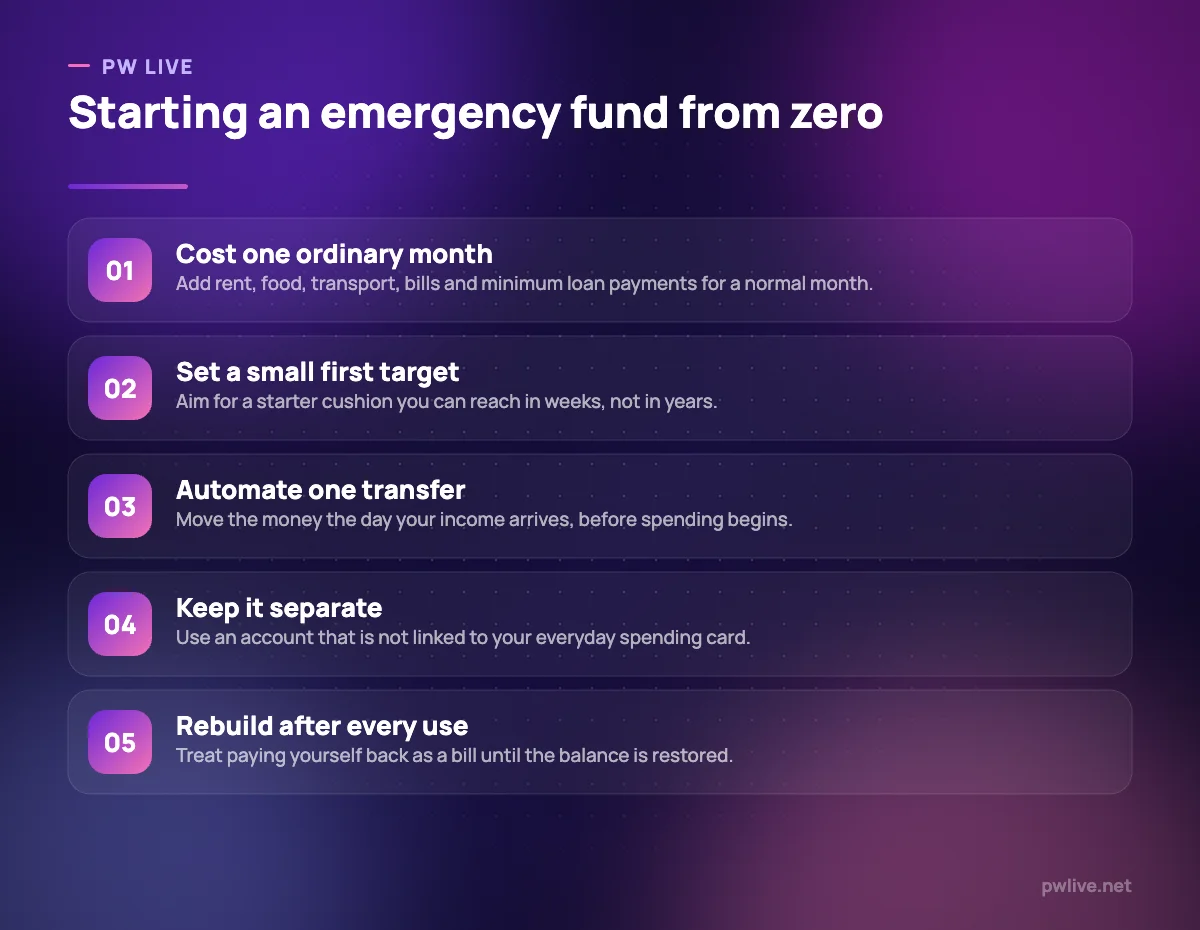
Work out what one ordinary month costs
You cannot set a target without a number, and the number is not your salary. It is what a plain month costs when nothing special happens.
List these, using your own actual amounts:
- Rent or your share of it, plus electricity, water and gas
- Food, including what you spend on eating out during a normal week
- Transport to work or college
- Phone, internet and any subscription you would struggle to cancel
- Minimum payments on any loan or card
- Medicines and anything recurring you cannot skip
Add them up. That total is one month of survival costs. Ignore holidays, gifts and shopping for now, because in a genuine emergency those stop anyway. A simple sheet works well for this, and our guide to using spreadsheets for planning and budgeting shows how to set one up in a few minutes.
Choose a first target you can actually reach
The classic figure of three to six months of expenses is a destination, not a starting line. Staring at it from zero is the main reason people never start.
Break it into stages instead:
- A starter cushion. Enough to handle a small, common emergency without borrowing. For many people this is a few thousand rupees, and it can be reached in weeks.
- One month of costs. This is the point where a delayed salary stops being a crisis.
- Three months or more. Build towards this once your income is steadier, and stretch it further if your work is freelance, commission-based or seasonal.
Each stage is a finished goal in itself, which matters psychologically. Reaching a small target and feeling it work is what keeps the habit alive. The same staged approach applies to any money target, as we cover in how to set money goals you will actually stick to.
Where to keep the money
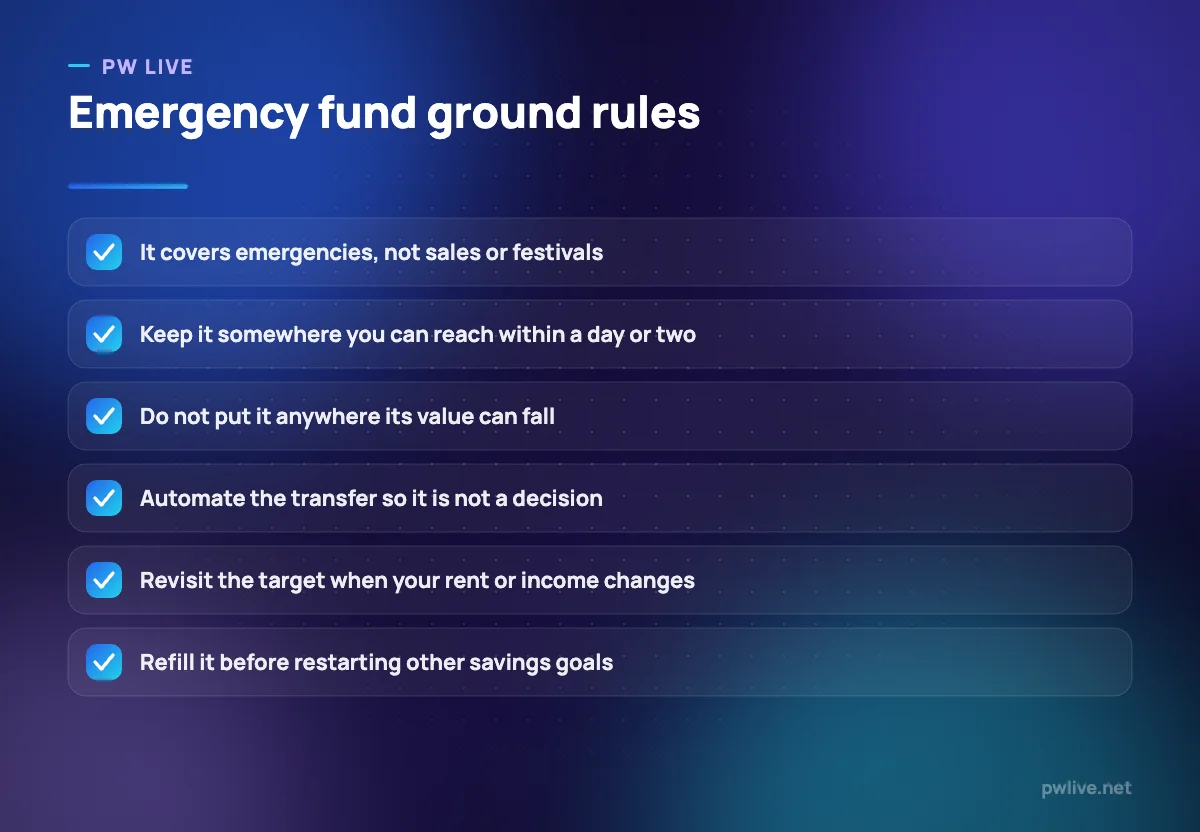
An emergency fund has one job: to be there, in full, on the day you need it. That rules out anything whose value can move.
Ask three questions of any place you might keep it:
- How fast can I get it out? Same day or next day is the standard to aim for. Money locked for a fixed period fails the test unless breaking it is easy and cheap.
- Can the amount fall? If the answer is yes, it is not an emergency fund. Market-linked options belong to your longer-term money, not this.
- How easy is it to spend by accident? Keeping it in your main spending account almost guarantees it disappears.
A separate savings account at your bank, not linked to your everyday debit card, covers most people’s needs. Interest rates and account rules change frequently, so check current terms with the bank or an official source rather than relying on figures you read anywhere, including here. If you want to understand how the trade-off between access and return works more broadly, our comparison of mutual funds and fixed deposits walks through the same logic.
Finding the money when the budget is already tight
If there is genuinely nothing spare, the fund has to come from somewhere other than willpower.
Things that tend to work:
- Pay yourself first. Move a fixed amount on income day rather than saving whatever survives the month.
- Start uncomfortably small. An amount so small it feels pointless is still better than a plan you abandon in week three.
- Bank the irregular money. Refunds, cashback, a festival bonus, a freelance payment, money from selling something you no longer use.
- Round down your balance. Some people keep a mental floor and sweep anything above it into savings at month end.
- Add a percentage of any raise. Increases are the easiest money to save because you never adjusted to it.
If your income itself is the constraint, the longer-term answer is earning capacity, not tighter budgeting. Building a paid skill alongside your job is a slow fix but a real one, and our personal finance skill track and guide to freelancing for beginners are reasonable places to start.
What counts as an emergency
A fund with vague rules gets spent. Write your own definition before you need it.
An emergency is usually unexpected, necessary and urgent at the same time. A medical bill qualifies. A laptop dying when you need it for work qualifies. A sale, a wedding gift, a trip and a new phone you simply want do not, because they are either predictable or optional.
Predictable-but-large costs deserve their own pot. Annual insurance premiums, festival spending and tuition fees are known in advance, so save for them separately rather than raiding the emergency money.
Rebuilding after you use it
Using the fund is not a failure. That is the entire point of it. What matters is the month after.
Set a repayment plan to yourself immediately, with a fixed amount and a rough end date, and treat it as seriously as a bill. Pause other optional savings until the balance is back. If you find yourself dipping in every month, the problem is not the fund, it is that the underlying budget does not balance, and that is worth confronting directly rather than patching.
Where borrowing has already crept in, deal with the highest-cost debt alongside rebuilding, and read our guide on how to avoid debt traps before taking on anything new. More articles on saving, tax and investing basics sit in the finance and investing category.
Key takeaways
- An emergency fund buys options, which is more valuable than the interest it earns.
- Base the target on one ordinary month of your own costs, not on a generic rule.
- Start with a small starter cushion, then build towards one month and beyond in stages.
- Keep it accessible, stable in value and separated from your spending account.
- Automate the transfer on income day so saving is not a monthly decision.
- Rebuild deliberately after every withdrawal, and pause other goals until you do.
Frequently asked questions
How much should an emergency fund hold?
A common guideline is three to six months of essential expenses, with more if your income is irregular. Start with a smaller starter target you can reach quickly, then extend it as your income steadies.
Should I build an emergency fund before clearing debt?
Many people build a small starter cushion first, so that new expenses do not create fresh debt, then focus on clearing high-cost borrowing. The right balance depends on the cost of your debt and your job security, which is worth discussing with a qualified adviser.
Can I keep my emergency fund invested for better returns?
The purpose of this money is certainty, not growth, so anything whose value can fall on the day you need it works against the goal. Keep it in a stable, easily accessible place and let your longer-term money take the investment risk.
What if I can only save a very small amount each month?
Save it anyway. The habit and the account are worth more than the early balance, and small automated transfers compound into a usable cushion faster than most people expect once irregular income like refunds and bonuses is added.
Keep learning with PW Live
Browse every guide in Finance & Investing, or pick a skill track and follow the roadmap step by step.





Leave a Reply