

Personal branding on LinkedIn is not about becoming an influencer. It is about being findable, understandable and credible to the specific people who might hire you, buy from you or refer you.
For most professionals in India, LinkedIn is now the default background check. Recruiters, clients and partners will look at your profile before a first conversation, and often instead of one.
This playbook covers the parts that actually change outcomes: a profile that reads clearly, a focus worth being known for, a sustainable posting habit and relationship-building that does not feel like cold spam.
Decide what you want to be known for
A brand is what someone can say about you in one sentence when you are not in the room. If that sentence is “works in IT”, it will not open any doors.
Pick a narrow, honest position at the intersection of three things:
- What you are genuinely good at, or actively getting good at.
- What the people you want to reach actually need.
- What you can talk about for a year without getting bored.
Narrow feels risky and is not. “Backend developer” competes with everyone. “Backend developer who works on payment reliability for small fintechs” gets remembered and gets referred.
Write your position as one sentence and keep it visible while you work through the rest of this. If a profile section or a post does not support it, cut it.
Fix the profile before you post anything
Posting drives traffic to your profile. If the profile is weak, the traffic is wasted. Fix it first.
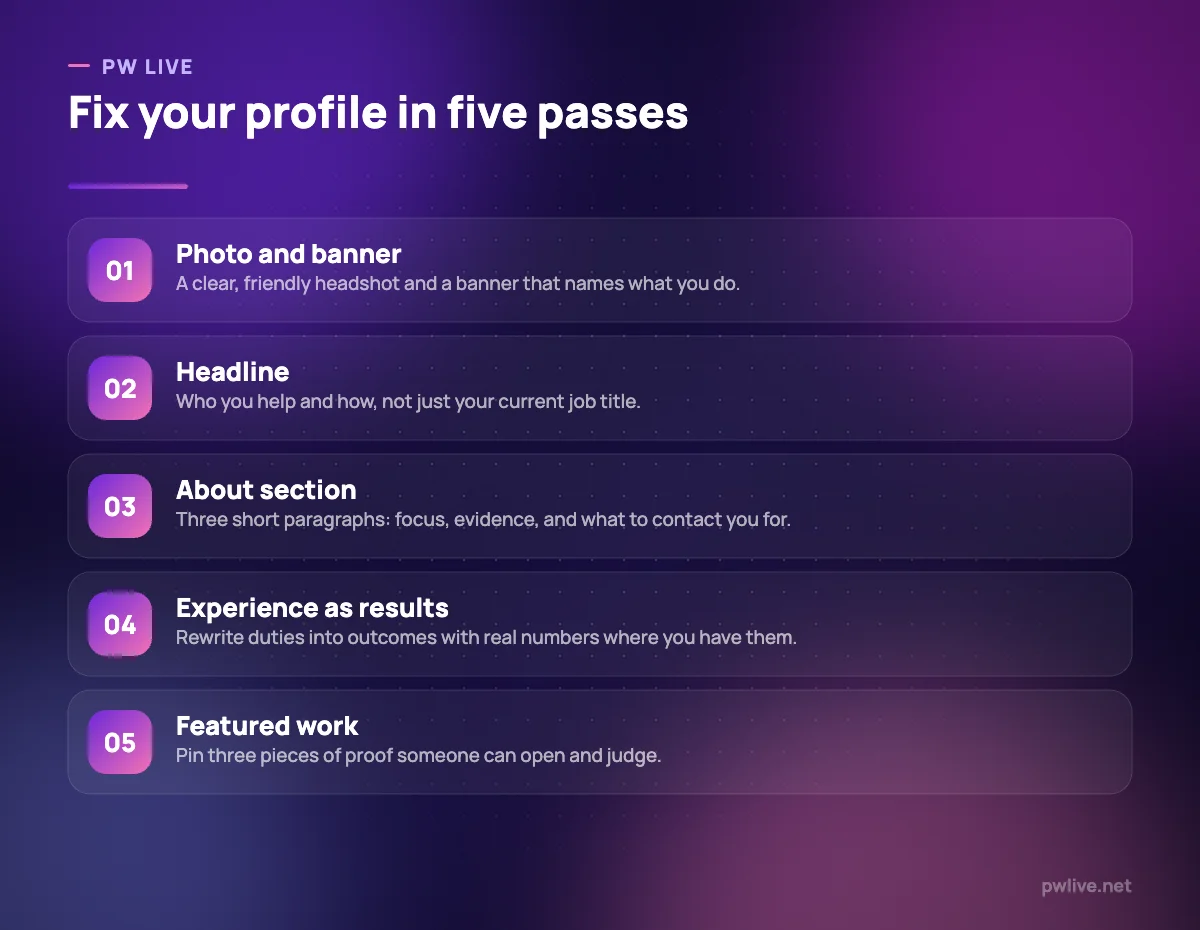
Photo. A clear, well-lit headshot where your face fills most of the frame. It does not need to be professionally shot; it does need to look like you.
Headline. This follows your name everywhere on the platform. Use it to say who you help and how, not just your job title. “Operations lead” is a label; “Operations lead helping D2C brands cut delivery delays” is a reason to click.
About section. Three short paragraphs. What you focus on, evidence that you can do it, and what people should contact you about. Write it in first person, in plain language.
Experience. Rewrite duties as outcomes. “Handled social media” becomes “grew a bakery’s enquiry volume by running a weekly posting system on one platform.” Use real numbers only where you have them; invented ones are easy to catch in an interview.
Featured and skills. Pin two or three things someone can actually open: a project, an article, a portfolio. Our guide to building a portfolio when you have no work experience covers what to put there when you are starting out.
Write posts worth someone’s time
You do not need to post daily, and you do not need a personal-story formula. You need to be visibly thinking about your field in public.
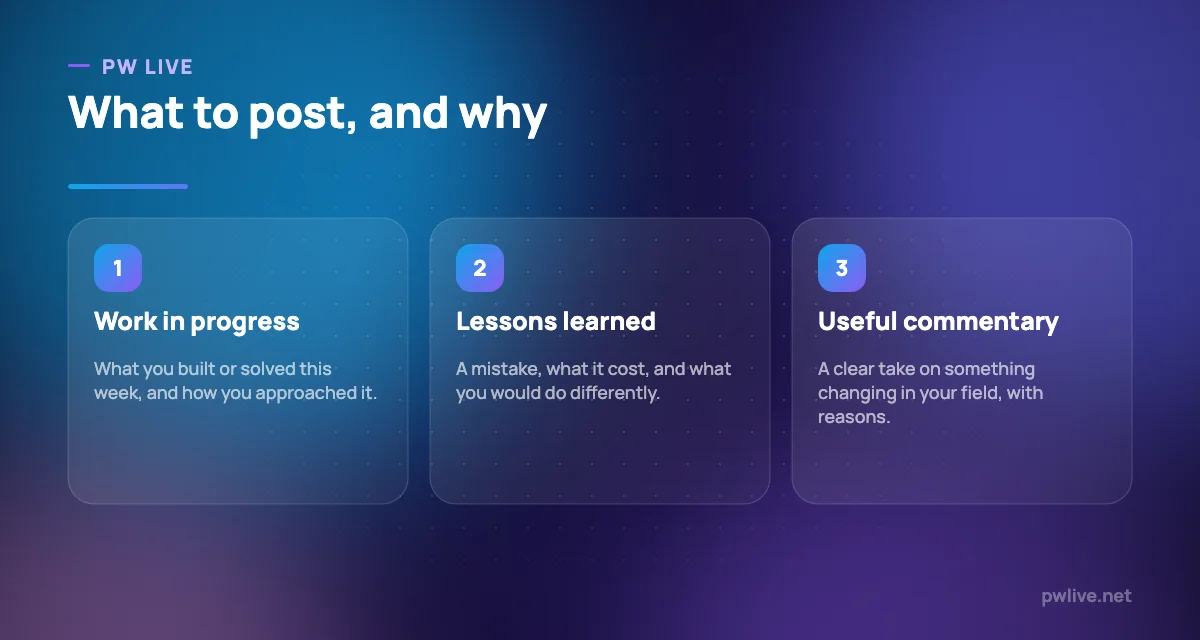
Three types carry almost any account:
- Work. Something you built, fixed, tested or shipped, with the reasoning behind a decision. This is the most underrated and the most credible.
- Lessons. A mistake, what it cost, what you changed. Specific and honest beats polished and generic.
- Commentary. A clear position on something changing in your field, with your reasons and your uncertainty stated.
Structural habits that help: put the point in the first line, keep paragraphs to one or two lines, and end with something a reader can use or respond to. The broader craft is covered in our guide to writing content people actually read and share.
What to avoid: engagement pods, comment-swap groups, bought followers, and automation tools that like and connect on your behalf. These breach platform terms, they are visible to anyone paying attention, and they build a following that cannot help you. A hundred relevant readers who trust you is worth more than ten thousand who do not know why they followed.
Build relationships instead of collecting connections
Connection count is not the asset. The asset is the number of people who would reply to your message.
A practical weekly routine, in about thirty minutes:
- Leave three substantive comments on posts by people whose work you respect. Add a point or ask a real question; “Great post” is worse than nothing.
- Send two connection requests with a specific note about why.
- Reply properly to everyone who comments on your own posts.
- Reconnect with one person you have lost touch with, without asking for anything.
When you do reach out, be direct about what you want and make it easy to say no. Never send bulk identical messages, and never use tools that scrape profiles or harvest contact details. Beyond breaking platform rules, it produces exactly the reputation you are trying to avoid.
This is the same muscle as offline networking, covered in our guide to finding a job through networking instead of applications.
Make it sustainable
Most LinkedIn efforts die in month two. The fix is a rhythm small enough to survive a bad week.
- One post a week, at a fixed time, is plenty. Consistency beats volume.
- Batch it. Write three posts in one sitting on a weekend, schedule them, forget about them.
- Keep an ideas note on your phone. Every question a colleague asks you is a post.
- Give it six months before judging. Reputation compounds slowly and then suddenly.
Do not check the numbers hourly. Look at reach and profile views once a month, and pay far more attention to what happens in your messages: enquiries, introductions, invitations. Those are the outcomes; the metrics are just noise around them.
Turn visibility into opportunities
Visibility without a path leads nowhere. Make the next step obvious for anyone who has decided they like your work.
- Say plainly in your About section what you want to be contacted about, and what you do not.
- Keep a current, honest description of your availability: open to roles, taking clients, not looking.
- Link to one place that answers the obvious next question, rather than five scattered links.
- Ask for recommendations from people you have actually worked with, and offer to write theirs first.
When an opportunity does arrive, the rest of your materials have to hold up. Our guides on writing a resume that gets interviews with no experience and preparing properly cover that side. For more on positioning yourself professionally, browse the career and jobs archive, or follow the career readiness skill track for a structured order.
Key takeaways
- Choose a narrow, honest position and make every part of your profile support it.
- Fix the profile before posting. Posts send traffic to a page that has to do the convincing.
- Rewrite job duties as outcomes, and only use numbers you can defend.
- Post weekly about work, lessons and considered opinions. Skip pods, bots and bought followers.
- Judge results by conversations and introductions, not by follower count.
Frequently asked questions
How often should I post on LinkedIn?
Once a week, consistently, is enough for most professionals. A sustainable rhythm you keep for a year does far more than a burst of daily posting that stops in a fortnight.
Do I need a personal brand if I am not looking for a job?
A clear profile still helps: it brings referrals, collaborators and opportunities you did not ask for. Think of it as being findable and understandable, not as self-promotion.
Is it worth paying for a premium account?
Rarely at the start. The free account covers everything in this playbook. Consider paid features only once you know exactly which limitation is blocking you.
What should I do if my posts get no engagement?
Expect that for the first several weeks. Check that the first line makes a specific point, that you are writing for a defined reader, and that you are commenting on other people’s posts rather than only broadcasting.
Keep learning with PW Live
Browse every guide in Marketing & Sales, or pick a skill track and follow the roadmap step by step.





Leave a Reply