

Asking why startups fail is more useful than it sounds gloomy. Failures are not random. The same handful of patterns repeat across industries and decades, and most of them are visible long before the ending.
None of this is about intelligence or effort. Plenty of capable, hard-working teams fail, usually because they were working hard on the wrong thing or ran out of time to correct it.
This article walks through the recurring patterns, the early signals of each, and the habits that give a company a better chance. Treat it as a set of things to check regularly rather than a prediction about any one company.
Building something nobody urgently needs
The most common pattern is also the simplest. The product works, the team is competent, and the problem it solves is not painful enough for anyone to change their behaviour or their budget.
This happens for understandable reasons. Building is satisfying and controllable; selling to strangers is not. So founders keep building.
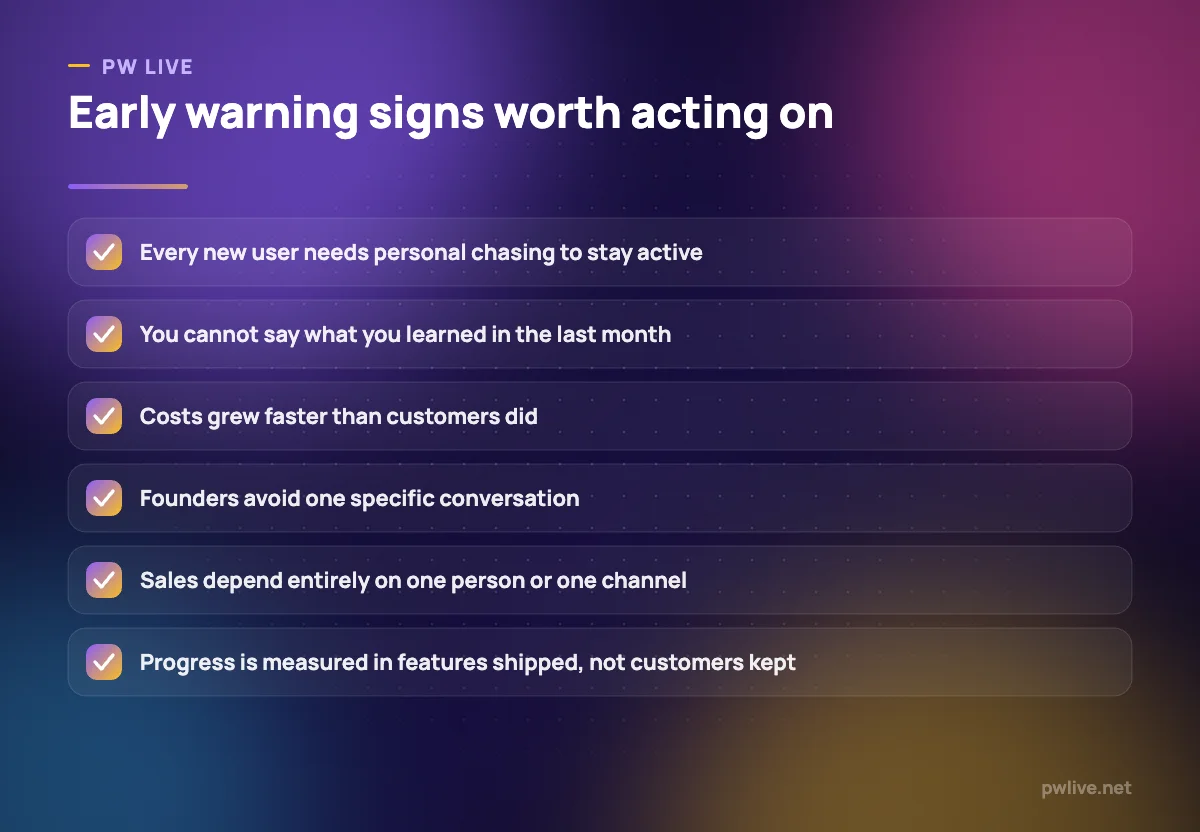
The signals appear early:
- People say the idea is interesting but do not ask when they can have it.
- Users sign up after a nudge and never return on their own.
- Your pipeline is full of “circle back next quarter”.
- Nobody complains, because nobody depends on it.
The fix is uncomfortable and cheap: go back to conversations before you go back to code. Our guide to talking to users and finding problems worth solving covers the questions that surface real urgency, and product-market fit and how to know if you have it explains the evidence that demand is genuine.
Running out of cash before running out of ideas
Companies rarely die because the idea was wrong. They die because the money ended before they finished learning.
The pattern usually looks like this: a round of funding or a burst of savings creates a feeling of security, hiring and spending rise to match, and the burn rate quietly outpaces learning. When the money thins, there is no time left to fix anything.
Practical habits that prevent it:
- Know your runway in months, and recalculate it whenever anything material changes.
- Separate experiments from commitments. A three-month contractor is an experiment; a full-time hire is a commitment.
- Watch timing, not just totals. Profitable businesses fail when receivables arrive later than payables, as our guide to cash flow basics explains.
- Set a decision point while you still have several months of money, not weeks.
The last one matters most. Decisions made with six months of runway are strategic. Decisions made with three weeks are desperate.
Founder conflict that nobody addressed
Team breakdown is one of the least discussed and most damaging patterns. It rarely starts with a dramatic argument. It starts with a small unfairness that neither person mentions.
Common sources:
- Unequal effort with equal ownership, or the reverse.
- Unclear decision rights, so every disagreement escalates.
- Different definitions of success. One founder wants a steady business, the other wants scale.
- Life changes: a job offer, a move, family responsibilities, exams.
- No vesting, which turns a departure into a permanent structural problem.
Most of these are solvable in advance by writing things down, which is the subject of our guide to equity and co-founder agreements. The rest are solved by a habit of raising small frictions early, before they harden. The leadership and management track is a useful place to build that skill.
Learning too slowly
Two teams can spend the same year and end up in completely different places, purely because one ran more experiments and drew clearer conclusions.
Slow learning shows up as:
- Long build cycles with no user contact in between
- Metrics that are collected but never reviewed
- Big launches instead of small tests
- Explaining away bad results rather than investigating them
- No written record of what was tried and what happened
A better rhythm is short and boring: a weekly review of what was tested, what the numbers said and what you will do differently. Our guide to the weekly review habit covers a version of this that works for individuals and small teams alike.
Growing before the model works
Scaling something unproven is an efficient way to lose money. If each customer costs more to acquire than they return, more customers make the problem worse, not better.
The pattern usually involves one early channel that worked unusually well, often because it reached a small, receptive group. The team pours money in, the cost per customer climbs, and the previous economics no longer hold.
Before increasing spend, check three things:
- Does a customer repay their acquisition cost within a period you can afford to wait?
- Is retention stable for the segment you are about to spend on?
- Can you deliver at higher volume without quality collapsing?
Reading unit economics explained alongside how to find your first ten customers will help you tell a real channel from a lucky one.
Ignoring the boring parts
Some failures have nothing to do with the market. Companies stall because of unpaid attention to structure: unregistered intellectual property, missing contracts, tax and compliance problems, a messy cap table, no records when someone finally wants to invest or acquire.
These are avoidable with a few hours a month. Keep signed agreements in one place, register the business properly for its stage, invoice on time and keep books current. Our guide to invoices, quotes and contracts covers the minimum.
Founder health belongs in this category too. Exhaustion degrades judgement long before it stops the work, and many companies end because the founders simply could not continue.
What the patterns teach you
Read across all of these and a shorter list emerges. Companies that last tend to do a few unglamorous things consistently.
- They talk to customers every single week, in good months and bad.
- They keep costs low until something is demonstrably working.
- They write decisions down, including the ones that went badly.
- They settle ownership, roles and expectations before there is anything to argue about.
- They set explicit checkpoints and honour them instead of drifting.
- They treat a failed idea as information rather than identity.
That last point deserves emphasis. Closing a company is a business event, not a verdict on you, and the skills you built are portable. If a venture ends badly, our guide to recovering after a result that did not go your way is written for exams but applies just as well here. The wider startups and innovation archive has the practical guides for whatever you build next.
Key takeaways
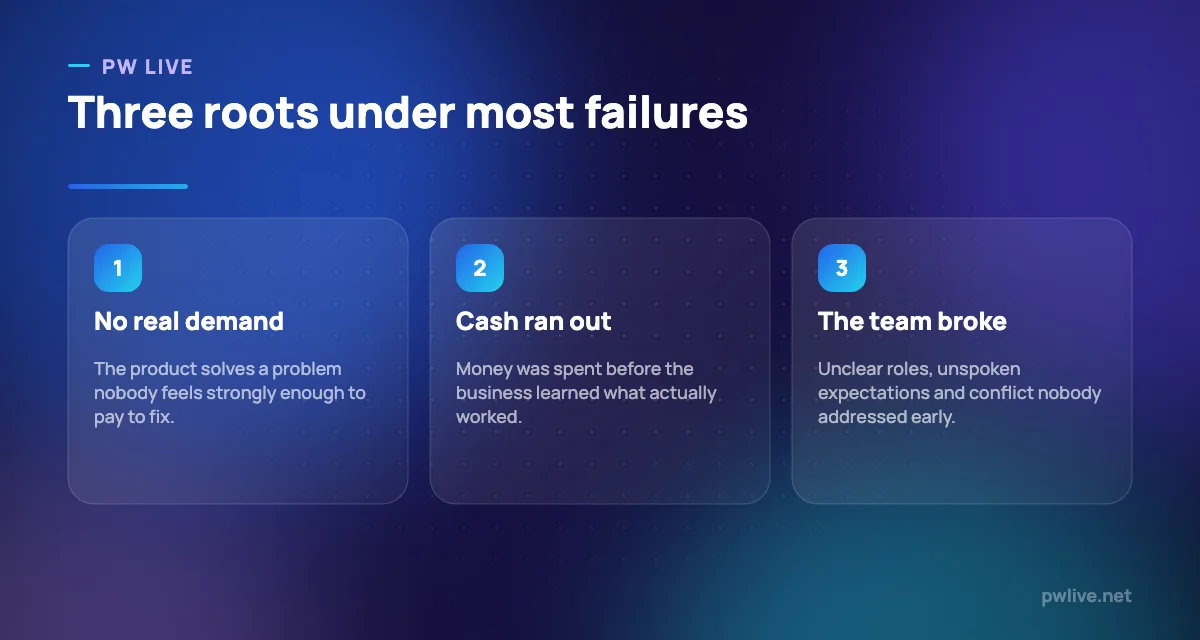
- Most failures trace back to weak demand, cash running out, or the team breaking.
- Lack of urgency in customers shows up early as polite interest and no repeat use.
- Runway is a learning budget; spend it on experiments, not on commitments.
- Founder conflict is usually structural and preventable with written agreements.
- Do not scale a channel until retention and unit economics hold up.
- Set checkpoints in advance so hard decisions are made calmly, not in a panic.
Frequently asked questions
Is failure mostly bad luck?
Timing and luck matter, but the recurring patterns are largely about behaviour: how quickly a team learns, how carefully it spends and how honestly it reads its own numbers.
How do I know whether to pivot or persist?
Decide in advance what evidence would justify each. If a defined experiment produced no movement in the metric that matters, that is a reason to change something specific, not to work harder on the same plan.
Does raising money make failure less likely?
Not by itself. Funding buys time, which helps only if the time is used to learn. It also raises expectations and fixed costs, which can shorten the runway it created.
What should I do if my startup is failing right now?
Get an accurate picture of your cash and your commitments first, then decide with months rather than weeks in hand. Winding down deliberately, paying what you owe and keeping relationships intact is a far better outcome than drifting to a stop.
Keep learning with PW Live
Browse every guide in Startups & Innovation, or pick a skill track and follow the roadmap step by step.





Leave a Reply