

Knowing how to price your product is the difference between a business that pays you and one that quietly funds your customers. Most first prices are guesses, usually copied from a competitor and then trimmed out of nerves.
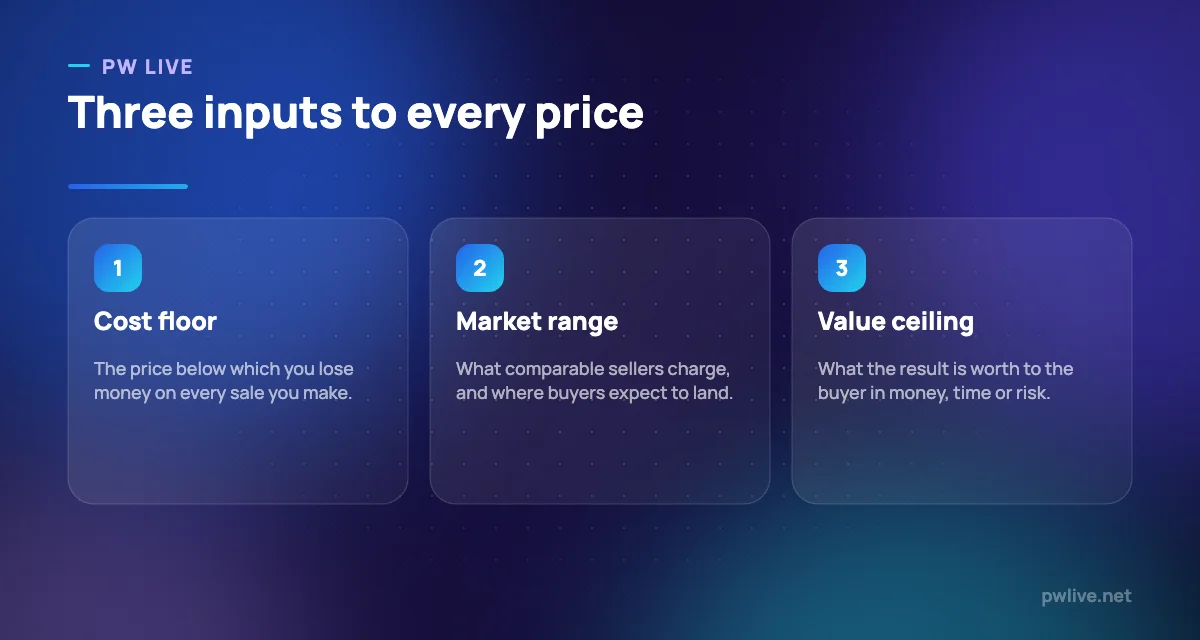
There is a better method, and it does not require an accountant. You work out three numbers, put your price between them, then test it deliberately rather than agonising over it.
This guide covers the arithmetic, the psychology and the practical scripts for raising a price you already set too low.
Start with the cost floor, not the competition
Your floor is the price below which each sale makes you poorer. Work it out before you look at anyone else’s price list.
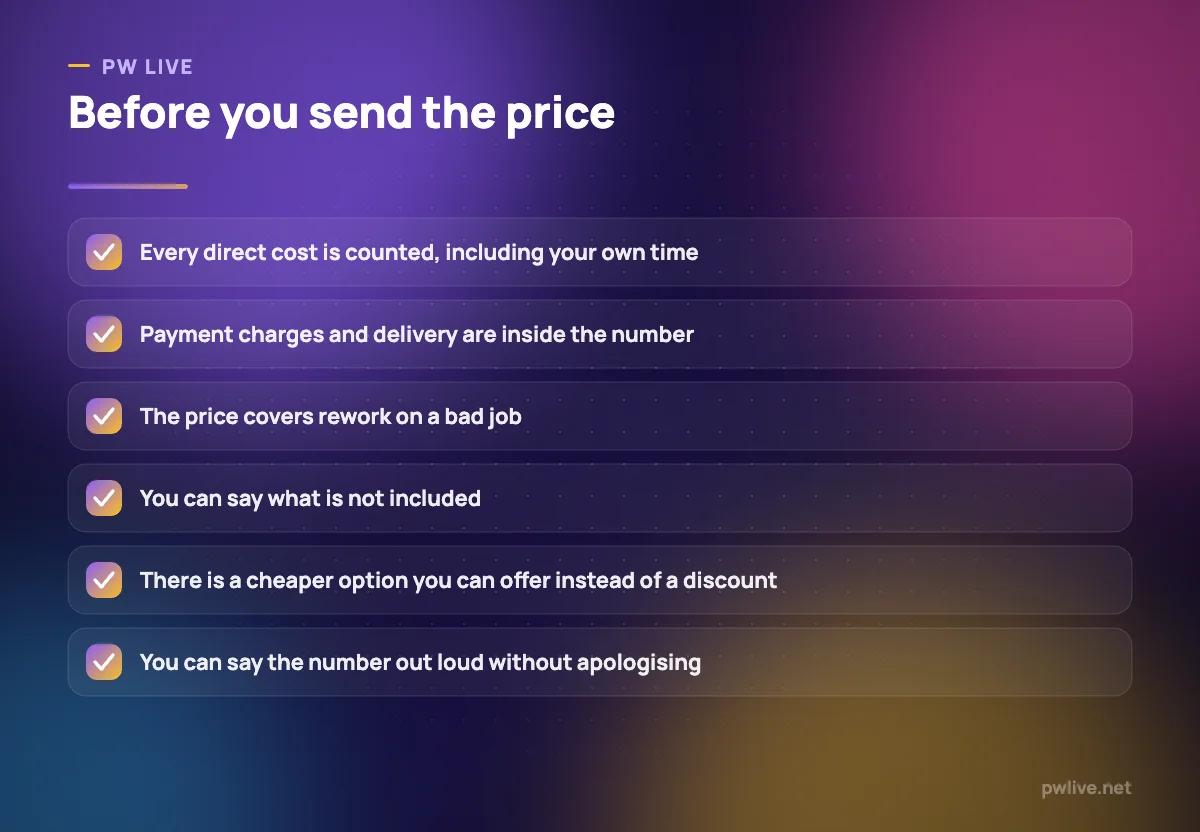
Count every direct cost of delivering one unit:
- Materials, ingredients or stock
- Packaging and delivery
- Payment gateway or platform charges
- Any subcontractor or freelancer you pay for that job
- Your own working time, valued at a rate you would accept from someone else
That last one is where most service businesses go wrong. If a job takes you six hours and you have not costed those hours, you have not priced the job, you have donated it.
Add a realistic allowance for waste, returns and the occasional job you have to redo. If one in ten orders needs fixing, your true cost per order is higher than the clean-run cost.
Then find the market range
Now look outward. Collect real prices, not impressions. Ask for quotes as a customer would, check published rate cards, look at marketplace listings for the same category.
Write down five to eight prices and note what each one includes. You will usually find a wide band rather than a single going rate, because sellers bundle different things.
Two things matter more than the average:
- The shape of the range. Is there a cheap cluster and a premium cluster, with a gap in the middle? That gap is often the most comfortable place to sit.
- What the expensive sellers include. Faster delivery, longer support, a guarantee, better packaging. Those are the levers that let you charge more without inventing anything.
Do not price at the bottom of the range as a strategy. The cheapest seller in any category is fighting a war of attrition, and a new business rarely has the reserves for it.
Work out what the result is worth to the buyer
The ceiling is set by value, not by your effort. A buyer does not care that a job took you three days. They care what changes for them afterwards.
Ask what the result is worth in one of three currencies:
- Money earned or saved. A better product photo that lifts sales. A repair that avoids replacing a machine.
- Time returned. Hours the buyer no longer spends on the task themselves.
- Risk removed. Fewer mistakes, less chance of a penalty, one less thing to worry about.
For business customers, you can often put a rough number on this and check it with them. If a monthly service saves a shop owner ten hours, and they value their own hours at 500 rupees, the service is plainly worth more than 2,000 rupees a month. Those figures are illustrative, but the conversation is real and worth having.
For consumer products, the value question is usually about the alternative: what would they otherwise buy, and what annoys them about it?
Choose a pricing model, not just a number
The model often matters more than the digits. Common options:
- Per unit or per item. Simple, easy to compare, best for physical goods.
- Per hour or per day. Honest for unpredictable work, but caps your income and punishes you for getting faster.
- Per project or fixed fee. Rewards speed and expertise, but you must define scope tightly.
- Retainer or subscription. Steady income, easier planning, and it makes each customer worth far more over time.
- Tiered packages. A small, standard and larger option, so buyers choose between yours and yours rather than yours and someone else’s.
If you currently sell hours, moving even one offer to a fixed fee or a monthly retainer changes your business more than any price rise would. Freelancers can see how this fits a wider client strategy in our guide to getting your first client as a freelancer.
Test the price instead of debating it
You cannot reason your way to the right number. You can test it in weeks.
- Set the price using the three inputs above and commit to it for a fixed run, say the next ten enquiries.
- Record the outcome of each: quoted, won, lost, and any reason given.
- If you win nearly everything, the price is too low. A win rate close to 100 percent almost always means you left money on the table.
- If you win almost nothing, look first at how the offer is presented, then at the number itself.
- Change one thing at a time and run another ten.
Keep the record in a simple sheet. Ten rows of real outcomes will teach you more than a month of second-guessing.
How to raise a price you set too low
Almost every business underprices at the start, and the fix is easier than it feels.
- Raise it for new customers first. No conversation required, and you learn quickly whether the new number holds.
- Give existing customers notice and a reason. A short, unapologetic message with a date works. Something like: from the first of next month, this service is priced at X, and here is what is now included.
- Change the package when you change the price. Adding one genuine improvement makes the increase easier for both sides.
- Expect to lose a few. If you raise prices and lose nobody, you were far too cheap. Losing the most demanding, least profitable customers is a good outcome, not a bad one.
- Never negotiate down without removing something. Cut the scope, not the rate, or you teach every future buyer to ask.
The words matter as much as the number. Practise saying the price plainly, then stopping. The silence after a price is uncomfortable for about two seconds and then it passes.
Watch the margin, not just the revenue
A price is only healthy if what remains after costs pays your bills. Track gross margin per sale and margin per hour of your own time, not just the total money coming in.
Two rules keep you honest:
- Recalculate your floor whenever a supplier price, a platform fee or your own time cost changes.
- Review your five most recent jobs each month and mark the ones where the real hours exceeded the quoted hours. That is where your pricing model is leaking.
For the full picture of how price, cost and customer acquisition fit together, read unit economics explained, and pair it with cash flow basics so a good margin does not turn into an empty bank account.
Better presentation also lets a higher price land more easily. Our guides to copywriting fundamentals and product descriptions that convert both help you explain value rather than list features. For more on running the business around the price, browse the business and entrepreneurship archive or the personal finance skill track.
Key takeaways
- Work out your cost floor before you look at competitors, and include your own time in it.
- Collect real market prices and note what the expensive sellers include, not just what they charge.
- Value is measured in money earned, time returned or risk removed for the buyer.
- The pricing model, per hour against fixed fee or retainer, often matters more than the number.
- Test a price across ten enquiries and record outcomes instead of guessing again.
- Winning every quote is a sign you are too cheap, not a sign you are doing well.
Frequently asked questions
Should I show prices publicly on my website?
Publishing at least a starting price filters out buyers who were never going to afford you and saves everyone time. If your work varies a lot, publish a from price or a typical range with an example of what it includes.
What if a competitor is much cheaper than me?
Compete on what your price includes rather than on the number. Speed, reliability, support and a clear guarantee are usually easier to deliver than being the cheapest, and they attract better customers.
How often should I review my prices?
Once or twice a year as a habit, and immediately whenever your input costs change. A price that stays fixed for years quietly shrinks as your own costs rise.
Is offering a discount ever a good idea?
A discount tied to something you get in return, such as a bulk order, upfront payment or a longer commitment, is fine. An unconditional discount just resets your price to a lower number in the buyer’s mind.
Keep learning with PW Live
Browse every guide in Business & Entrepreneurship, or pick a skill track and follow the roadmap step by step.





Leave a Reply