
Most people lose interviews they were qualified for because their job interview preparation stopped at reading the job description twice. The candidate who gets the offer is rarely the smartest one in the pipeline. It is usually the one who arrived with specific examples ready and could explain why this role, at this company, made sense.
The good news is that interview preparation is a checklist, not a talent. You can work through it in about five focused hours spread across a week.
This guide gives you that checklist: what to research, what to rehearse, what to carry, and what to do in the twenty minutes before you walk in.
Start by decoding the job description
The job description is the marking scheme. Before anything else, paste it into a document and mark it up.
Look for the requirements that appear more than once, or that appear in both the responsibilities and the requirements section. Those are the real priorities. A posting that mentions “working with stakeholders” three times is telling you that half the interview will be about communication.
Then build a two-column table. In the left column, write each requirement. In the right column, write one specific thing you have actually done that demonstrates it. A college project, a part-time job, a freelance task, a club you organised, a course you completed and applied.
If a row is empty, do not invent something to fill it. Instead, prepare an honest line: what you have done that is closest, and how quickly you have picked up similar things before. Interviewers respect a candidate who says “I have not used that tool, but I learned the neighbouring one in three weeks and here is what I built with it.”
Research the company until you can explain it in one sentence
Surface-level research is obvious to interviewers. Deep research is rare and memorable.
Work through these in order:
- The product or service. Use it if you can. Sign up for the free tier, read the pricing page, click through the app. Note one thing you liked and one thing that confused you.
- The website’s own words. Read the About page, the careers page and the two most recent blog posts or announcements. Companies describe their priorities honestly in their own marketing.
- The people. Look up your interviewer on LinkedIn if you know their name. Not to flatter them, but to understand whether you are speaking to an engineer, a founder or an HR generalist. The same answer needs different depth for each.
- The market. Identify who else does something similar. You do not need a competitive analysis, only enough to ask an intelligent question.
The test is simple: can you finish the sentence “This company helps ___ do ___ so that ___”? If you can, you are ahead of most of the pipeline.
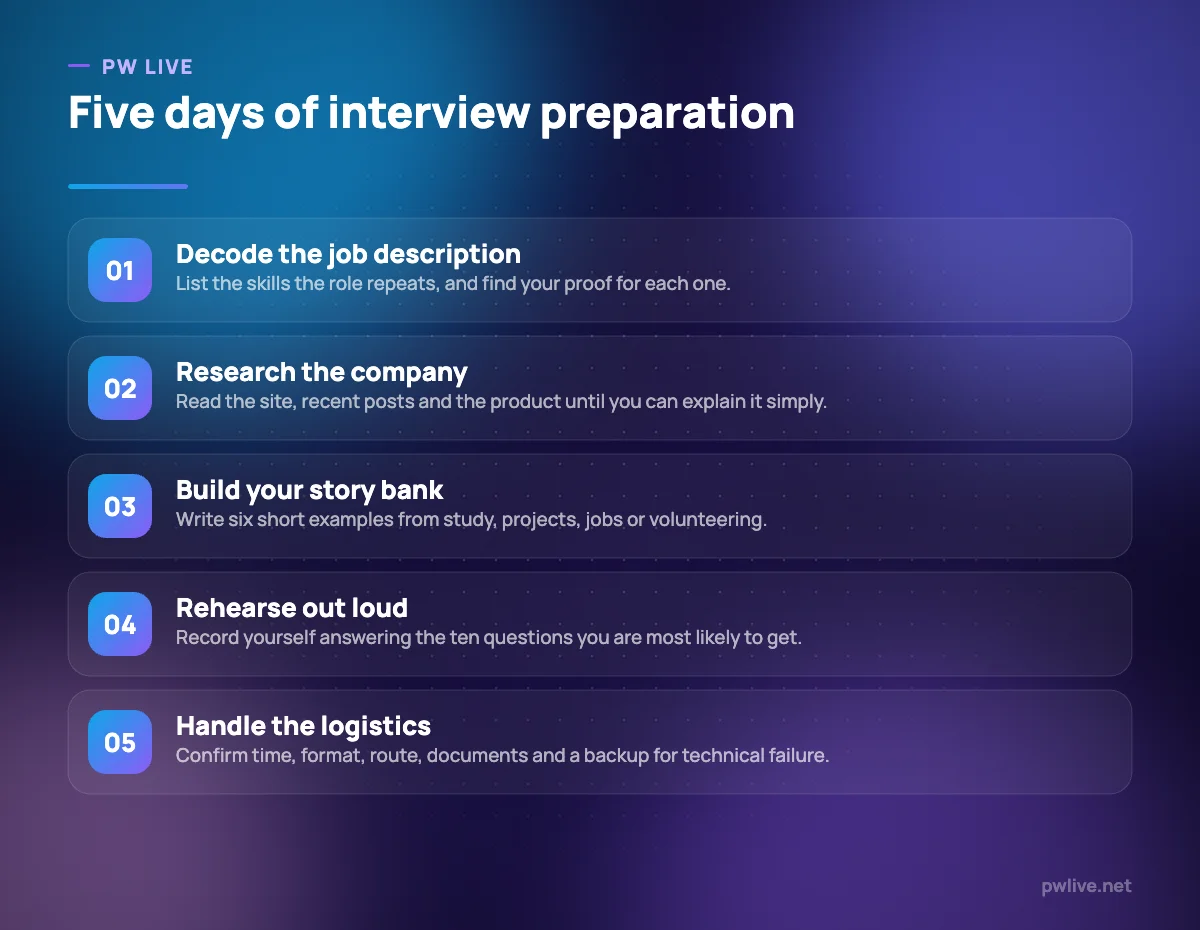
Build a story bank of six examples
Almost every behavioural question is asking for a story. Rather than preparing fifty answers, prepare six flexible stories that you can reshape.
Aim for one story each covering:
- A time you solved a difficult problem
- A time you worked with people who disagreed with you
- A time you failed or made a mistake
- A time you learned something quickly under pressure
- A time you led or took initiative without being asked
- Something you built or delivered that you are genuinely proud of
Write each one in four beats: the situation, what you specifically had to do, the actions you took, and the outcome. Keep the actions section longest, since that is the part interviewers are assessing. Aim for roughly ninety seconds spoken.
Everything in these stories must be true. Exaggerating a role you did not have is the fastest way to fall apart under a follow-up question, and follow-up questions always come. If your contribution was one part of a team effort, say so and describe your part precisely. That is more impressive than a vague claim of ownership.
Rehearse the questions you can predict
You can predict most of an interview. Prepare spoken answers for the opening question about yourself, why this role, why this company, your strengths, a weakness you are actively working on, and where you want to be in a few years.
Our guide to answering the tell me about yourself question covers the opener in detail, and it matters more than any other single answer because it sets the tone.
Rehearse out loud, not in your head. Record a voice note and play it back. You will immediately hear the filler words, the sentences that never end, and the places where you undersell yourself. Two rounds of this beats ten rounds of silent reading.
If nerves are your main obstacle rather than content, the techniques in our guide on what actually helps with performance anxiety transfer directly from exam halls to interview rooms.
Prepare the technical or role-specific round
For technical roles, the interview usually includes a live problem, a case, or a portfolio walkthrough.
- Coding or technical roles: practise explaining your thinking out loud while you work. Silence reads as being stuck. If you have limited work history, a strong portfolio does the convincing for you, and our guide to building a portfolio with no experience shows how to assemble one.
- Business, marketing or operations roles: expect a case or a “how would you approach this” question. Structure beats brilliance. Say what you would measure, what you would try first, and how you would know it worked.
- Any role: be ready to walk through one thing on your resume in detail, including the parts that did not go well.
Employers increasingly assess what you can demonstrate rather than what you list, a shift explored in our piece on skill-based hiring in India.
Prepare questions to ask them
“Do you have any questions for us?” is a real question, not a formality. Having none suggests you are not evaluating the job as seriously as they are evaluating you.
Prepare three, and make them specific:
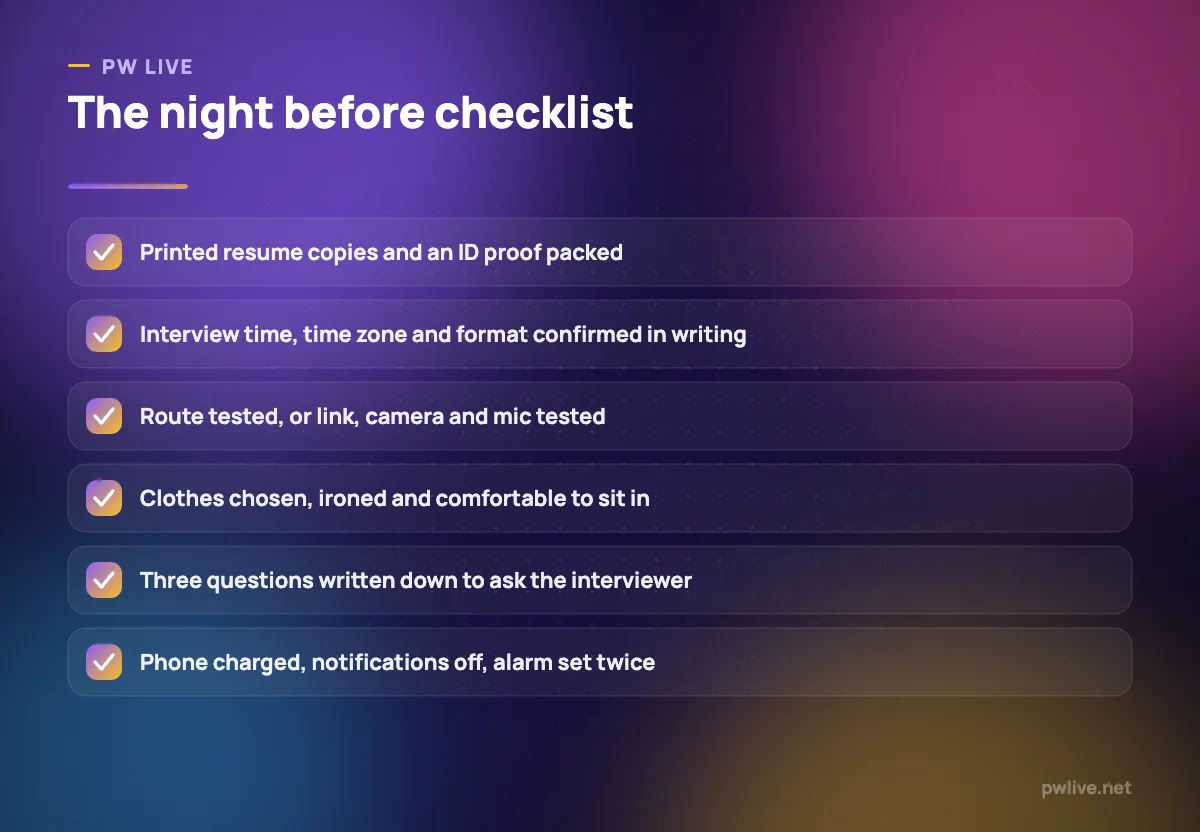
- What does success in this role look like in the first six months?
- What is the biggest challenge the person in this role will face?
- How does the team decide what to work on next?
Avoid asking about leave policy or salary in a first round unless the interviewer opens that door. Save it for the offer conversation, where you will have more leverage. Our guide to negotiating your first salary explains the right moment to raise it.
Handle the day itself
Logistics failures ruin otherwise strong candidates.
For an in-person interview, plan to arrive in the area thirty minutes early and enter the building ten minutes before the scheduled time. Carry printed copies of your resume, an ID, and a pen and notebook.
For a video interview, test the link, camera, microphone and internet on the same device you will use, at the same time of day if possible. Sit facing a window or a lamp rather than with a bright window behind you. Keep your phone charged as a hotspot backup.
In the last twenty minutes, stop revising. Re-read your two-column table, drink water, and breathe slowly for two minutes. Cramming right before an interview makes you sound rehearsed rather than prepared.
Afterwards, send a short thank-you email within a day. Three sentences: thanks, one specific thing from the conversation you found interesting, and a line reaffirming your interest. It costs nothing and very few candidates do it.
For more on how the whole hiring journey fits together, browse the rest of our career and jobs articles, or work through the structured career readiness skill track.
Key takeaways
- Treat the job description as a marking scheme and map every requirement to real evidence you can describe.
- Research the company until you can explain what it does and for whom in a single sentence.
- Prepare six honest stories rather than fifty scripted answers, and rehearse them out loud.
- Never inflate your role in an example, because follow-up questions expose it immediately.
- Bring three specific questions of your own, and treat logistics as part of the preparation.
Frequently asked questions
How long should I spend preparing for one interview?
Around four to six focused hours for a role you genuinely want, spread over several days. Concentrated preparation the night before produces stiff, memorised answers rather than confident ones.
What should I say when I do not know the answer?
Say so plainly, then show your thinking: what you would do to find out, or the closest thing you do know. Interviewers are testing honesty and reasoning as much as knowledge.
Is it acceptable to keep notes during a video interview?
Yes, a short bullet list of your key points and your questions is fine and normal. Reading full sentences off a script is obvious and works against you.
How do I follow up if I hear nothing back?
Wait until the date they mentioned, then send one polite email restating your interest and asking about the timeline. One follow-up is professional; three in a week is not.
Keep learning with PW Live
Browse every guide in Career & Jobs, or pick a skill track and follow the roadmap step by step.





Leave a Reply