

Choosing products to sell online is the decision that quietly determines how hard the rest of your business will be. A good product forgives an average website and clumsy marketing. A bad product punishes even excellent execution, because no amount of advertising fixes a thin margin or a returns rate you cannot survive.
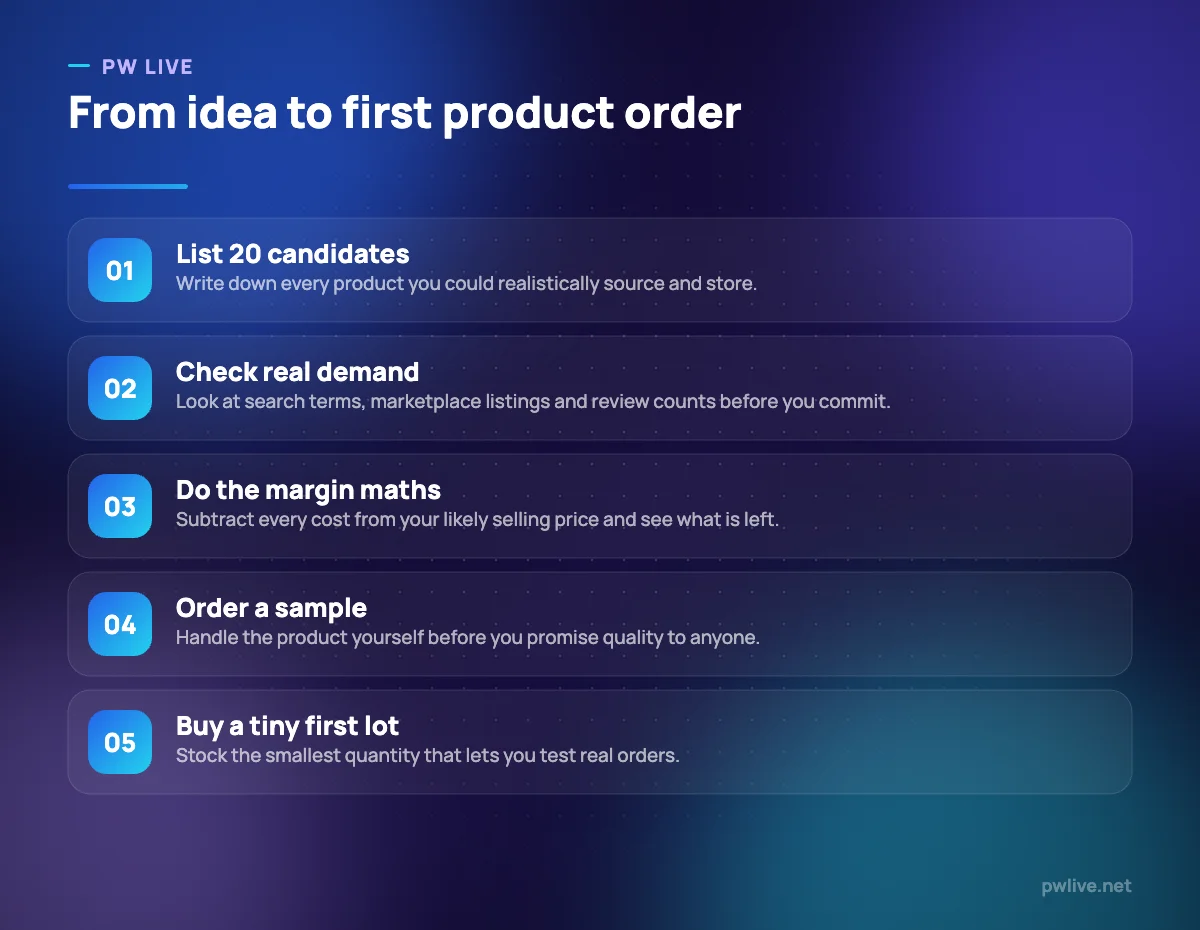
Most first-time sellers pick a product because they like it, or because someone said the category was hot. Both are guesses. What you want instead is a short, repeatable filter that tests demand, cost, logistics and competition before you spend money on stock.
This guide gives you that filter. Work through it with a spreadsheet open and a pen, and you should end up with one product you can start with rather than twenty you keep debating.
Start with what you can actually source
Before you think about demand, think about supply. The most common way a new seller gets stuck is falling in love with a product they have no reliable route to buy.
Ask three questions about every idea. Can you buy it in small quantities to begin with? Can you reorder within a couple of weeks? Do you know who is making it, or are you buying blind from a listing photo?
Your realistic sourcing routes usually look like this:
- Local wholesale markets and manufacturing clusters. Slow to research, but you can inspect goods and negotiate.
- Domestic wholesale and B2B platforms. Convenient, but verify with a sample order before you scale.
- Making the product yourself. Highest control and margin, lowest scale. Good for handmade, print, food and craft categories.
- White-label or private-label suppliers. You put your brand on an existing product. Watch the minimum order quantity.
- Print on demand or dropshipping. Almost no upfront stock, but the margin is thin and you do not control quality or delivery time.
If you cannot describe your supply route in one sentence, the idea is not ready yet.
Test demand before you trust your instinct
Demand research does not need paid tools. It needs an hour and a sceptical mind.
Type the product name into a search engine and look at what fills the first page. Are people asking questions about it, comparing versions, looking for a specific size or material? That is buying intent. If the only results are generic category pages, the demand may be shallow.
Then go to two or three large marketplaces and search the same term. Read the listings that rank near the top. Look at how many reviews they carry, what buyers complain about repeatedly and what the price band looks like from cheapest to most expensive.
Reviews are the single most useful free research source you have. A recurring complaint is a product feature you can fix. Our guide to keyword research without expensive tools shows how to turn those phrases into the terms real buyers type.
Do the margin maths before anything else
A product is only viable if there is money left after every cost, not just after the cost of goods. Write the full list down.
- Cost of the product itself, including transport to you.
- Packaging: box, filler, tape, label, any insert.
- Shipping to the customer, or the courier rate a marketplace deducts.
- Platform commission, payment gateway charges and any fixed per-order fees.
- Returns and damage, spread across all orders as a realistic percentage you estimate.
- Marketing cost per order, once you start advertising.
- Taxes that apply to your sale.
Marketplace commissions vary by category and change over time, and shipping is charged by weight and distance, so pull the current numbers from the platform’s own seller fee page and your courier’s rate card rather than from a blog. Then rebuild the maths with your real figures.
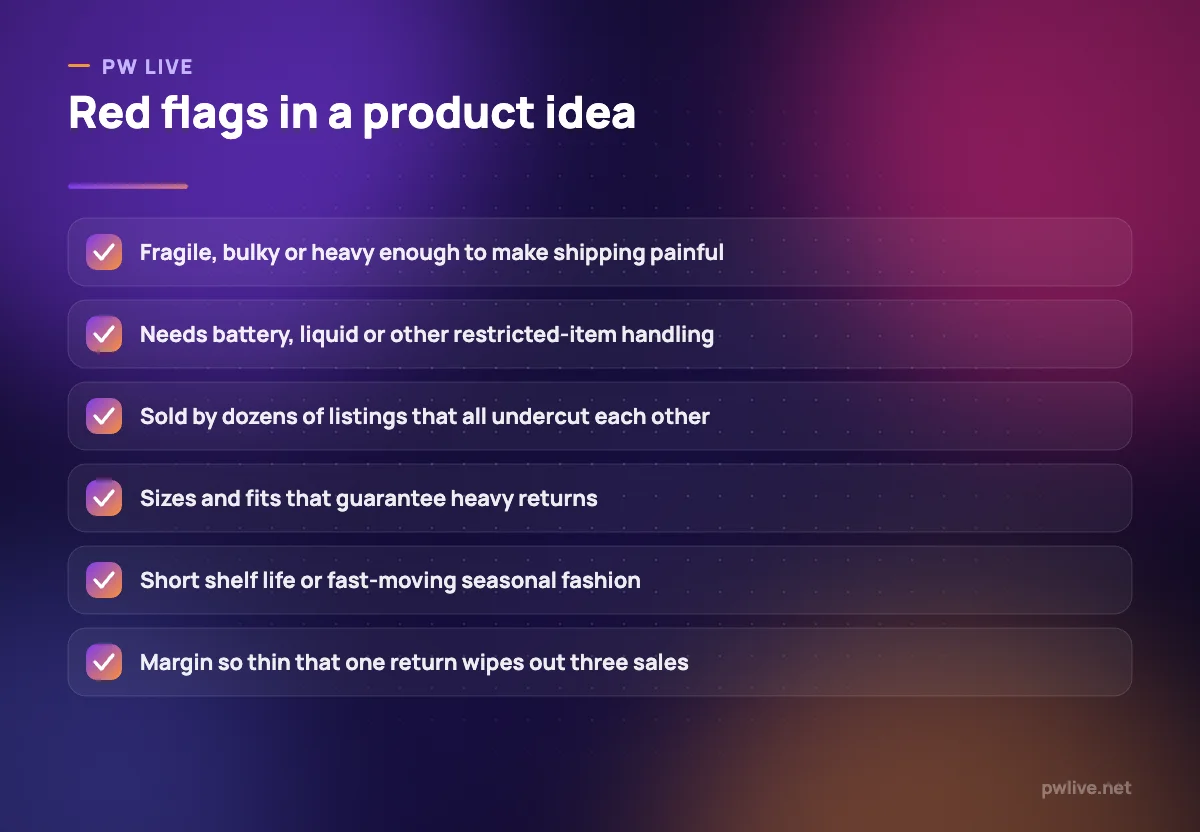
What is left is your contribution per order. If that number is small, a single return can erase the profit from several sales. Unit economics explained walks through the same calculation in more depth, and how to price your product without guessing covers what to do when the number comes out too low.
Prefer products that ship easily
Logistics quietly eats margin. Two products with identical purchase costs can have very different economics once you weigh and measure them.
Favour items that are light, compact, hard to break and not restricted for air transport. Avoid glass, liquids, lithium batteries and anything with an awkward shape until you have experience.
Also think about volumetric weight: couriers charge on whichever is higher, actual weight or the space the parcel occupies. A large box of light cushions can cost more to ship than a small box of heavy tools. Our logistics basics for Indian sellers explains how that pricing works.
Look honestly at the competition
Competition is not a reason to avoid a product. Zero competition usually means zero demand. What you are looking for is a gap you can defend.
Ask what you would do differently. Better photography, a clearer size guide, a bundle nobody offers, faster dispatch, a colour or variant that is always out of stock elsewhere. If your only answer is “sell it cheaper”, you are entering a race you will lose to whoever has deeper pockets.
Categories dominated by a handful of very large brands with heavy advertising are hard for a first product. Categories with many small sellers and inconsistent listing quality are usually more welcoming.
Check the rules before you buy stock
Some categories carry obligations that are easy to miss and expensive to discover late.
- Food, cosmetics and supplements carry licensing and labelling requirements.
- Electronics and toys may need safety or standards certification.
- Packaged goods generally require declarations such as manufacturer details, quantity and country of origin.
- Anything you import brings customs duty and documentation into your cost sheet.
Requirements change, so confirm what applies to your category on the relevant government portal or with a professional before you place a purchase order. Our overview of GST and compliance basics for online sellers covers the tax side at a high level.
Test with the smallest order you can
The final step is not a decision, it is an experiment. Buy the smallest quantity your supplier will sell you, list it properly, and try to sell it.
Give yourself a clear read on three things: does it sell at the price you planned, how many buyers return it, and what do they say in messages and reviews. Twenty real orders teach you more than a month of research.
If it works, reorder more. If it does not, you have lost a small amount of money and gained a genuine answer. That is the whole point of starting small, and it is the same discipline described in how to validate a business idea before you spend a rupee.
Build a repeatable process, not a lucky guess
Your first product rarely becomes your best product. Sellers who last are the ones who run this filter again every few months, keep what works and quietly drop what does not.
Keep a simple spreadsheet with one row per idea and columns for demand signal, landed cost, shipping difficulty, competition and compliance. Score each out of five. Over a year, that sheet becomes the most valuable asset in your business. For more on the surrounding skills, browse the e-commerce and retail archive or the digital marketing skill track.
Key takeaways
- Sourcing comes first: if you cannot restock reliably in small quantities, the idea is not viable yet.
- Use search results and marketplace reviews as free demand research, and read complaints as product briefs.
- Calculate margin after every cost, including packaging, commissions, returns and marketing, using current rates from the platform itself.
- Favour light, sturdy, unrestricted products and check volumetric weight before committing.
- Confirm category-specific licensing and labelling rules before you place a purchase order.
- Test with the smallest possible first lot and let twenty real orders decide, not your enthusiasm.
Frequently asked questions
How many products should I start with?
One to three closely related products is plenty. A narrow range keeps your photography, packaging and customer answers consistent, and it makes stock decisions far simpler while you are learning.
Is dropshipping a good way to begin?
It lowers upfront risk because you hold no stock, but you give up control over quality and delivery time, and margins are usually thin. Treat it as a way to test demand, not as a long-term plan.
Should I sell something I am personally interested in?
Interest helps, because you will understand buyers and stay motivated through slow months. It is not enough on its own, so run the same demand, margin and logistics checks you would apply to any other idea.
How do I know if a category is too competitive?
Look for many listings at similar low prices with little to distinguish them. If you cannot name one thing you would do better than the top sellers, choose a different product or a narrower niche within it.
Keep learning with PW Live
Browse every guide in E-commerce & Retail, or pick a skill track and follow the roadmap step by step.





Leave a Reply