

Getting your first 100 orders is the hardest stretch in any online business. You have no reviews, no ranking, no audience and no proof. Everything that makes selling easy later is a result of orders you have not made yet.
The way through is not a clever growth tactic. It is doing several unglamorous things at once, in a deliberate order, and staying consistent long enough for them to compound.
This guide lays out the sequence that works for most small sellers, from the first ten orders to the point where sales arrive without you chasing each one.
Orders one to ten: your own network
Your first orders will come from people who already trust you. That is not cheating, it is how every small business starts.
Message people individually rather than posting once to a group. A personal message asking whether a specific person would find the product useful converts far better than a broadcast nobody feels responsible for answering.
Be direct about what you want. You need real orders at real prices, honest feedback and, if they are happy, permission to use a photo or a line of what they said.
- Send individual messages, not mass forwards.
- Ask for the sale plainly, and accept a no without pressure.
- Charge full price, or a small launch discount at most. Free samples teach you nothing about willingness to pay.
- After delivery, ask two questions: what nearly stopped you buying, and what would you tell a friend about it.
Those answers rewrite your product page. The same approach is covered in more depth in how to find your first ten customers.
Get where buyers are already searching
Your network runs out quickly. The next block of orders should come from people who are already looking for what you sell.
A marketplace listing puts your product in front of intent-driven traffic on day one. You pay commission for that, but at this stage you are buying proof and reviews, which are worth more than the margin. See marketplace vs own website for how to think about the trade-off.
To actually get seen there:
- Fill every attribute field, not just the required ones. Filters are how buyers narrow a category.
- Use the words buyers type in your title, once, in a natural sentence.
- Upload the full set of images, including a scale shot.
- Price near, not far below, the visible band for similar products.
- Keep your dispatch time promise, since delivery performance affects visibility on most platforms.
Two of our guides do a lot of the work here: product descriptions that convert and how to take good product photos with a phone.
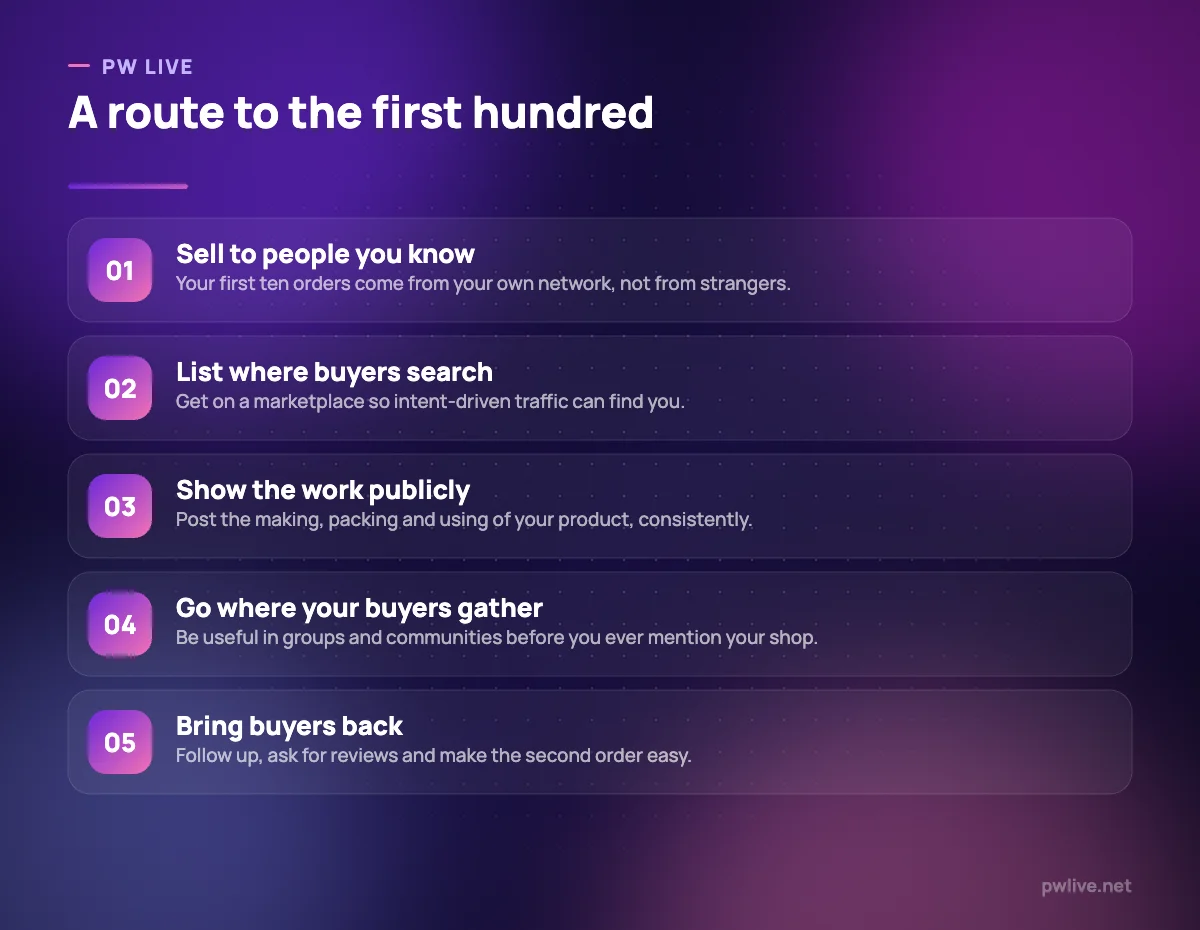
Show the work, publicly and repeatedly
Content is how you create demand rather than compete for it. For a small seller with no budget, the most effective content is not polished advertising. It is documentation.
Post the things you find ordinary: sourcing the materials, a batch being made, packing an order, a customer’s parcel going out, a mistake and how you fixed it. People follow process, and process builds the familiarity that leads to a purchase weeks later.
Practical rules that keep this sustainable:
- Pick one platform where your buyers actually spend time, and go deep before adding a second.
- Post at a rhythm you can maintain for six months, even if that is twice a week.
- Show the product in use far more often than you show a price.
- Reply to every comment and message. Early on, conversations convert better than reach.
- Put a working link to buy in your profile and mention it without apology.
For the wider approach, see social media strategy for small businesses on a small budget.
Be useful where your buyers already gather
Communities are the most underused source of early orders, and the easiest to get wrong.
Find the groups, forums and local networks where your buyers discuss the problem your product solves. Then spend weeks being genuinely helpful before you mention what you sell. Answer questions properly, share what you have learned, and let your profile do the selling.
When you do mention your product, do it where it is welcome: a launch thread, a self-promotion day, a direct question about where to buy something. Being thrown out of a community for spamming costs you more than the orders it might have produced.
Local matters too. Neighbourhood groups, college networks, weekend markets and small exhibitions put a physical product in people’s hands, which no photograph can match.
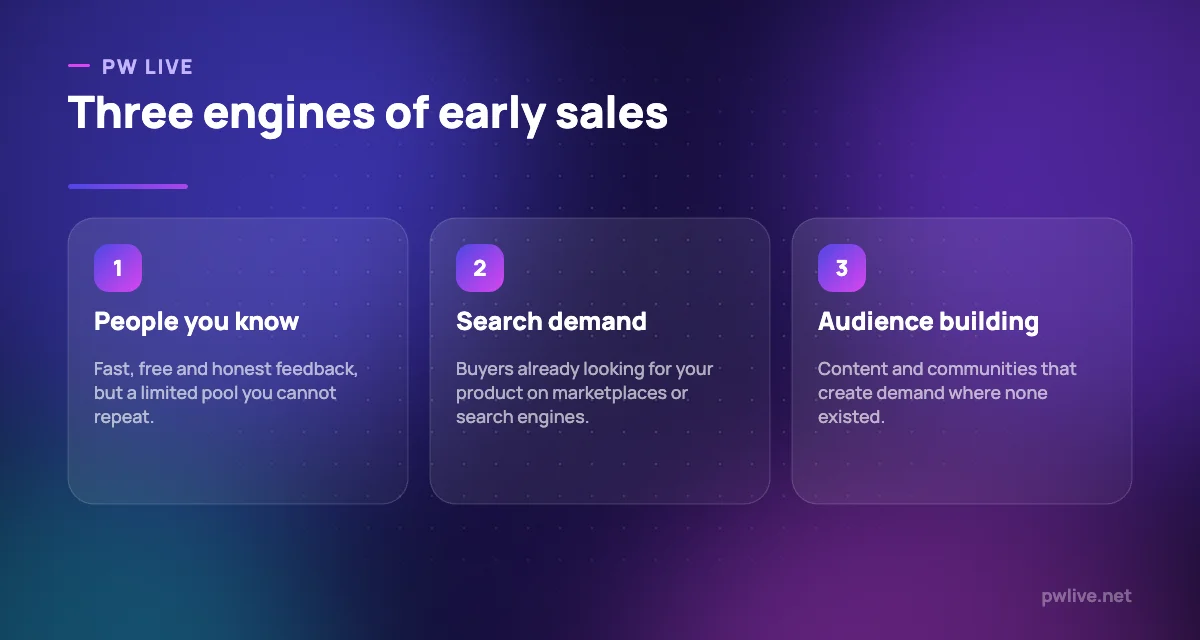
Turn search into a slow, compounding channel
Search takes months to work, which is exactly why you should start it now rather than when you need it.
If you have your own site, write pages that answer the questions buyers ask before they choose a product in your category. Comparison pages, how-to-choose guides, care and maintenance advice, sizing help. Each one gets found by someone earlier in the buying process than a product page reaches.
On marketplaces, the equivalent is optimising your listing copy, attributes and images so the platform’s own search shows you more often. Our guides to SEO for beginners and keyword research without expensive tools cover both sides.
Do not expect this channel to deliver in your first month. Expect it to deliver in your sixth, and every month after.
Collect reviews deliberately
Reviews are the mechanism that turns your first orders into your next ones. Nothing else moves conversion as much for an unknown seller.
Ask every buyer, once, a few days after delivery. Keep it short and human, mention that you are a small business and that reviews genuinely help, and make it one tap to do.
Two important limits. Follow the platform’s rules exactly, which generally prohibit incentivised or exchanged reviews. And never write or buy fake reviews, which is dishonest, usually against platform policy, and increasingly detectable.
Include a small printed note in the parcel thanking the buyer and explaining how to get help. It lifts both reviews and repeat orders, and it reduces angry messages.
Make the second order easier than the first
Around order forty, most sellers realise something uncomfortable. Chasing new buyers forever is exhausting, and repeat buyers are far cheaper.
Start building for repeats immediately:
- Collect email addresses or phone numbers with consent, and send an occasional useful message rather than constant offers.
- Follow up when a consumable would be running out.
- Offer a bundle or a refill that only makes sense to someone who already owns the first product.
- Fix problems generously. A well-handled complaint produces more loyalty than a smooth order.
Email marketing basics covers how to run this without a large tool budget.
Track what is actually working
Keep a single sheet with one row per week: orders, revenue, and where each order came from. Ask every buyer, or infer it from links and channels.
After a month you will see that one or two sources produce most orders and the rest produce almost none. Put your hours into the ones that work rather than spreading yourself thin across five channels out of anxiety.
Watch three numbers: orders per week, repeat purchase rate and cost per order once you start spending on ads. Marketing metrics that matter explains what to do with them, and the e-commerce category has more on the operational side. If marketing itself is the gap, work through the digital marketing skill track.
Key takeaways
- Your first ten orders come from individual messages to people you know, at full price, with honest feedback attached.
- Marketplaces give you intent-driven traffic and early reviews, which are worth more than the commission at this stage.
- Document your process publicly on one platform, at a rhythm you can sustain for six months.
- Be genuinely useful in communities long before you mention what you sell.
- Ask every buyer for a review within the platform’s rules, and never buy or incentivise them.
- Build for repeat orders from the start, and track which channel each order came from so you can drop what does not work.
Frequently asked questions
How long should the first 100 orders take?
There is no standard answer, and it varies enormously by product, price and channel. Judge yourself on consistency of effort and on whether orders per week are trending up, rather than on a deadline.
Should I run paid ads to get started?
Usually not first. Ads amplify a page that already converts, so fix your photos, description and price with organic orders before spending, or you will pay to send traffic to a page that is not ready.
Is discounting a good way to get early orders?
A small launch offer is fine, but heavy discounting attracts buyers who will not return at full price and trains your audience to wait. Improving the listing usually beats cutting the price.
What if I get orders but people keep returning items?
Treat that as a listing problem before an operational one. Add exact measurements, a scale photo and an honest note about fit, colour or assembly, then check whether the return rate falls.
Keep learning with PW Live
Browse every guide in E-commerce & Retail, or pick a skill track and follow the roadmap step by step.





Leave a Reply