

A simple exercise routine for students has to survive coaching classes, deadlines and revision weeks, which is why most ambitious plans die by the second Wednesday. The problem is rarely motivation. It is that the plan was built for a life you do not have.
You do not need a gym, a trainer or an hour a day. You need something short enough that skipping it takes more effort than doing it, and useful enough that you notice the difference in your focus.
This guide gives you a routine you can start today with no equipment, plus a way to keep it going through your busiest month.
Why movement helps studying, not just fitness
The strongest argument for exercise as a student is not appearance. It is that movement changes how the rest of your day feels.
Regular activity generally helps with energy through the afternoon, sleep quality at night, and the restless tension that builds during long sitting sessions. It also breaks the mental loop that revision can trap you in, which is why so many people solve a problem on a walk that they could not solve at the desk.
Set aside any weight or body-shape framing here. The goal is a body that can sit through a long paper without aching and a mind that can concentrate after lunch. That is it.
Start smaller than feels serious
Almost every failed routine starts too big. An hour a day, six days a week, from a standing start, in the middle of an exam term.
Start with something you would be slightly embarrassed to call a workout. Ten minutes. Five, on the worst days. The point of the first few weeks is not fitness gains, it is proving to yourself that this is something you do.
Once the habit exists, adding time is easy. Adding a habit that does not exist is the hard part, which is the same principle behind our guide to building habits that stick.
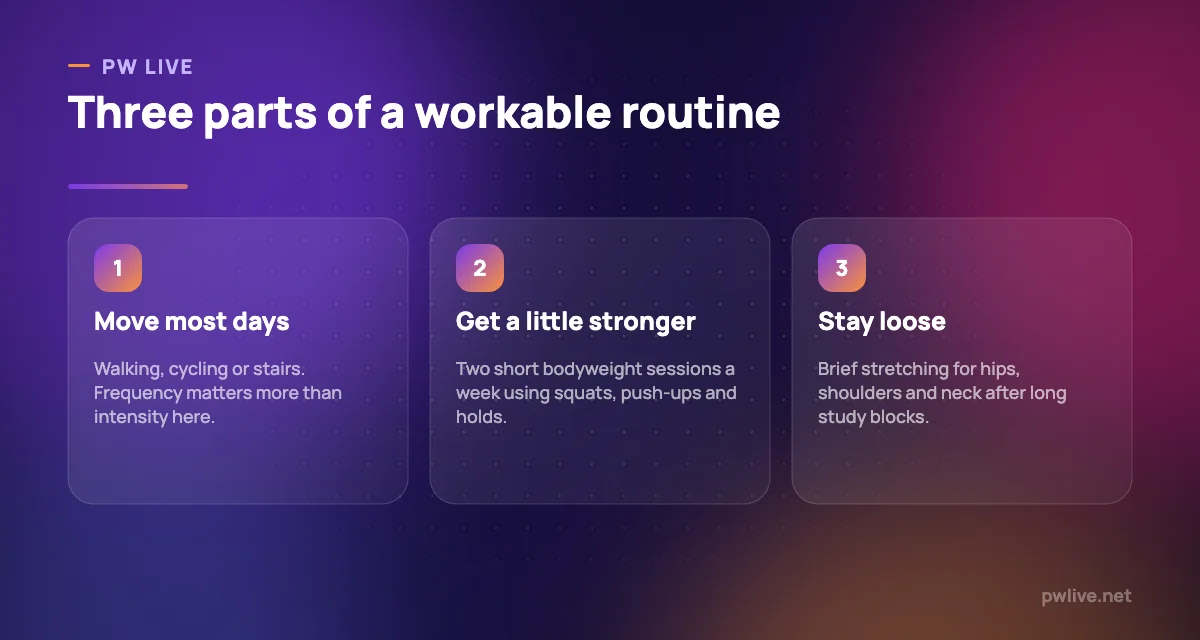
A no-equipment routine you can start today
Here is a plain structure. Adapt the numbers to your own level, and stop any movement that causes pain rather than effort.
- Daily walk. Ten to twenty minutes, ideally outside and ideally at the same time each day. Walking to a class, a shop or the end of your street all count.
- Strength, twice a week. Two or three rounds of squats, push-ups (on your knees or against a wall if needed), a plank hold and lunges. Rest as long as you need between rounds.
- Mobility, after long study blocks. Stand up, roll your shoulders, open your chest, stretch your hips and hamstrings, and move your neck slowly through its range.
- One thing you enjoy, weekly. Cricket, badminton, dancing, cycling with a friend. This is the part that keeps the rest alive.
That is a complete routine. It takes very little equipment, no membership and under three hours a week including the walking.
Making it harder over time
Progress does not need a spreadsheet. Add one repetition, one round, or a few minutes when the current version starts to feel comfortable. If a movement is too hard, reduce the range rather than abandoning it.
Fit it into a real student timetable
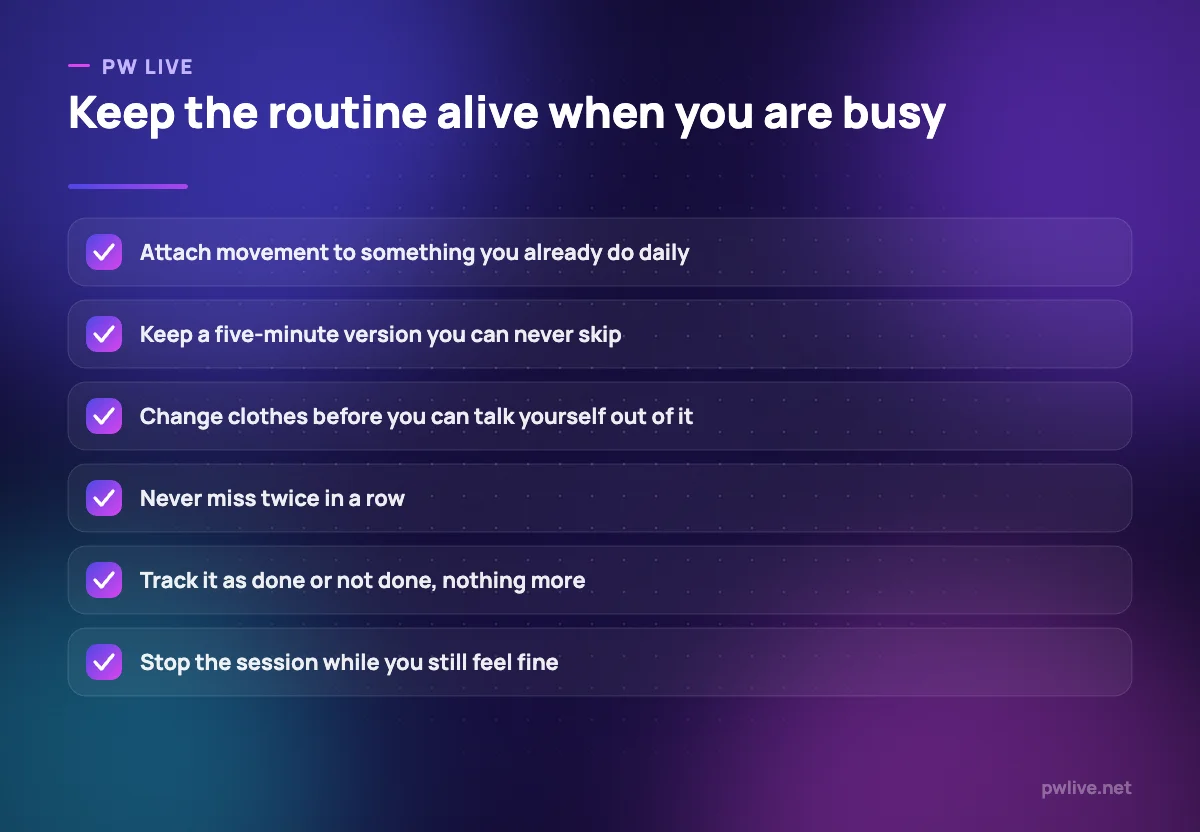
The best time to exercise is the time that survives contact with your actual week. For most students that means attaching movement to something already fixed.
- Walk during the gap between classes rather than sitting in the canteen the whole time.
- Do your strength session right after your first study block, when you are already at your desk and about to take a break anyway.
- Use the ten minutes while food is cooking for mobility work.
- Take stairs deliberately instead of counting on a separate session later.
If your day is already tightly planned, slot movement in as a fixed block using the approach in our time blocking guide, and think of it as recovery rather than an extra task. Our piece on how to manage your energy, not just your time explains why a short walk often buys back more study time than it costs.
Study breaks that actually restore you
Most study breaks involve sitting in a different chair and scrolling. You return to your desk with the same stiff body and a more scattered mind.
A better break has three features: you stand up, you look at something further away than your screen, and you move for a few minutes. Even a lap of the building resets more than ten minutes of feed-scrolling.
This pairs naturally with fixing the physical side of studying. Long hours in a bad chair create the aches that make exercise feel impossible, so it is worth reading our guide on studying without back, neck and wrist pain alongside this one, and setting up your desk properly using our study space setup guide.
What to do during exam weeks
Exam periods are exactly when students drop exercise and exactly when it helps most. The answer is not to hold your normal routine. It is to shrink it deliberately.
Keep the daily walk. Cut strength sessions to one short one. Keep mobility after long sittings. That is a maintenance routine, and it takes almost nothing while protecting your sleep and your mood during the hardest weeks. Our exam stress and burnout guide covers the rest of the picture.
Decide the shrunken version in advance, on a calm day, so you are not negotiating with yourself at 11pm.
Common mistakes and how to avoid them
- All-or-nothing thinking. A five-minute session is not a failure. It is the thing that keeps the habit alive.
- Copying an advanced plan. Programmes designed for people who train daily will break a student schedule in a fortnight.
- Pushing through real pain. Effort is fine, sharp or persistent pain is a signal to stop and get it checked.
- Measuring the wrong thing. Track whether you did it, not how impressive it was.
- Restarting from zero after a gap. Missing a week means resuming, not starting again.
A word on limits. This is general wellbeing guidance, not personalised advice. If you have an existing health condition, an injury, chest pain, dizziness, or you feel unusually breathless or unwell during activity, speak to a doctor before continuing. And if low energy or low mood is making everything hard, not just exercise, please talk to a doctor, a counsellor, or a trusted adult or friend rather than trying to push through alone.
For more on building routines that hold up under pressure, browse the lifestyle and productivity archive or our productivity skill track.
Key takeaways
- Judge a routine by whether it survives a busy week, not by how impressive it looks.
- Start with ten minutes and a daily walk. Frequency beats intensity at the beginning.
- A complete routine needs three parts: daily movement, twice-weekly strength, and mobility after long sitting.
- Attach exercise to something already fixed in your day so it does not need fresh motivation.
- Shrink the routine during exam weeks instead of dropping it, and decide the shrunken version in advance.
- Stop for pain rather than effort, and speak to a doctor if difficulties persist or affect daily life.
Frequently asked questions
How much exercise do I actually need as a student?
Enough that you move most days and get slightly out of breath a few times a week. Consistency matters far more than any specific target, and something short done regularly beats an ambitious plan you abandon.
Can I exercise without any equipment or a gym?
Yes. Walking, stairs, squats, push-ups, lunges and planks cover the basics and need nothing but floor space. Equipment adds options later, but it is never the barrier at the start.
Is it better to exercise in the morning or the evening?
Whichever one you will actually do. Morning sessions are less likely to be squeezed out by the day, but an evening walk you keep is better than a dawn plan you skip.
Will exercising eat into my study time?
In practice it usually gives time back, because a short break with movement restores focus faster than sitting through a slump. Treat it as part of your study system rather than a competitor to it, as described in our deep work routine for students.
Keep learning with PW Live
Browse every guide in Health & Wellness, or pick a skill track and follow the roadmap step by step.





Leave a Reply