
The marketplace vs own website question stops more new sellers than any product decision. One route puts your listing in front of buyers who are already shopping. The other gives you a shop you fully control but nobody has heard of yet.
Both work. They fail in different ways, and the right answer depends on how much traffic you can generate, how much margin your product carries, and whether you are building a brand or simply moving stock.
This guide compares the two honestly, then gives you a decision test you can apply to your own situation today.
What you are really choosing between
Strip away the platform names and the choice is simple. On a marketplace you rent access to demand. On your own site you own the shop but must create demand yourself.
That single difference explains almost everything else: fee structures, how much branding you get, who owns the customer relationship, and how quickly you can be live.
A third option exists and is often overlooked. Social selling, where you take orders through messaging apps or social profiles and collect payment by a link or UPI, needs no store at all. It is a legitimate way to test a product before committing to either channel.
The case for starting on a marketplace
Marketplaces solve the hardest problem in early e-commerce: getting a stranger to buy from a seller they have never heard of.
- Traffic already exists. People arrive with intent to buy, not to browse.
- Trust is borrowed. Buyers trust the platform’s returns and payment process even when they do not know you.
- Logistics is often bundled. Pickup, tracking and returns handling come as part of the package.
- Setup is fast. You can go from registration to a live listing in days rather than weeks.
- Demand data is free. Search suggestions, competing listings and review complaints tell you what buyers want.
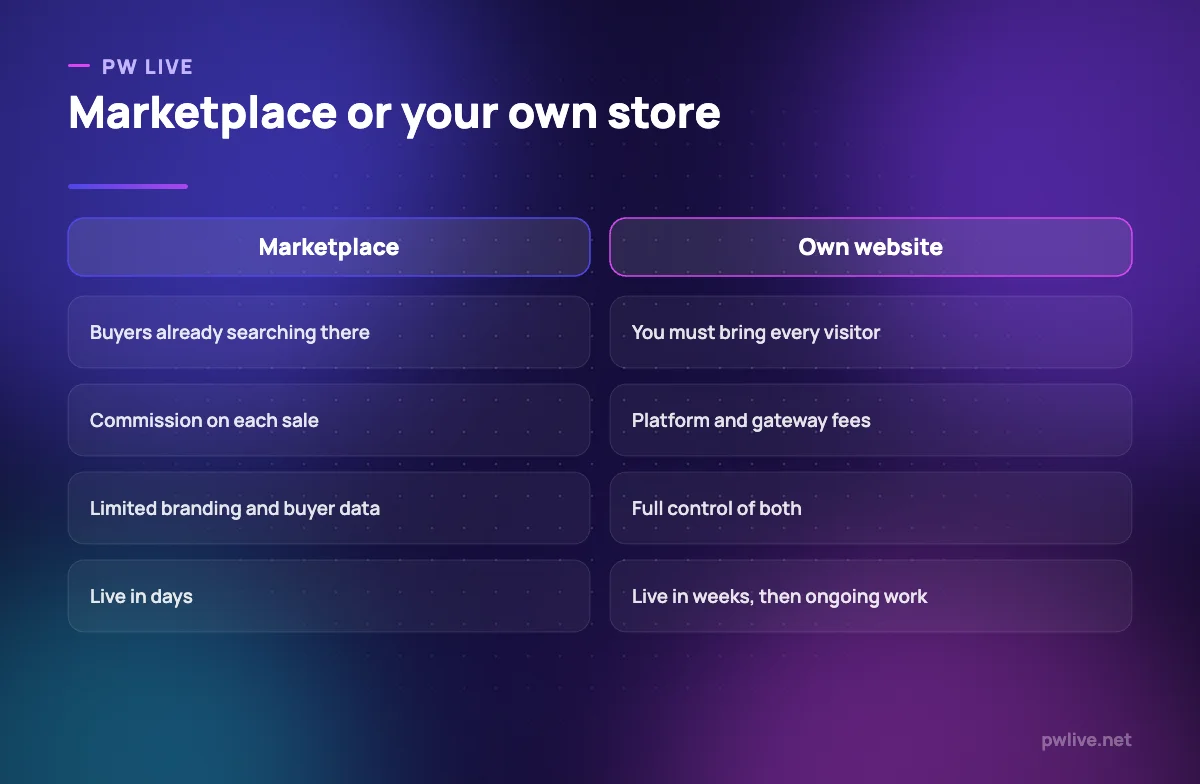
The trade-offs are real. You pay a commission on every sale, plus fulfilment and payment charges. Fee structures differ by category and change periodically, so read the platform’s own seller fee documentation rather than relying on a figure you saw quoted somewhere.
You also compete on a page full of alternatives, you get limited branding, and you rarely get full buyer contact details. If a listing is suspended, your revenue can stop the same day.
The case for your own website
Your own store flips every one of those trade-offs. You keep more of each sale, you control the whole experience, and you own the customer data that lets you sell again cheaply.
That last point matters most. Repeat buyers are the difference between a business and a treadmill. When you have email addresses and phone numbers you have consented permission to use, your second sale to the same person costs a fraction of the first.
You also control:
- Product presentation, bundles, storytelling and photography without template limits.
- Pricing and offers, without a price war on the same page.
- Checkout flow, which is where a lot of revenue is quietly lost. See how to reduce cart abandonment on your online store.
- The brand itself, which is the asset that survives a platform’s policy change.
The cost is traffic. Nobody visits a new domain by accident. You are now responsible for search, social, email and possibly paid advertising, which is a real skill set. Start with SEO for beginners and email marketing basics if this is the route you choose.
There is also a running cost. Platform subscription, domain, payment gateway charges, apps and your own time. On a small order volume, that can work out more expensive per sale than a commission.
A decision test you can run today
Answer these five questions honestly and the answer usually becomes obvious.
- Can you bring traffic? If you already have an audience, a following, a mailing list or a local customer base, your own site is viable from day one.
- What is your margin? Thin margins struggle to absorb both commissions and advertising. Higher-margin products can afford either.
- Is your product searched for by name? Commodity items get found on marketplaces. Distinctive or design-led products can build their own audience.
- Do you want repeat purchases? Consumables, refills and anything bought monthly reward owning the customer relationship.
- How much time do you have each week? A marketplace listing is maintainable in a few hours. A store plus marketing is closer to a part-time job.
If you scored mostly on the traffic and margin side, start with your own store. If not, start where the buyers already are.
Why most small sellers end up doing both
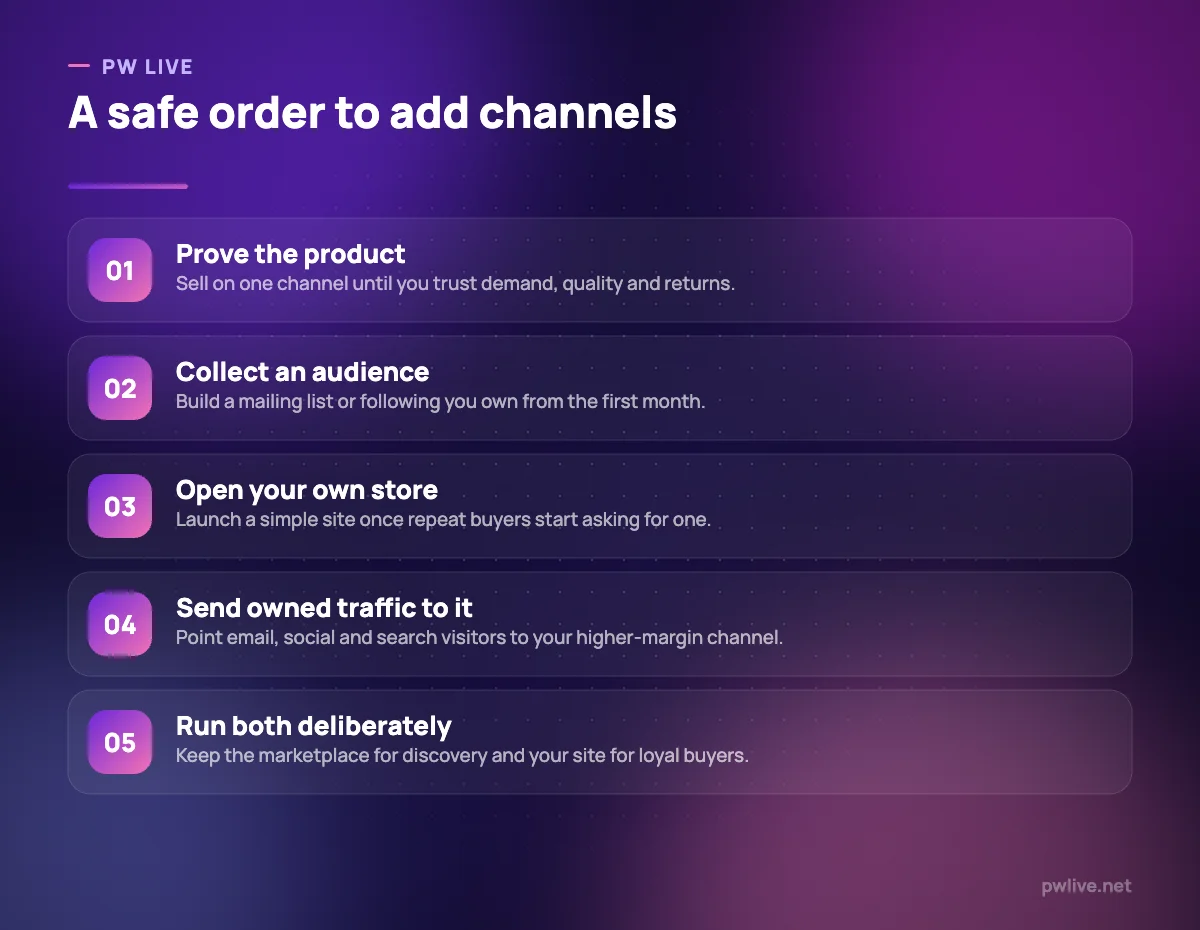
The channels are not rivals. Used together, each covers the other’s weakness.
The common pattern is to use a marketplace for discovery, where new buyers find you, and your own site for loyalty, where repeat buyers get better bundles and you keep more margin. A card or insert in every marketplace parcel that invites the buyer to follow you or join your list, within the platform’s rules, quietly builds the audience you will need later.
Watch two things when you run both. Keep pricing and stock consistent so you do not oversell an item you no longer have, and check each platform’s rules on directing buyers elsewhere before you print anything.
Costs to compare properly
Compare channels on cost per delivered order, not on headline fees. Build one row per channel in a spreadsheet with these columns:
- Product cost and packaging
- Platform commission or subscription
- Payment gateway charge
- Shipping, including any weight-based slabs
- Expected returns, as a share of orders
- Marketing spend needed to generate one order
- Your time, valued at something
Pull the current rates from each platform’s seller documentation and your courier’s rate card. The channel that looks cheaper on commission often loses once you add the advertising it takes to make a new site sell. Our guide to unit economics explained covers the maths behind that comparison.
Do not skip the boring setup either way
Whichever channel you pick, some groundwork is the same. You need clear product photos, honest descriptions, a stated returns policy, a working way to accept payment, and the tax registrations that apply to your business.
Start with how to take good product photos with a phone and how to write product descriptions that convert, because both channels live or die on those two assets. For the wider picture of getting started, see how to start selling online in India, and browse the e-commerce category for related guides. If marketing is the gap, the digital marketing skill track is the place to build it.
Key takeaways
- A marketplace rents you demand; your own website makes you responsible for creating it.
- Marketplaces win on speed, trust and built-in logistics, at the cost of commission, branding and customer data.
- Your own store wins on margin, control and repeat purchases, at the cost of traffic you must generate yourself.
- Fee and shipping structures change, so compare channels using current numbers from each platform’s own seller documentation.
- Compare cost per delivered order, including marketing and returns, not just the headline commission.
- Most small sellers end up using both, with marketplaces for discovery and their own site for loyal, repeat buyers.
Frequently asked questions
Can I sell on a marketplace and my own website at the same time?
Yes, and many sellers do. Keep stock and pricing synchronised so you do not oversell, and check each marketplace’s policy on how you may reference your own store.
Is my own website cheaper than paying commission?
Not automatically. You swap commission for subscription, gateway fees and marketing spend, so compare total cost per delivered order rather than the headline percentage.
How long does it take to make sales on a new website?
Longer than most people expect, because you are building traffic from zero. Plan for several months of consistent content, email and social effort before organic sales become steady.
Which should I choose if I have almost no budget?
Start where buyers already are. A marketplace listing, or even taking orders through social messages, lets you test demand without paying for a store and advertising at the same time.
Keep learning with PW Live
Browse every guide in E-commerce & Retail, or pick a skill track and follow the roadmap step by step.





Leave a Reply