

A student support system is the small set of people you can turn to when studying gets hard, and it matters far more than most students are told. Preparation is usually treated as a solo project. It rarely is.
Difficult stretches are normal. Falling behind, losing motivation, feeling isolated in a new city, struggling with a subject everyone else seems to understand: none of these mean something is wrong with you.
This guide is about building support before you desperately need it, asking for it without feeling like a burden, and knowing when to bring in someone qualified.
Why doing it alone is the harder route
There is a story students absorb early: that serious preparation means isolating yourself, cutting everyone off and grinding alone. It sounds disciplined. In practice it makes everything heavier.
Isolation removes the things that keep a long effort sustainable. You lose perspective, so a bad mock feels like a verdict. You lose feedback, so mistakes go uncorrected for months. You lose the ordinary human moments that reset your mood.
Support is not the opposite of focus. It is part of what makes sustained focus possible.
The three kinds of support you need
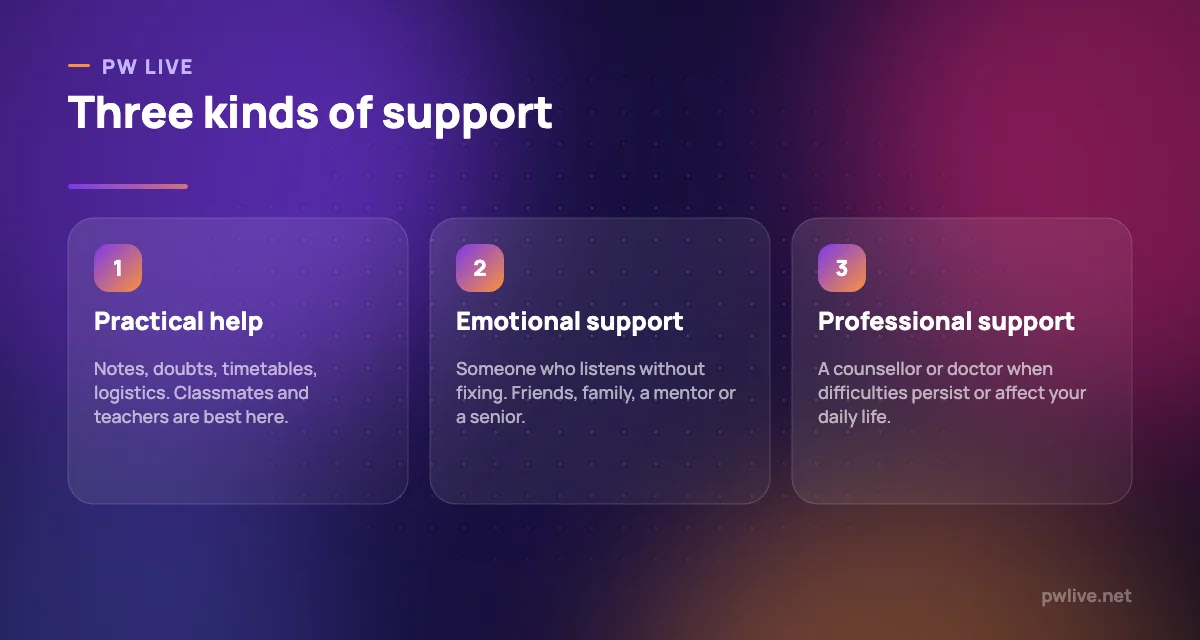
Most students think of support as one thing: someone to talk to when it gets bad. It is actually three, and they usually come from different people.
Practical support is help with the work itself. Notes when you miss a class, someone to explain a topic, a study group that keeps you honest.
Emotional support is someone who listens without immediately trying to fix you. This is the one students most often skip and most often need.
Professional support is a counsellor, doctor or trained adult when things are persistent, heavy, or affecting your daily life. This is not the last resort in an emergency. It is a normal option.
Build it from the people already around you
You do not need to find new people. You need to be slightly more deliberate with the ones already there.
- One classmate or study partner. Someone at roughly your level who you can message about a doubt without ceremony.
- One senior or someone a year ahead. They have already survived what you are in the middle of, and their perspective is worth a great deal.
- One teacher or mentor. Someone who knows your subject and will tell you the truth about your work.
- One person outside your studies entirely. A friend, a cousin, a sibling. Someone with whom your identity is not “the student preparing for an exam”.
- One adult at home who knows how you are actually doing. Not the polished version.
That is five people, and most students already know all five. The work is in telling them what is going on rather than assuming they can see it.
How to ask when asking feels awkward
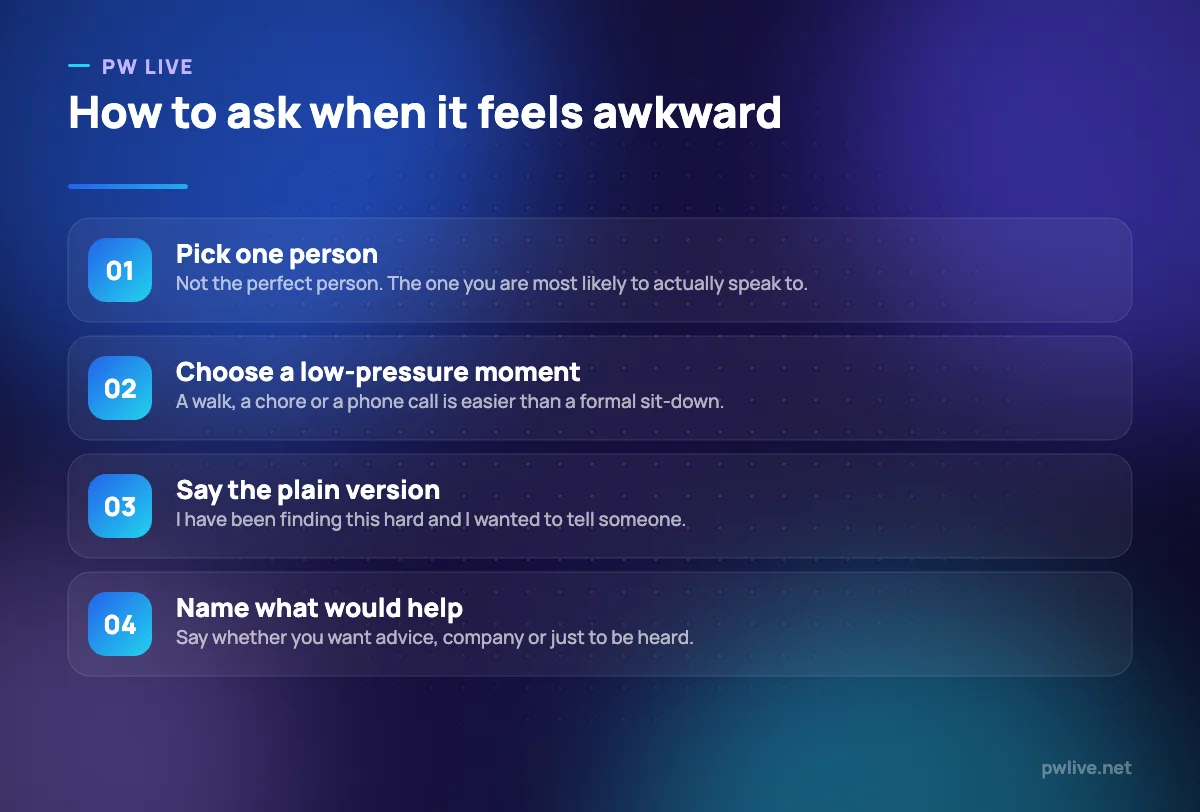
The hardest part is usually the first sentence, so here is a version that works: “I have been finding this really hard lately, and I wanted to say it out loud to someone.”
You do not need a crisis to justify it. You do not need to have tried everything first. You do not need to explain it perfectly, or have a solution in mind.
Two things make the conversation easier. Choose a low-pressure setting, because people talk more freely on a walk or over a chore than across a table. And say what kind of help you want, because most people default to advice when you may only want to be heard.
If you find these conversations genuinely difficult, that is a skill you can build like any other. Our communication skills track is a useful place to start, and our guide on how to say no and protect your study time covers the other half of the same skill.
Study groups that help rather than harm
A good study group is one of the most efficient support structures available. A bad one is a source of anxiety, comparison and wasted evenings.
The difference is usually structure. Groups that work tend to share these features:
- A clear purpose for each session, decided in advance.
- A small size, usually three or four people.
- A rule that questions are welcome and nobody is judged for not knowing something.
- Some teaching in both directions, because explaining a topic is one of the best ways to learn it.
- An agreed end time, so it does not drift into three hours of chatting.
Rank talk, hour-counting and constant comparison are the signals of a group that will make you feel worse. You are allowed to step back from one, and doing so is not disloyalty. Our guide to active recall works particularly well in a group setting.
Talking to family without it becoming a fight
Family conversations about studies often go wrong in the same way. You mention struggling, they hear failure, and the response comes out as pressure.
It usually helps to separate the feeling from the request. Tell them how you are doing, then say plainly what would help: fewer questions about results, a quieter hour in the evening, or simply someone to sit with.
If they respond badly the first time, that is often fear rather than a verdict on you. Try again later, or bring in a relative or teacher they trust. Our guide on how parents can support a student without adding pressure is written to be shared, and sending it is sometimes easier than starting from scratch.
Being someone else’s support
Support runs in both directions, and being useful to someone else is one of the quickest ways to feel less alone yourself.
You do not need to have answers. Ask how they are actually doing, then let there be a pause. Listen without rushing to fix it. Avoid comparing struggles or telling them others have it worse.
If a friend tells you they are having a very difficult time, take it seriously, stay with them, and encourage them to speak to an adult they trust or a counsellor. You are not responsible for carrying it alone, and helping them find proper support is genuinely helping.
When to involve a professional
Some things are beyond what friends and family can hold, and that is not a failure of anyone involved.
Please speak to a doctor, a school or college counsellor, or another qualified professional if low mood, anxiety or exhaustion is persistent rather than occasional, if it is affecting your sleep, eating, health or daily life, if you are withdrawing from people and activities you used to care about, or if you have thoughts of harming yourself. If it is urgent, tell a trusted adult straight away rather than waiting.
Reaching out is not dramatic and it is not weakness. It is the same instinct as seeing a doctor about a persistent cough. Many students find that one conversation with a counsellor changes how an entire term feels.
For related reading, our exam anxiety guide covers the exam-specific side, our exam stress and burnout guide covers sustained pressure, and the health and wellness archive collects the rest.
Key takeaways
- Studying alone is not more serious, it is just harder. Support is part of what makes long effort sustainable.
- You need three kinds of support: practical, emotional and professional. They rarely come from one person.
- Build your system from people you already know, and tell them the honest version of how you are doing.
- One plain sentence is enough to start the conversation. You do not need a crisis to deserve help.
- Choose study groups with structure and no rank talk, and leave ones that make you feel worse.
- Speak to a doctor, counsellor or trusted adult if difficulties persist or affect your daily life.
Frequently asked questions
I do not want to burden anyone. Is it still okay to ask for help?
Yes. Most people want to be told and feel trusted when they are, and support given early is much lighter than support given in a crisis. Being asked for help is rarely experienced as a burden.
What if my family does not understand what I am going through?
Try telling them how you feel rather than only what is wrong, and say clearly what would help. If that does not work, a teacher, relative, senior or counsellor can be a good bridge, and you are allowed to build support outside your home.
Are study groups actually useful or just a distraction?
They are useful when they have a clear purpose, a small size, an end time and no rank talk. Explaining topics to each other is one of the most effective revision methods there is.
How do I know if I need to speak to a counsellor?
If difficulties are persistent rather than passing, or they are affecting your sleep, appetite, health, relationships or ability to study, it is worth speaking to one. You do not need to reach a threshold of severity first, and doing it early is the easier route. Our guide to recovering after a result that did not go your way covers a common trigger point.
Keep learning with PW Live
Browse every guide in Health & Wellness, or pick a skill track and follow the roadmap step by step.





Leave a Reply