

Building a portfolio with no work experience feels circular: employers want proof you can do the job, and the only proof they trust seems to come from having done the job. That loop breaks the moment you accept a simple idea.
A portfolio is not a record of employment. It is evidence of capability. Nobody checks whether you were paid for the work, only whether the work is good and whether you can explain how you did it.
That means the first three items in your portfolio are entirely within your control, starting this week.
What a portfolio is actually for
It answers one question a recruiter cannot answer from a CV: what does this person’s work look like when nobody is holding their hand?
A CV lists claims. A portfolio shows outcomes and, more importantly, decisions. Hiring managers read portfolios to see how you think, because thinking is the part that transfers to their problems.
This is why a modest project explained clearly beats an ambitious one dumped as a link. The explanation is the product.
Where projects come from when nobody has hired you
Self-set projects count, provided the problem is real. Four sources work well.
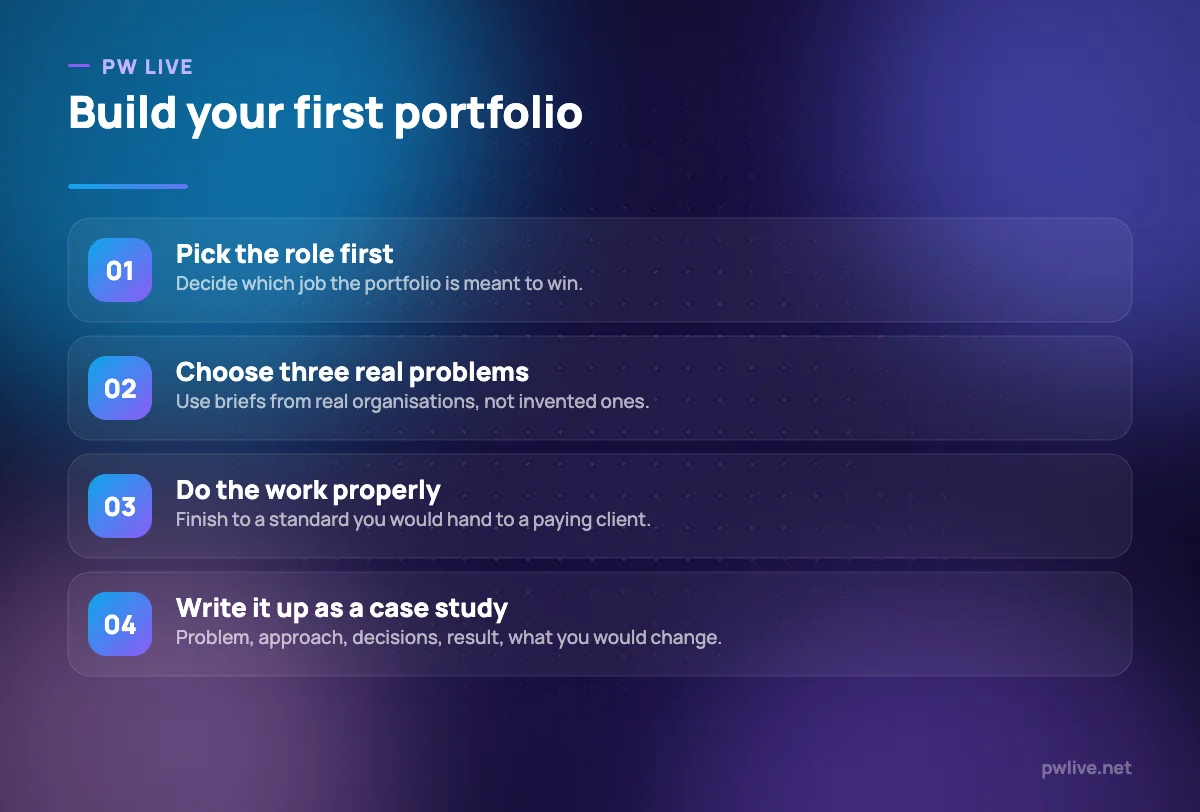
- Local organisations. A neighbourhood shop, a coaching centre, a college society, an NGO. Offer to solve one narrow problem for free, in exchange for permission to write it up.
- Public data and public products. Analyse an openly published dataset, or redesign a badly built page of a well-known service and justify each change.
- Your own life. A tool that solves an annoyance you personally have is a legitimate project, and you understand the requirements better than anyone.
- Structured briefs. Community challenges, hackathons, open source issues labelled for beginners, or college competitions all provide constraints, which is exactly what invented projects lack.
Avoid tutorial clones. If a hiring manager has seen the same to-do app or the same template dashboard forty times, it proves only that you can follow instructions. Working from your own brief is the difference, and it is why teaching yourself through projects rather than tutorials pays off directly here.
The three-to-five project rule
Most people either publish one project or twenty. Both hurt you.
Aim for three strong projects, up to five at most, chosen to cover different aspects of the role:
- One that shows technical depth in the core skill
- One that shows breadth, or the ability to work with others
- One that shows judgement, where you had to choose between options and can defend the choice
Quality is judged by your weakest item, not your best. If a project embarrasses you slightly, take it down. An empty slot is better than a bad exhibit.
How to write a case study that gets read
Every project needs a short written page, structured the same way each time.
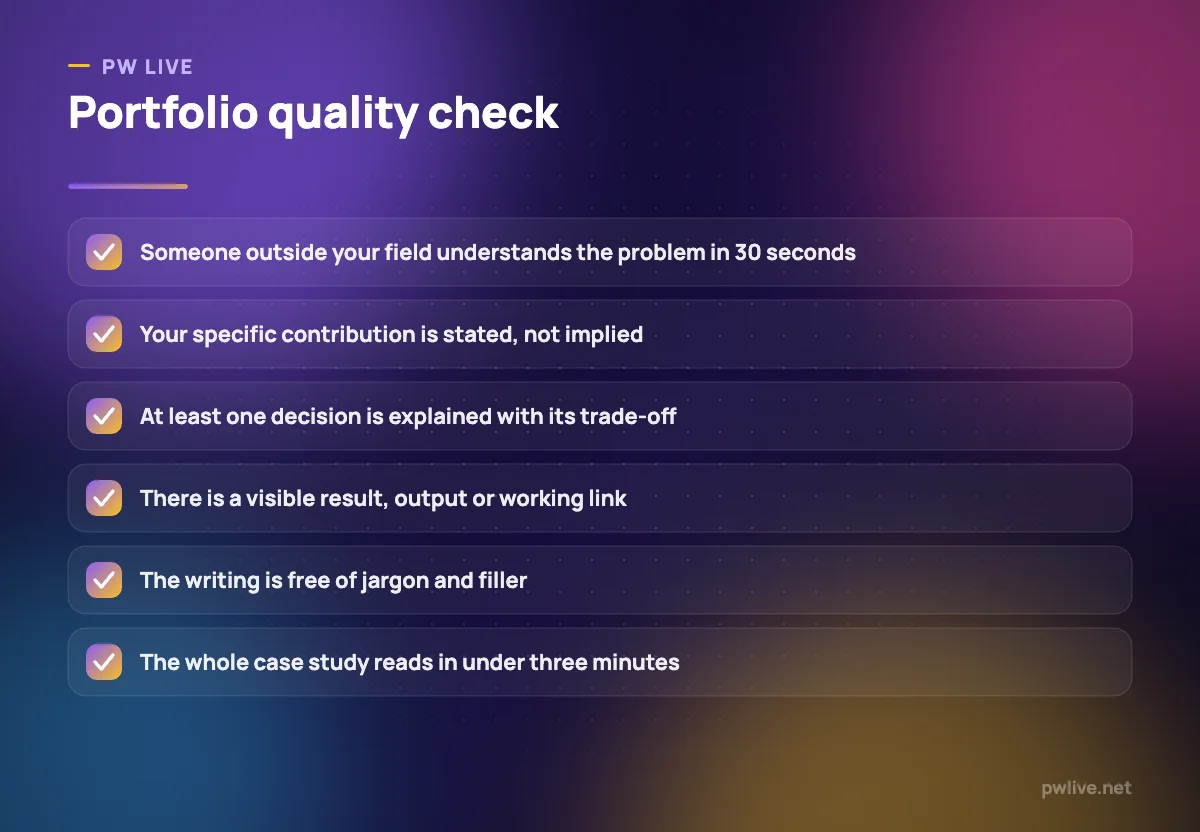
- The problem, in plain language. Who had it, why it mattered, what was previously happening instead.
- Constraints. Time, budget, data quality, no design assets, whatever was genuinely limiting.
- What you did. The steps, briefly, with your reasoning visible.
- One hard decision. The alternative you rejected and why. This single paragraph does more than everything else on the page.
- The result. What exists now. A link, a screenshot, a document, a recording. If you have a measurable outcome, say it plainly; if you do not, describe the output honestly rather than inventing a number.
- What you would do differently. Self-awareness reads as seniority.
Keep it under three minutes of reading. Recruiters skim, then read properly only if the first paragraph earns it.
Where to put it
The format should match the field, and the bar is lower than most beginners assume.
- Developers: a code host with clean repositories, meaningful commit messages and a readable overview file for each project.
- Designers and creatives: a simple visual site or a well-organised PDF, with process shots and not only finished art. The design and creativity track covers what to include.
- Writers and marketers: a single page linking to published pieces, with one line of context per item.
- Analysts: notebooks or dashboards, plus a short written summary of findings for a non-technical reader.
A basic personal site is ideal, but do not let building the site become a substitute for building the work. A well-structured document you can attach to an email is enough to start with.
Turning the portfolio into interviews
A portfolio nobody sees is a hobby. Put it into circulation deliberately.
- Add the link to your CV header, not buried at the bottom, alongside the advice in our guide to writing a resume with no experience.
- Post each project when you finish it, with a short note on what you learned. A steady record of shipped work is the most useful thing on a profile, as our LinkedIn personal branding playbook explains.
- Send a relevant project directly to a person, not a portal, when you apply.
- Use projects as your talking points in interviews rather than generic answers.
The same body of work also unlocks paid opportunities without a formal job. Most beginners who read freelancing for beginners find their first client through a project they had already published, and self-set work is often what gets you shortlisted for an internship too.
Mistakes that quietly cost you
- Hiding the process. Finished output alone is unconvincing, because it could have been copied.
- Overclaiming. Never present a class exercise as client work or invent results. One check destroys the whole portfolio.
- Group work with no attribution. State your specific part clearly.
- Perfectionism. A published, imperfect project outperforms a polished one still on your laptop.
- Letting it go stale. Add or refresh one item a quarter, in step with whichever track you are working through in the skills development category.
Key takeaways
- Portfolios prove capability, not employment, so self-set projects count fully.
- Three to five strong projects beat a long list, and your weakest item sets the standard.
- Every project needs a short case study with the problem, one hard decision and the result.
- Show process, not just polished output, so the work is clearly yours.
- Never invent results or claim group work as solo work.
- Circulate the portfolio actively: CV header, posts, direct outreach, interview answers.
Frequently asked questions
Do personal projects really count as portfolio work?
Yes, as long as the problem is real and the write-up is honest. Hiring managers care about the thinking and the quality of the output, not who paid for it.
How long should each portfolio project take?
Two to four weeks of part-time work is usually enough for a project with real substance. Anything much shorter tends to look like a tutorial exercise.
Should I include college assignments?
Only if you extended them beyond the brief or the result is genuinely strong. Standard assignments look identical across hundreds of applicants.
What if my field does not produce visible output?
Write short case studies instead. Operations, finance and HR work can all be shown as a documented problem, the approach you took and what changed, with confidential details removed. The career readiness track has examples of this format.
Keep learning with PW Live
Browse every guide in Skills Development, or pick a skill track and follow the roadmap step by step.





Leave a Reply