

A SIP, or systematic investment plan, is simply an instruction to invest a fixed amount at a fixed interval, usually monthly, into a mutual fund. It is not a product in itself and it is not a scheme with a guaranteed return. It is a method of putting money in.
Compounding is the other half of the story, and it is the part most people repeat without really picturing. It means the returns your money earns start earning returns of their own, so growth accelerates the longer you leave it undisturbed.
This article is general educational information, not personalised financial advice. Returns are never promised, and you should consult a qualified adviser before making investment decisions.
What a SIP actually is
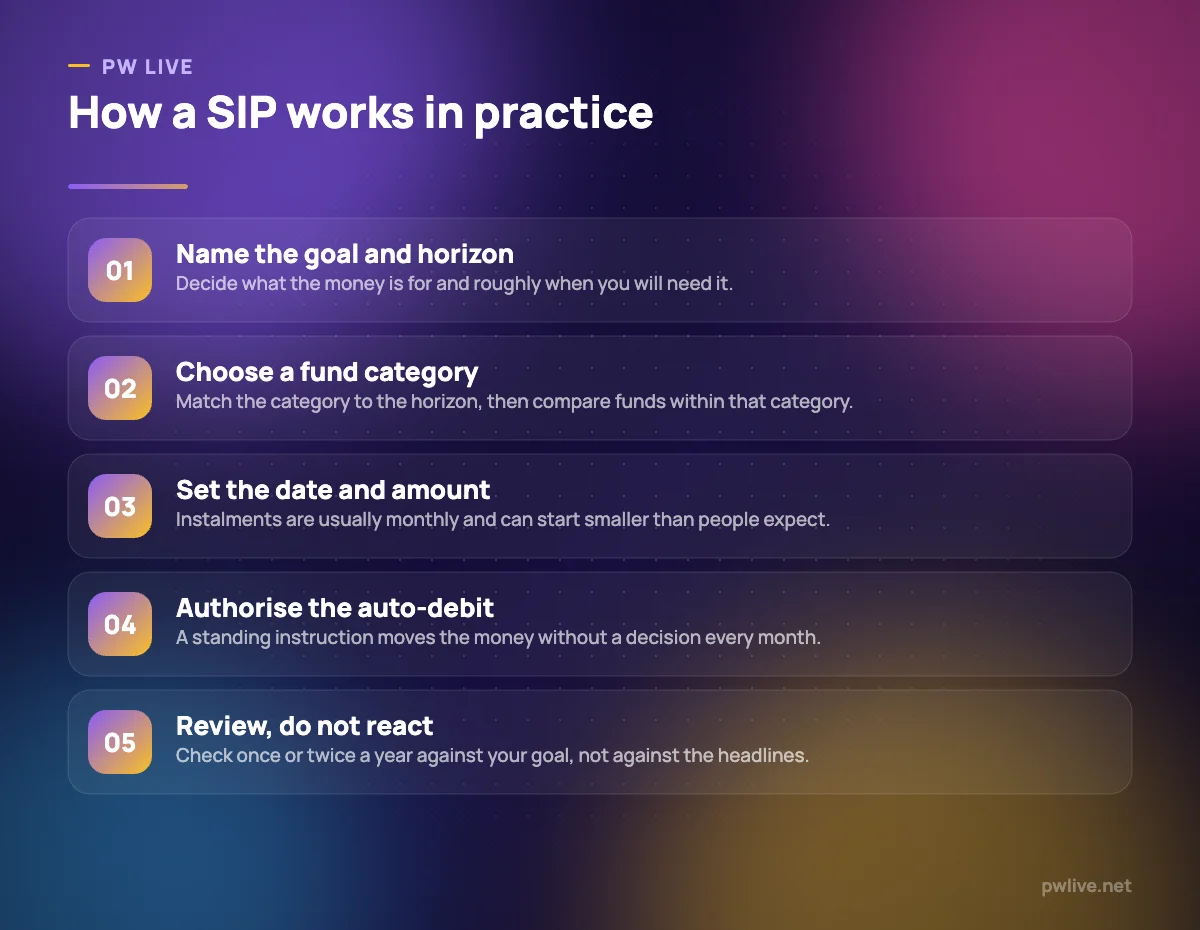
When you set up a SIP, you tell a fund house to collect a fixed amount from your bank account on a chosen date and buy units of a chosen fund with it. A standing instruction on your account handles the transfer.
Because the price of a unit moves, the same instalment buys a different number of units each month. When prices are lower you get more units; when they are higher you get fewer.
Three things follow from this. You do not need a large sum to start. You are not trying to pick the right moment to invest. And the decision is made once, not thirty times over thirty months, which removes most of the emotion from it.
A SIP is a delivery mechanism, not a promise. The outcome still depends entirely on what the underlying fund holds and how those assets perform. If you are still deciding between market-linked and fixed-return options, our comparison of mutual funds and fixed deposits covers that choice first.
How compounding actually works
Take a hypothetical example with round numbers. Assume you invest 10,000 once and assume a return of 10% a year, purely as an illustration and not as a forecast.
After one year you have 11,000. In the second year the 10% applies to 11,000 rather than 10,000, so you gain 1,100 and finish with 12,100. In the third year it applies to 12,100. The gain gets bigger every year even though the rate never changes.
That is the whole mechanism: growth on the original amount plus growth on the growth. Nothing about it is dramatic in the early years, which is exactly why people abandon it.
The important consequence is that compounding rewards time far more than it rewards effort or cleverness. Doubling your monthly amount helps in a straight line. Adding years bends the line upward.
Why starting early beats starting big
Stay with hypothetical numbers. Assume 1,000 invested every month at an assumed 10% annual return, which again is an assumption chosen for illustration, not a prediction.
- Over 20 years you would have contributed 2,40,000 and the total would come to roughly 7.6 lakh.
- Over 25 years you would have contributed 3,00,000 and the total would come to roughly 13.3 lakh.
Five extra years of contributions add 60,000 of your own money and, under that assumption, roughly another 5.7 lakh to the outcome. The extra came from time, not from saving harder.
Real returns do not arrive in a smooth 10% every year. Some years are negative. The arithmetic above only shows why horizon matters so much, which is why long-dated goals are treated differently from short ones.
What a SIP does not do
Clearing up the common misunderstandings saves a lot of disappointment.
- It does not guarantee returns. A SIP into an equity fund can be worth less than you put in, especially over short periods.
- It does not eliminate risk. Spreading your entry points softens the effect of buying at one bad moment. It does not protect you from a market that falls over your whole holding period.
- It is not a savings account. Money in a market-linked fund can fall exactly when you need it, which is why your emergency fund should sit somewhere stable instead.
- It is not automatically tax-free. Gains are taxed according to rules that depend on the fund type and holding period, and those rules change, so check the current position.
Questions to ask before you start
Ask about the goal first and the fund second.
- What is this money for, and when will I need it? A SIP for a goal two years away and one for retirement should not sit in the same kind of fund.
- Can I sustain this amount every month for years, including in a bad month? An amount you have to cancel is worse than a smaller one you keep.
- What does the fund actually hold, and does that match my horizon?
- What are the charges? The expense ratio comes out of returns every year, and some funds carry an exit load if you leave early.
- Is there a lock-in? Some categories restrict withdrawals for a set number of years by design.
- How will the gains be taxed in my case?
The point of these questions is to make the decision yours rather than a salesperson’s. A fund that suits somebody else’s situation is not evidence that it suits yours.
Making the habit survive real life
The failure mode of a SIP is rarely the market. It is cancellation.
Set the debit date just after your income arrives, not at the end of the month when the account is thin. Start with an amount you would not resent in a difficult month, and raise it when your income rises rather than trying to be heroic on day one. Many people increase the instalment by a set amount each year so the plan grows with their earnings.
Expect falls and decide now what you will do about them, which is nothing. The most common way people convert a temporary dip into a permanent loss is by stopping and withdrawing at the bottom.
If sticking to routines is your weak point rather than the maths, our guide to building habits that stick applies here as much as it does to studying, and a simple tracker in a sheet helps, as covered in using spreadsheets for planning and budgeting.
Fitting a SIP into the rest of your money
A monthly investment belongs after a few other things are in place: stable essential spending, a cushion for emergencies, and a plan for any high-cost debt. Investing while paying heavy interest on a card rarely makes sense.
Once those are handled, connect each SIP to a named goal with a date, so you know what it is for and when it is allowed to be touched. Our guide to setting money goals you will actually stick to covers how to write those down usefully, the finance category has the rest of the basics, and the personal finance skill track runs through them in order.
Key takeaways
- A SIP is a method of investing a fixed amount at a fixed interval, not a product with a promised return.
- Compounding means returns earn returns, so the benefit grows disproportionately with time.
- Illustrative arithmetic shows why horizon matters, but assumed rates are assumptions, not forecasts.
- Spreading entry points reduces timing risk; it does not remove market risk.
- Check charges, lock-ins and current tax rules before committing, using official sources.
- Consistency matters more than the starting amount, so choose an instalment you can sustain.
Frequently asked questions
How much money do I need to start a SIP?
Minimum instalments are set by each fund and are often small enough that the amount is not the barrier. The more useful question is what you can maintain every month for years without cancelling.
Can a SIP lose money?
Yes. The units you buy move in value with the fund’s holdings, so the total can be below what you invested, particularly over short periods. That is why the horizon of your goal should guide which fund category you use.
Is a SIP better than investing a lump sum?
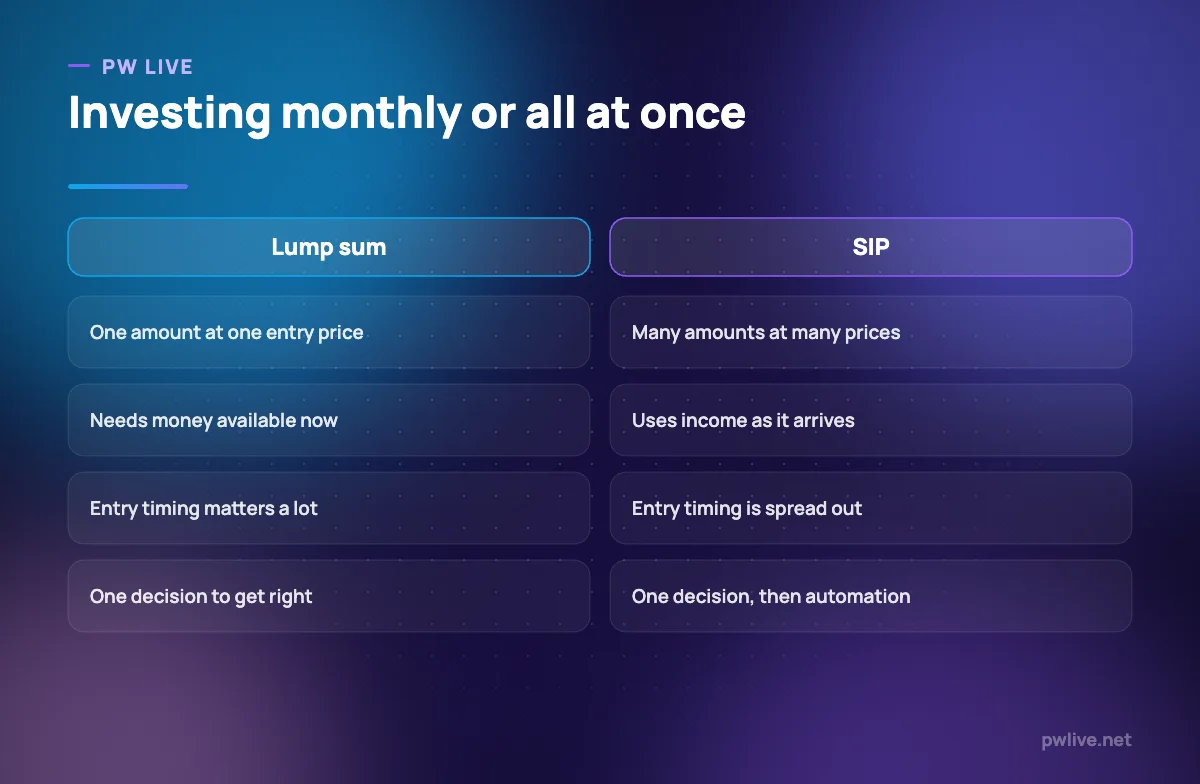
Neither is universally better. A SIP suits money that arrives monthly and spreads out entry timing, while a lump sum puts the full amount to work immediately, with more sensitivity to when you invested.
Should I stop my SIP when the market falls?
Stopping during a fall converts a paper decline into a realised one and removes the instalments that buy units at lower prices. Whether it suits your circumstances is a question for a qualified adviser who knows your full position.
Keep learning with PW Live
Browse every guide in Finance & Investing, or pick a skill track and follow the roadmap step by step.





Leave a Reply