
Skill-based hiring is the idea that what you can demonstrably do should count for more than which institution issued your degree. In India, where the gap between a qualification and readiness for a specific job has long been a familiar complaint, that shift matters to almost every student and early-career professional.
It is a direction, not a switch that has been flipped. Plenty of employers still filter by degree, college tier and marks. But more processes now include a practical component, and more job postings describe capabilities rather than credentials.
That creates an opening. If you can prove a skill, you can compete with candidates whose paper qualifications look stronger than yours. This guide explains why the shift is happening, what it looks like in practice, and exactly what to build.
Why employers are looking past the degree
The reasoning is practical rather than idealistic. A degree tells an employer that you completed a programme; it does not tell them whether you can do the specific task the role needs next month.
Three pressures push in the same direction.
Roles change faster than curricula. Tools and methods in areas like software, marketing and data move quickly, so employers cannot assume any course covered the current version.
Hiring mistakes are expensive. A candidate who cannot do the work costs the team months. A short practical assessment is cheaper than that risk.
The talent pool is wide. Employers who filter only by institution rule out large numbers of capable people, and many have noticed.
None of this makes education irrelevant. It changes what education is for: building the understanding that lets you learn the next tool quickly.
What skill-based hiring looks like in practice
You will usually recognise it by the stages rather than by the language in the advertisement.
- A practical task, assignment or short project instead of, or alongside, an aptitude test
- Interview questions about work you have actually done, in detail
- A request for a portfolio, repository or writing sample
- A structured conversation about how you approach a problem, not just the answer
- Less weight on college name and marks, more on what you show
Not every employer does all of this. Government recruitment, in particular, still runs on structured written examinations, and that is unlikely to change quickly. Check the actual process on the employer’s own careers page rather than assuming.
The gap this creates, and how to close it
Skill-based processes reward people who have done things. That is a problem if your last few years were spent almost entirely on examinations, which is the normal Indian student experience.
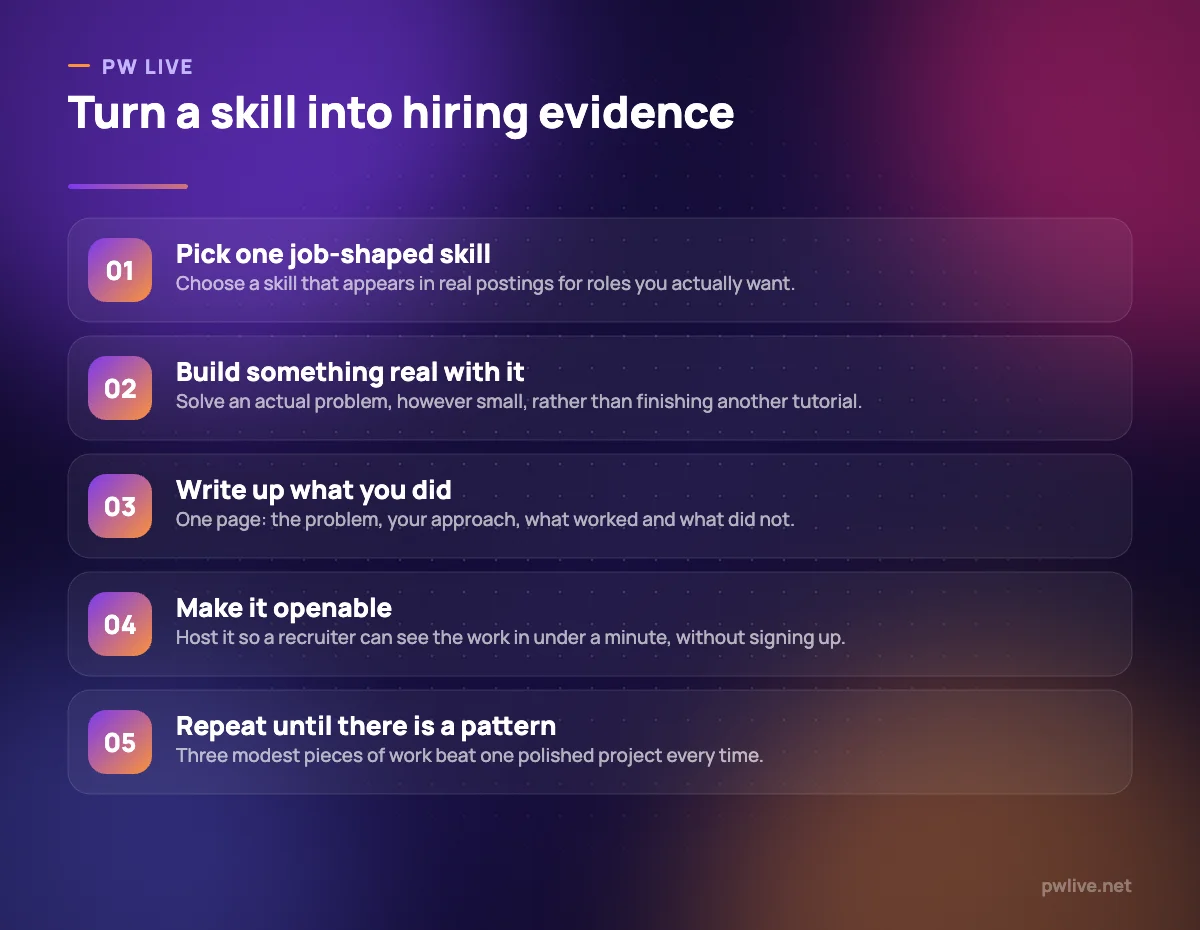
The fix is not dramatic. It is a steady habit of building small, real things alongside your studies.
- Choose one skill that appears repeatedly in postings for roles you want.
- Give it a fixed weekly slot, protected like a class.
- Build something small every few weeks rather than planning something large.
- Write up each one briefly, including what went wrong.
- Review after three months and decide whether to go deeper or switch.
Our guide to learning any new skill in 90 days lays out a repeatable version of this, and choosing the right skill to learn for your career helps with the first step, which is where most people go wrong.
Proof beats claims
The central move in skill-based hiring is replacing adjectives with evidence. “Proficient in data analysis” is a claim. A short write-up of a messy dataset you cleaned, the questions you asked of it and the chart you produced is evidence.
Good evidence has three properties. It is specific, it is openable without effort, and it is yours in a way you can discuss.
Tutorials do not count as evidence, because everyone who followed the same tutorial produced the same output. Projects that started from a real problem do. Our guide to teaching yourself with projects instead of tutorials covers how to find those problems, and building a portfolio when you have no work experience covers how to present them.
Soft skills are part of the assessment, not a bonus
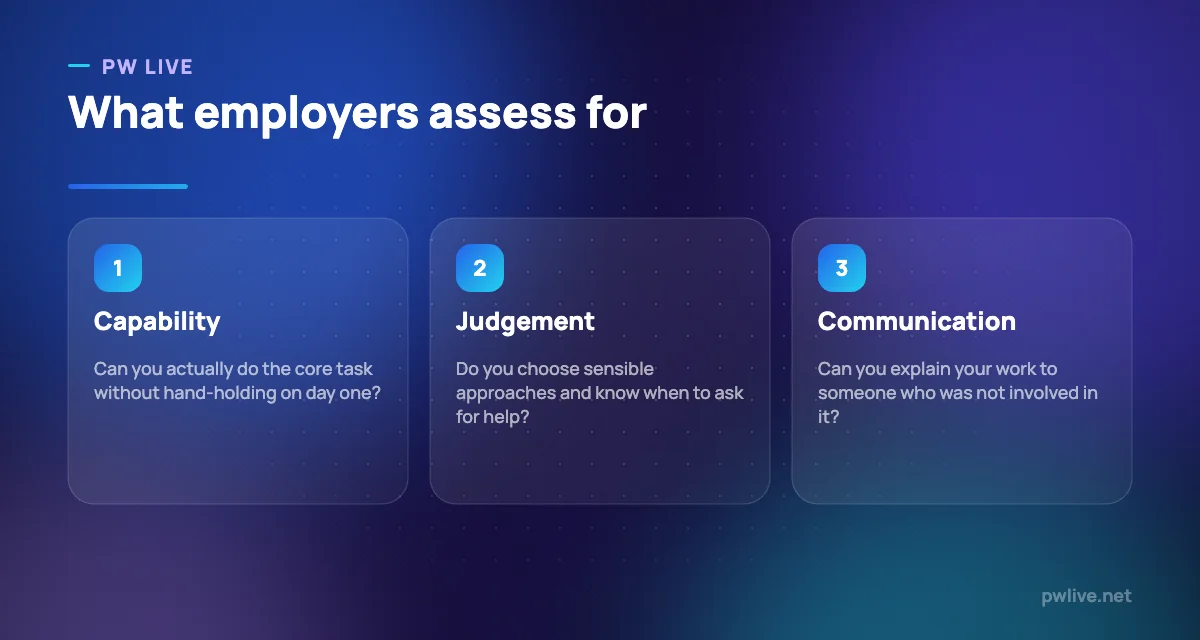
Skill-based does not mean technical-only. In most practical assessments, half of what is being judged is how you think and how you explain yourself.
Interviewers watch for whether you ask clarifying questions before starting, whether you state your assumptions, whether you notice your own mistakes, and whether you can describe a decision to someone outside your field.
These are learnable. Explaining your work to a friend in a different subject is the cheapest available practice. Our comparison of hard skills and soft skills explains how employers actually weigh the two.
Certificates, courses and what they are worth
A certificate is a claim that you completed something. Its value depends entirely on whether it is attached to work you can show.
Treat a course as a means, not an outcome. A useful test: after finishing, can you point to something you built during it that was not on the syllabus? If not, the course has taught you a syllabus rather than a skill.
- Prefer courses that require you to produce something.
- Keep the artefacts you build, not just the completion badge.
- Do not stack certificates in the same area hoping quantity substitutes for depth.
- Be sceptical of any programme that promises a job outcome rather than a capability.
- Verify claims about placement or partnerships on the provider’s own official pages.
How to prepare while you are still studying
The best time to build evidence is before you need it, because portfolios cannot be assembled in the week before placements begin.
Start with one skill and one project per semester. Keep a running document of what you did, with links. Do at least one thing that involves other people, since collaboration is what most practical assessments quietly test.
If your campus process is approaching, our guide to preparing for campus placements a year in advance sets out a timeline. For broader guidance, browse the skills development category, and use the career readiness skill track to sequence what you build.
Key takeaways
- Skill-based hiring is a gradual shift towards assessing what you can do, not only where you studied.
- It usually shows up as practical tasks, portfolio requests and detailed questions about your own work.
- Evidence beats claims: small, real, openable projects are the most valuable thing you can build.
- Judgement and communication are assessed alongside technical capability in almost every practical process.
- Certificates matter only when attached to work you can show and discuss in detail.
Frequently asked questions
Does a degree still matter if hiring is becoming skill-based?
Yes. Many roles and most government recruitment still require specific qualifications, and a degree remains the foundation. The change is that it is increasingly a starting point rather than the whole case for hiring you.
How many projects do I need in a portfolio?
Three modest, genuinely different pieces of work usually say more than one elaborate project. Consistency over time is the signal employers read.
Can I show college assignments as evidence?
Yes, if you extend them beyond what was required and can explain the choices you made. An assignment everyone in your batch submitted identically carries little weight on its own.
How do I find out whether an employer uses skill-based assessment?
Read the employer’s own careers page and the job posting itself, and ask the recruiter what the stages are when you are contacted. Avoid relying on second-hand accounts of any company’s hiring process.
Keep learning with PW Live
Browse every guide in News & Updates, or pick a skill track and follow the roadmap step by step.





Leave a Reply