

Keyword research without tools is not a compromise. The free sources are the same ones the paid tools are built on top of, and for a small site they are usually enough to fill a year of content.
What you lose is speed and tidy volume estimates. What you keep is the part that matters: knowing exactly which questions your customers are typing, and which of those you can realistically answer better than what already ranks.
This is the full process. A browser, a spreadsheet and an afternoon.
What you are actually looking for
A useful search phrase has three properties at once. Drop any one of them and the page will not earn anything.
- Real demand. People genuinely type it, in those words.
- Relevance. Someone searching it could plausibly become your reader or customer.
- Winnability. You can produce a better answer than what currently ranks.
Beginners obsess over the first and ignore the third. A phrase with enormous demand that you cannot win is worth nothing, while a modest phrase you can own outright can bring qualified visitors for years.
Before you start, it helps to know what the search engine is doing with all this. Our plain-language explainer on how search engines work covers crawling, indexing and ranking without the jargon.
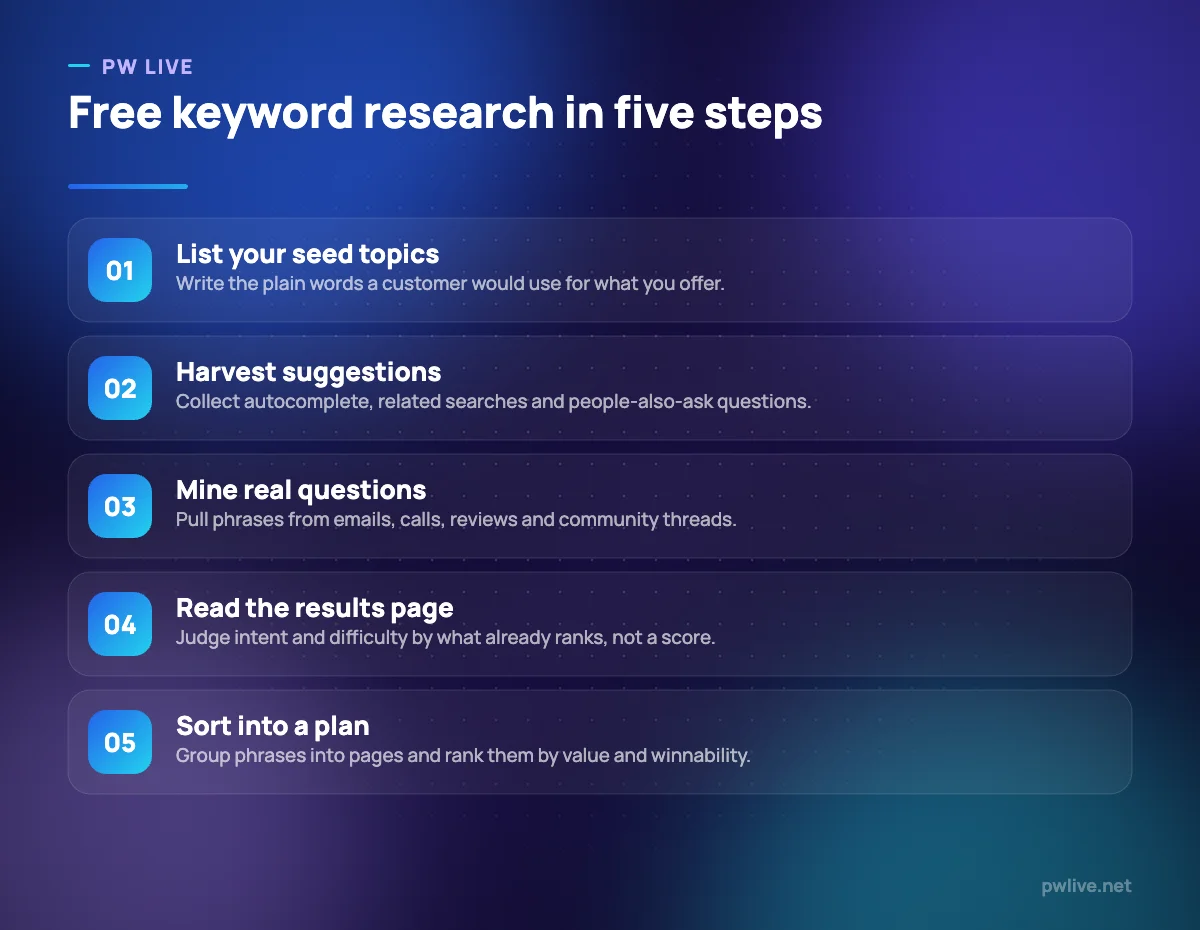
Start with seed topics in customer language
Open a blank sheet and write down the plain words a customer would use. Not your industry terms, theirs.
A photographer might write: wedding photographer, pre-wedding shoot, photo prices, album, candid photography. A bookkeeper might write: GST filing, invoices, tally, accountant charges, tax return.
Three sources make this list honest rather than imagined:
- Your own inbox. Search your sent mail for the questions you answer repeatedly. The exact phrasing people use is your keyword list.
- Your call notes. What do prospects ask in the first two minutes?
- Your reviews and your competitors’ reviews. People describe what they wanted in the words they were thinking in.
Aim for fifteen to thirty seed terms. Quality of language matters more than quantity here.
Harvest suggestions from the search box
Every search engine will hand you real query data for free if you know where to look.
- Autocomplete. Type a seed term and read the suggestions. Then add a letter at a time — “wedding photographer a”, “wedding photographer b” — and note what appears. These reflect what people actually search.
- People also ask. The expandable question boxes on a results page are a direct list of the follow-up questions searchers have. Expanding one loads more.
- Related searches. Scroll to the bottom of the results page for a cluster of adjacent phrases.
- Question prefixes. Run each seed with how, what, why, when, where, best, vs, near me, for beginners, and cost. Each prefix maps to a different intent.
- Site search on large platforms. Autocomplete on a big marketplace or a video platform reveals what people search when they are close to buying or learning.
Paste everything into your sheet, one phrase per row, with a column for where it came from. Duplicates are fine at this stage. A basic spreadsheet is all you need, and our guide to using spreadsheets for planning covers the sorting and filtering if you are new to it.
Mine the places your customers already talk
Search boxes give you phrasing. Communities give you the problem behind the phrasing, which is where the good content ideas live.
Look at question-and-answer sites, subject-specific forums, product review sections and the comment threads under popular videos in your field. Read for the sentences that begin “I’ve tried X but”, “does anyone know how to”, “is it worth”.
Two rules. First, take the language and the questions, never anyone’s personal details. Second, do not scrape at scale or against a site’s terms. Reading and taking notes is fine; harvesting personal data is not.
Your own analytics is the last free goldmine. If your site has any traffic, a free search analytics account for your property will show the exact queries that already bring impressions. Phrases where you rank on the second page are the fastest wins you will ever get.
Judge difficulty by reading the results page
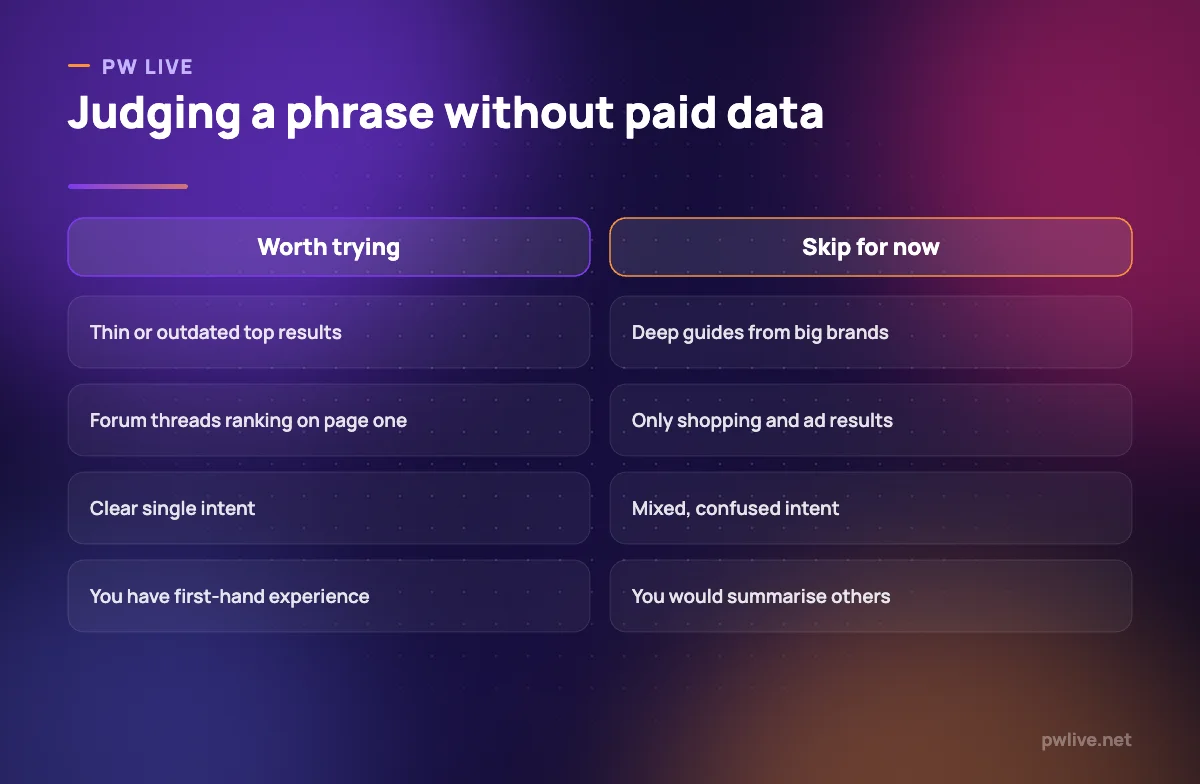
Without a paid difficulty score, you judge competition the way an editor would: by opening the top results and reading them.
Ask four questions.
- What kind of pages rank? If they are all national brands with deep guides, look elsewhere. If forum threads and thin pages appear, there is room.
- How good are they really? Long is not the same as good. A 3,000-word page that never answers the question directly is beatable.
- When were they written? Pages that are visibly out of date are an opening.
- Could you do meaningfully better? Not “add more words” but add first-hand experience, clearer steps, a template, real examples.
If the answer to the last question is no, do not write the page. Adding another summary to a crowded topic is the most common wasted effort in content marketing.
Group phrases into pages, not one page per phrase
Search engines understand that many phrasings mean the same thing. Ten near-identical pages compete with each other and dilute everything.
Group your sheet instead. Put phrases that would be satisfied by the same page into one cluster, pick the clearest phrase as the primary target, and treat the rest as sections or sub-headings on that page.
Then split clusters where the intent genuinely differs. “How to file GST returns” and “GST filing services in Pune” look related but need completely different pages: one a guide, one a service page.
A simple structure for your sheet:
- Cluster name
- Primary phrase
- Supporting phrases
- Intent (learn, compare, buy, find)
- Page type (guide, comparison, service page, FAQ)
- Priority
Turn the sheet into a publishing plan
Rank clusters by two things: how close the searcher is to becoming a customer, and how winnable the phrase looks. Start where both are high, even if the demand looks small.
Ten specific pages that each answer one question completely will outperform thirty generic ones every time. Commit to a cadence you can actually sustain, and schedule a review every quarter to update what is already published.
Once you have the plan, the execution is covered elsewhere on the site: the on-page and technical side in our guide to SEO for beginners, and the craft of the pages themselves in how to write content people actually read. For the surrounding channels, browse the marketing and sales archive, and for a structured path through all of it, follow the digital marketing skill track.
Key takeaways
- A good phrase has demand, relevance and winnability. Winnability is the one beginners ignore.
- Build your seed list from customer language in emails, calls and reviews, not industry jargon.
- Autocomplete, people-also-ask and related searches are free, direct signals of what people type.
- Judge competition by reading the top results, not by chasing a difficulty score.
- Group phrases into clusters and build one strong page per cluster instead of many thin ones.
Frequently asked questions
Can I really compete without paid keyword tools?
Yes, for a small site. Paid tools mainly save time and add volume estimates. The judgement calls that decide whether a page ranks are made by reading the results page, which is free.
How accurate are free search volume numbers?
Treat any free estimate as a rough order of magnitude, not a fact. Use it to separate “almost nobody searches this” from “many people do”, and make the real decision on relevance and winnability.
How many keywords should one page target?
One primary phrase and a handful of closely related supporting phrases that the same page naturally answers. If a supporting phrase needs a different kind of page, it belongs elsewhere.
Should I target competitive phrases at all?
Not at first. Build authority on specific, winnable phrases, then attempt broader ones once you have pages that rank and links pointing at them.
Keep learning with PW Live
Browse every guide in Marketing & Sales, or pick a skill track and follow the roadmap step by step.





Leave a Reply