

Learning how to negotiate your first salary is uncomfortable precisely because it feels like the offer might vanish if you ask. That fear is why so many first jobs are accepted within an hour of the email arriving.
In practice, a polite, well-researched request from a candidate a company has already chosen is a normal part of hiring. Companies expect some candidates to ask. They rarely withdraw an offer over a reasonable, respectfully made request.
This guide covers how to research your own range, what to say word for word, when negotiating genuinely does not apply, and how to protect the relationship while you ask.
Understand what you are actually negotiating
The headline number is not the offer. Before you can evaluate anything, you need the full structure.
Ask for a written breakdown that includes:
- Fixed pay, the amount that arrives predictably every month
- Variable or performance pay, and what determines whether it is paid
- Any joining or retention bonus, and the conditions attached
- Benefits, such as health insurance for you and dependants
- Employer contributions and deductions that affect what actually reaches your account
- The review cycle, meaning when your pay is next reconsidered
Two offers with the same total can differ enormously once you separate guaranteed money from conditional money. A large variable component tied to targets you cannot control is worth less than the same amount as fixed pay.
Our guide to reading your salary slip and understanding deductions explains how the headline figure becomes the amount you actually receive, and is worth reading before you compare offers.
Research your range instead of guessing
Never negotiate from a number you invented or a figure a friend mentioned once. Build a range from several sources and look for where they overlap.
Practical ways to research:
- Ask people doing the job. Seniors from your college one to three years ahead are the best source, because their situation resembles yours. Ask about ranges rather than their exact salary: “What band do people at your level usually land in?”
- Read job postings. Many listings state a range. Collect several for the same title, level and city, and note the pattern.
- Use salary aggregation sites carefully. Treat them as one input, not the answer. Filter to your city, your years of experience and your exact title, since averages across all levels are meaningless.
- Ask your placement cell or alumni network. Colleges often know what companies have offered recently for similar roles.
- Ask the recruiter directly. “What range has been budgeted for this role?” is a reasonable question early in the process, and many recruiters will answer.
Location, company size, funding stage and role scope all move the number considerably. A range is realistic; a single precise figure is usually false confidence.
Decide your three numbers before you reply
Write down three figures before any conversation happens.
- Your ask. Somewhat above your target, but still inside the range your research supports. If it is wildly outside, you lose credibility rather than money.
- Your target. The number you would be genuinely happy accepting.
- Your walk-away. The number below which you would decline, given your costs and your alternatives.
Being clear on the walk-away is what lets you stay calm. If you know your floor, the conversation stops feeling like a threat.
Be honest with yourself about your alternatives. A candidate with one offer and no other processes running has less room than one with three interviews in final rounds. That does not mean you cannot ask. It means you ask once, gracefully, and accept the answer.
What to say, and when
Timing matters. Do not raise money in a first interview unless they raise it. The right moment is after they have made an offer, because that is the point at which they have chosen you and would prefer not to restart the search.
When the offer arrives, do not accept on the call. Say something like:
“Thank you, I am really pleased. Could you send the full details in writing? I would like to read through it properly and come back to you within two days.”
Two days is normal and asking for it signals nothing negative.
Then make one clear ask. A template you can adapt:
“Thank you for the offer, I am keen to join. Based on what I have researched for this role and level in this city, and given the scope we discussed around owning the reporting pipeline, I was hoping we could look at a fixed component of [number]. Is there flexibility there?”
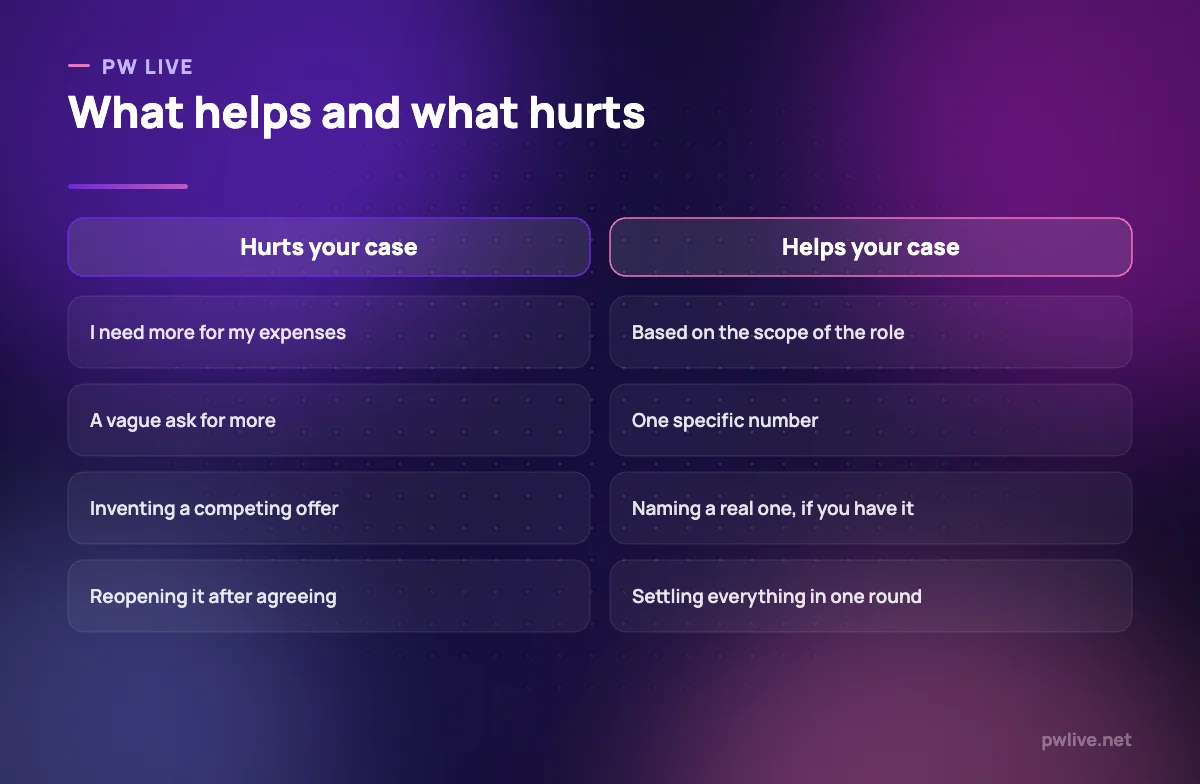
Three things make that work. It confirms your interest first, it gives a specific number, and it grounds the number in the role rather than in your personal expenses. Then stop talking and let them respond. Silence after your ask is uncomfortable and useful.
Never invent a competing offer to create pressure. It is a common suggestion and a bad one. Recruiters ask follow-up questions, industries are smaller than they look, and a discovered bluff ends the process immediately.
Negotiate beyond the base figure
If the fixed pay is genuinely capped, ask what else is movable. Many companies have less room on base and more room elsewhere.
Things worth asking about:
- A joining bonus, which often sits outside the salary band
- An earlier first review, for example at six months rather than twelve
- A written note on what a promotion or band change would require
- A relocation or equipment allowance
- Additional leave, or a defined remote or hybrid arrangement
- A training or certification budget
Ask for one or two of these, not a list of six. A long list reads as a negotiation exercise rather than a genuine need.
When not to negotiate
There are situations where pushing costs you more than it gains.
- Fixed structured programmes. Many campus hiring processes and large graduate programmes pay identical, non-negotiable packages across a whole cohort. Ask whether there is flexibility; if the answer is no, accept it gracefully.
- After you have already accepted. Reopening a settled number damages trust before your first day. Settle everything in one round.
- When your research does not support the ask. If everything you have found sits below your number, you are guessing rather than negotiating.
- When it is not really about money. If the role itself is wrong, more pay will not fix it.
Our guide to preparing for campus placements a year in advance covers how structured placement offers work and where the real leverage sits.
Handle the outcome well
There are three possible answers, and you should be ready for all of them.
If they say yes, thank them and ask for a revised letter. Nothing is agreed until it is written down. Read the final document carefully, including notice period, bond or training-repayment clauses, and probation terms.
If they meet you partway, take it. A partial improvement plus a good relationship is a better result than a standoff over a small gap.
If they say no, respond warmly: “Understood, thank you for checking. I am happy to accept and I am looking forward to starting.” Then ask what would make a difference at your first review, and write the answer down. That conversation sets you up for the raise you will ask for in a year.
Once the money is settled, decide what it will do. Our guides to personal finance for students and first earners and setting money goals you will stick to cover what to do with a first salary before lifestyle creep decides for you. You will find more on the whole hiring journey in our career and jobs section, and the personal finance skill track builds the wider foundation.
Key takeaways
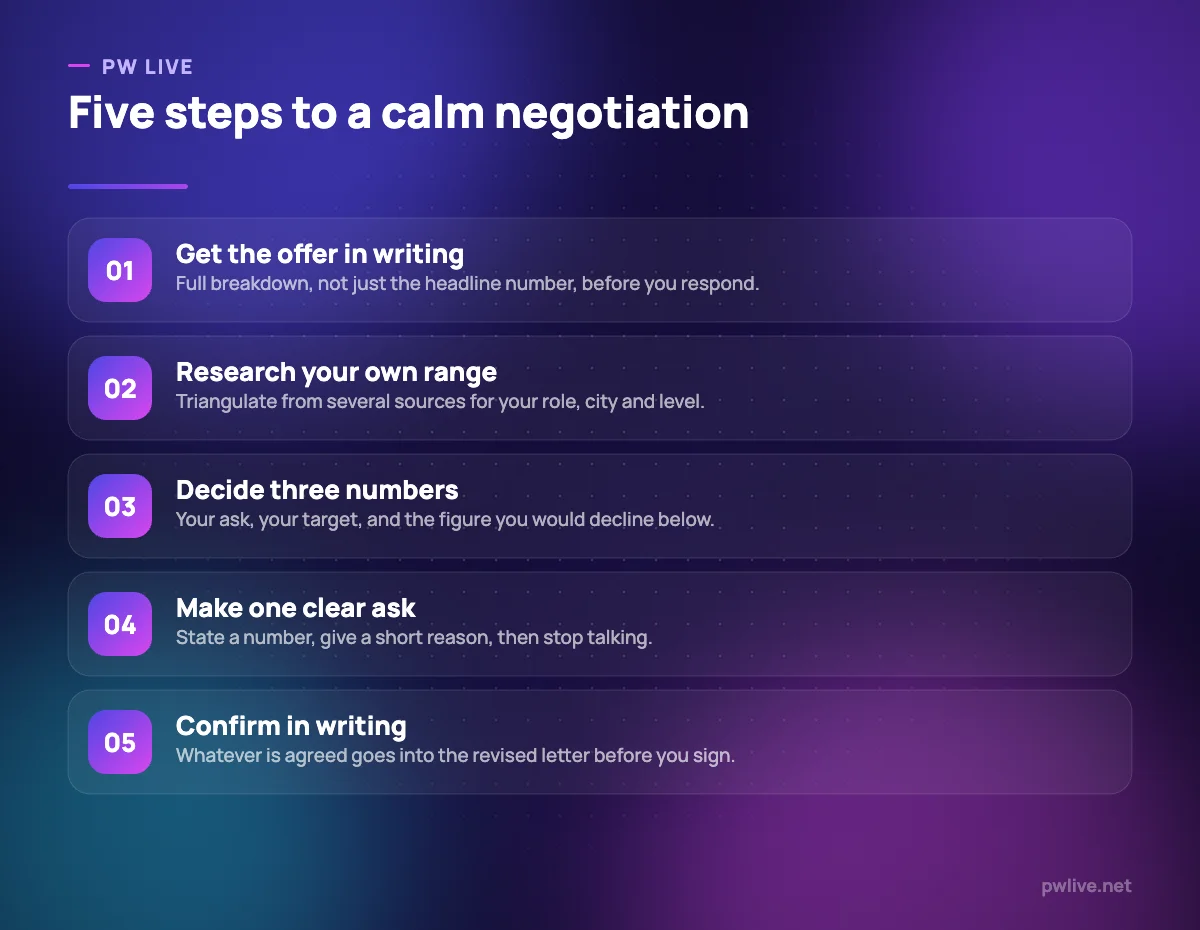
- Get the full written breakdown before responding, and separate guaranteed pay from conditional pay.
- Build your range from several sources rather than a single figure someone mentioned.
- Decide your ask, your target and your walk-away number before the conversation starts.
- Make one specific ask, justify it by the role rather than your expenses, then stop talking.
- Never invent a competing offer, and get any agreed change into a revised letter before signing.
Frequently asked questions
Can a company withdraw an offer because I negotiated?
It is uncommon when the request is polite, specific and reasonable. Offers are more often withdrawn over aggressive demands, repeated reopening of a settled number, or discovered dishonesty.
What do I say when asked my expected salary early on?
Turn the question around once: ask what range has been budgeted for the role. If pressed, give a researched range rather than a single number and say it depends on the full scope.
Should I negotiate my very first job at all?
Usually yes, if the offer is not part of a fixed cohort programme. One polite, well-researched ask carries little risk and your starting figure influences increments for years.
How do I find out what the role should pay?
Triangulate: recent job postings for the same title and city, seniors doing similar work, your placement cell, and salary sites filtered to your exact level. Look for where the sources overlap rather than for one number.
Keep learning with PW Live
Browse every guide in Career & Jobs, or pick a skill track and follow the roadmap step by step.





Leave a Reply