

Understanding how search engines work changes two things: how quickly you find what you need, and how sceptically you read what appears. Most people treat the results page as an answer. It is closer to an argument, assembled by a system with its own incentives.
The mechanics are less mysterious than they look. A search engine does three jobs: it finds pages, it stores what it found in an organised way, and it decides what order to show you. Everything else is refinement of those three.
This guide explains each stage, why your results differ from a friend’s, and how to search and read more effectively as a result.
Three jobs: crawling, indexing, ranking
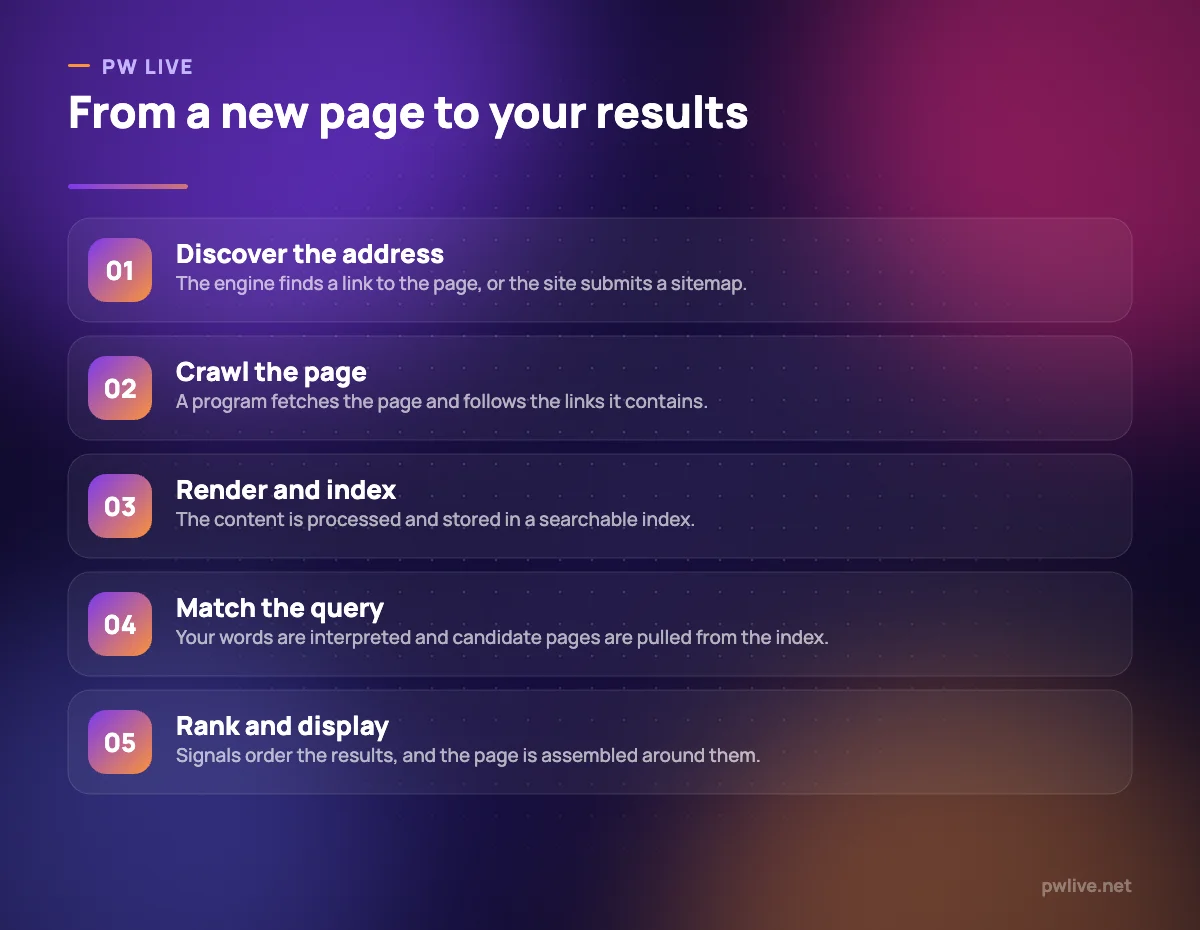
Crawling is discovery. Programs called crawlers fetch pages and follow the links on them to find more pages. This is why links are the circulatory system of the web: a page nothing links to is very hard to discover.
Indexing is storage. The fetched content is processed and filed into an enormous structure that maps words and concepts to the pages containing them. Without an index, every search would require reading the entire web from scratch.
Ranking is judgement. When you type a query, the engine pulls candidate pages from the index and orders them using a large set of signals. This is the stage that shapes what you actually read, and it is the stage nobody outside the company fully understands.
Keep these separate in your head. A page missing from results might never have been crawled, might be crawled but excluded from the index, or might be indexed but ranked too low to see. Different problems, different causes.
How crawlers decide where to go
Crawlers work from a queue of addresses, and that queue is prioritised. Nobody can fetch the whole web constantly, so they make choices.
Pages get crawled sooner and more often when they are linked from pages the engine already trusts, when they change frequently, and when the site is fast and reliable to fetch. A news site that publishes hourly is revisited far more often than a page that has not changed in years.
Site owners influence this in a few legitimate ways:
- A sitemap file listing the addresses they want discovered.
- A robots file asking crawlers to skip certain areas, such as internal search results or login pages.
- Internal linking, which is how a crawler moves from your home page to a page five levels deep.
- Server speed, since a slow site gets crawled less thoroughly.
There is a common misconception that submitting a page guarantees it appears. It does not. Submission is a request to consider, not an instruction to include.
What the index actually stores
The index is not a copy of the web. It is a processed representation designed for fast lookup.
For each page, the engine stores the text it extracted, structural information about headings and links, technical details like language and page speed, and signals about which other pages point to it.
Two details matter for anyone publishing.
First, rendering. Many modern sites build their content with code that runs in the browser. The engine has to execute that code before it can see the text, which takes more resources and can delay or reduce what gets indexed. Content present in the initial page is more reliably captured.
Second, duplication. When the same content exists at several addresses, the engine picks one to represent the group. Site owners can signal a preference, but the engine decides. This is why one version of a page sometimes ranks and another does not.
How ranking decides the order
No outsider knows the exact recipe, and it changes constantly. But the broad categories of signals are well established and openly discussed by search companies.
- Relevance. Does the page address the meaning of the query, not just contain the words? Modern systems interpret intent, synonyms and context rather than matching strings.
- Quality and trust. Signals including which other sites link to the page, and how the site behaves overall. Topics affecting health, money or safety are typically held to a higher bar.
- Usefulness of the page itself. Whether it loads quickly, works on a phone, and does not bury the answer under interruptions.
- Freshness. Weighted heavily for news and fast-changing topics, barely at all for stable reference material.
- Context. Your location, your language, your device.
The critical insight is that ranking optimises for a proxy. The engine cannot measure truth. It measures signals correlated with usefulness, and those signals can be pursued deliberately. That is the entire industry of search optimisation, which our SEO for beginners guide explains from the publisher’s side.
This does not make results worthless. It means what you see is “pages that satisfied a ranking system”, not “the best information that exists”.
Why your results differ from someone else’s
Two people searching the same words often see different pages. The main reasons are ordinary rather than sinister.
Location is the biggest factor. Search for “physics coaching” and the results reshape entirely around where you are. Language settings do the same.
Device matters, because mobile and desktop results are assembled differently.
Timing matters more than people expect. Indexes update continuously, and a query run an hour later can return a different order.
Some personalisation exists, based on your recent activity and settings, though its effect on ordinary informational queries is usually smaller than people assume.
The practical consequence: if you are checking a claim, do not assume your results are universal. A private browsing window, a different device or a different location can show you a genuinely different picture. What your search history does contribute to is covered in our digital privacy guide.
The results page is not just links any more
The classic list of ten blue links now sits inside a page full of other things: paid advertisements at the top, direct answer boxes, “people also ask” panels, videos, maps, shopping units and increasingly AI-generated summaries.
This matters for how you read.
Advertisements are labelled but easy to miss. They occupy prime position and are bought, not earned. Check the label before you click.
Answer boxes pull an extract from one page. They are useful for a quick fact and risky for anything nuanced, because a sentence lifted out of context can invert its meaning.
AI summaries compress several sources into one paragraph. They can be genuinely helpful, and they can also blend sources into a confident answer with no clear origin. For anything consequential, open the underlying page. The reasoning behind that caution is in our explanation of how large language models work.
Zero-click answers are the norm now. Many searches are satisfied without visiting any site, which changes what publishers write and how they write it.
What this means for what you read
Three effects are worth naming, because they operate quietly.
Format shapes content. If ranking rewards a certain structure, writers produce that structure. This is why so many articles on the same topic look eerily similar.
Popularity feeds itself. Pages that rank get traffic, get linked, and rank harder. Newer or more obscure work with genuine value struggles to break in.
Query wording steers the answer. Ask “why is X bad” and you get pages arguing X is bad. The engine is trying to satisfy your phrasing, not challenge it. If you want a balanced picture, deliberately search the opposite framing too.
For students, this is the difference between researching and confirming. The habits in how to read education news without falling for rumours and how to spot misinformation about exams and admissions apply directly to search results, not just to social media.
How to search better
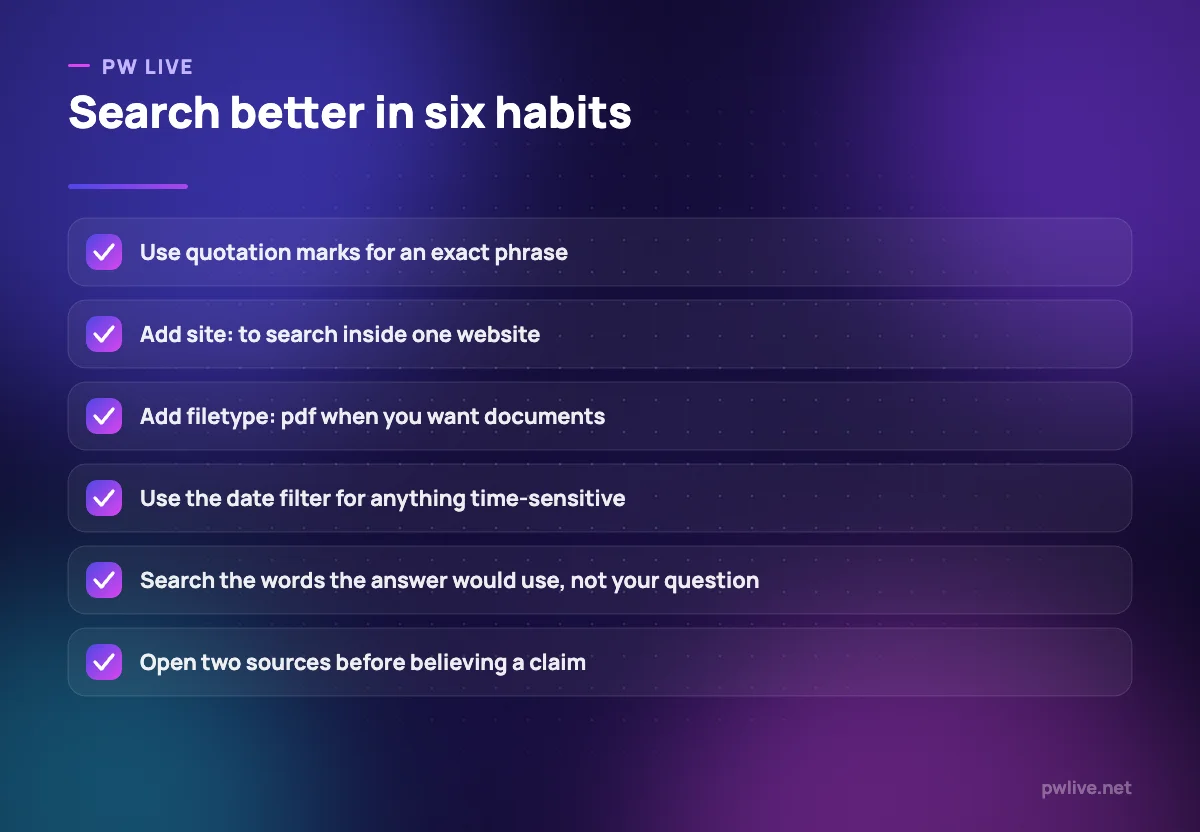
- Search like the answer, not like the question. The page you want probably uses technical vocabulary, so use it.
- Use quotation marks for exact phrases, especially error messages and specific wording.
- Restrict to a site with
site:when you know the source you trust, such as an official exam board. - Filter by date for anything where currency matters. Syllabus changes and technical instructions age badly.
- Add filetype restrictions when you want documents, such as official notifications published as PDFs.
- Read past the first three results. The top positions are heavily contested and not always the most useful.
- Open a second, independent source before you rely on anything that matters.
For anything official, go to the source itself rather than a summary. Search is how you find the official site, not a substitute for reading it.
If you want to understand this from the publishing side, how to do keyword research without expensive tools is the practical next step, alongside the marketing section and the digital marketing skill track.
Key takeaways
- Search engines crawl, index and rank. Problems at any stage look identical to the user.
- Links drive discovery, so unlinked pages are effectively invisible.
- Ranking uses proxies for quality, which means signals can be pursued deliberately.
- Location, device and timing change your results more than personalisation usually does.
- Ads, answer boxes and AI summaries sit above the organic links. Read the labels.
- Your phrasing steers the answer. Search the opposite framing to test a conclusion.
Frequently asked questions
Why does a page I know exists not appear in search?
It may not have been crawled, may be blocked or excluded from the index, or may simply rank below what you are willing to scroll through. Searching an exact phrase from the page in quotation marks usually distinguishes these cases.
Do search engines read the whole internet?
No. They crawl what they can discover and choose to fetch, which excludes pages behind logins, pages nothing links to, and content site owners have asked crawlers to skip.
Does clicking my own site improve its ranking?
No. Ranking systems are designed to ignore this kind of manipulation, and attempts to game engagement signals tend to be detected. Improving the page and earning genuine links is the only durable approach.
Should I trust the AI summary at the top of results?
Treat it as a starting point rather than a source. It compresses several pages into one confident paragraph, so open the cited pages before relying on anything specific, especially numbers, dates or official procedures.
Keep learning with PW Live
Browse every guide in Technology & Software, or pick a skill track and follow the roadmap step by step.





Leave a Reply