

Your credit score is a summary of how you have handled borrowed money. Lenders use it to decide whether to lend to you, how much, and on what terms, which means it quietly affects the cost of a home loan, a car loan or a credit card years before you apply for one.
It is not a judgement of your income, your savings or your character. It is a record of behaviour, built from data that banks and lenders report about your accounts.
This article is general educational information, not personalised financial advice. Scoring models, ranges and bureau practices differ and change, so check your own report with the bureau directly and consult a qualified adviser about borrowing decisions.
What a credit score is and who produces it
In India, credit information companies, commonly called credit bureaus, collect data from banks and lenders about the accounts you hold: loans, credit cards, and in many cases newer forms of borrowing. From that data each bureau produces a report and a score.
There is no single national score. Different bureaus hold slightly different data and use different models, so your numbers will not match exactly. Lenders may also apply their own internal scoring on top.
The scale used differs by bureau, and what counts as a strong score depends on the lender and the product. Rather than fixing on a target number you read somewhere, check what your own bureau publishes about its range and what your prospective lender says it looks for.
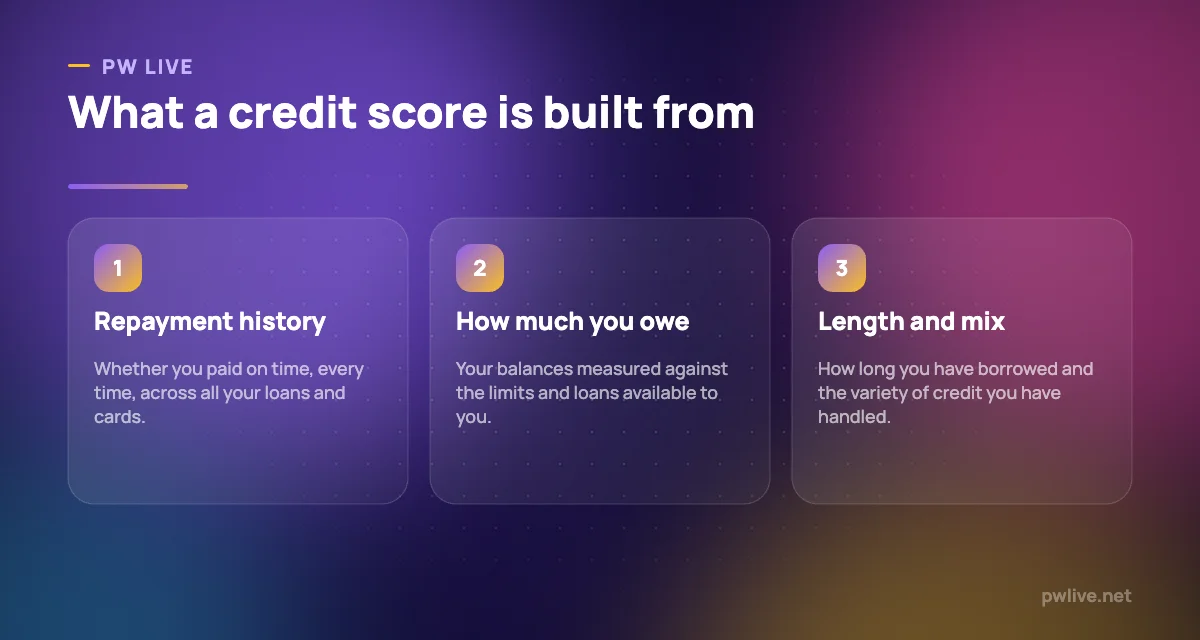
What actually goes into the number
The exact weightings are proprietary, but the categories are well established and broadly consistent.
- Repayment history. Whether you paid on time. This is usually the heaviest factor, and even one missed payment can be visible for a long time.
- Amounts owed. How much of your available credit you are using. A card near its limit signals strain, even if you never miss a payment. A common rule of thumb is to keep usage well below the limit, though it is guidance rather than a rule.
- Length of credit history. How long your accounts have been open. Time is the one input you cannot manufacture.
- Credit mix. Whether you have handled different types of borrowing, such as a secured loan alongside a card.
- Recent applications. Each formal application generates a hard enquiry on your report. Several in a short period can suggest you are struggling to get approved.
What does not affect your score
Just as useful to know what is not in there.
- Your income, savings balance or net worth, though lenders assess these separately.
- Money in your bank account, or transactions on a debit card or UPI, since these are not borrowing.
- Checking your own score or report, which is a soft enquiry and does not damage anything.
- Your education, employer or where you live, in themselves.
The distinction matters. A high earner with a pattern of late card payments can score worse than someone on a modest salary who has paid a small loan reliably for years.
Building a score when you have no history
Having no credit history is different from having a bad one, but it creates a similar problem: lenders have nothing to look at.
A workable sequence for someone starting out:
- Start with something small and manageable. An entry-level card, a card secured against a deposit, or a small consumer loan gives the bureaus something to record.
- Use it lightly and pay it in full. The behaviour being recorded is repayment, not spending, so there is no benefit in carrying a balance.
- Automate the payment. Set the debit for the full amount so a busy month cannot cause a miss.
- Keep the account open. Closing your oldest account shortens your history, which works against you.
- Wait. Several months of clean records are needed before a score becomes meaningful, and there is no way to speed this up.
Building a score is not a reason to borrow more than you need. The aim is a small, well-handled footprint, and our guide on how to avoid debt traps covers where that line sits.
What damages a score, and for how long
The main causes of damage are predictable.
- Missed or late payments. Reported after the lender’s grace window and typically visible on your report for years.
- High utilisation. Consistently running cards close to the limit.
- Settlements and write-offs. Settling a debt for less than the full amount is recorded, and it usually signals more caution to lenders than a fully repaid account.
- Defaults on any account, including small ones. A forgotten card with an annual fee outstanding can do real damage.
- A burst of applications. Applying to several lenders at once after a rejection tends to compound the problem.
Exactly how long each item stays on a report is set by bureau and regulatory practice and can change, so check with the bureau. What is consistent is that recovery is gradual: a run of on-time payments matters more than any single fix, and there is no legitimate service that can erase accurate negative information.
Beware anyone promising to fix or delete a genuine default for a fee. If your accounts are under strain, talk to the lender before missing a payment, and use your emergency fund rather than skipping a due date.
Reading your credit report and correcting errors
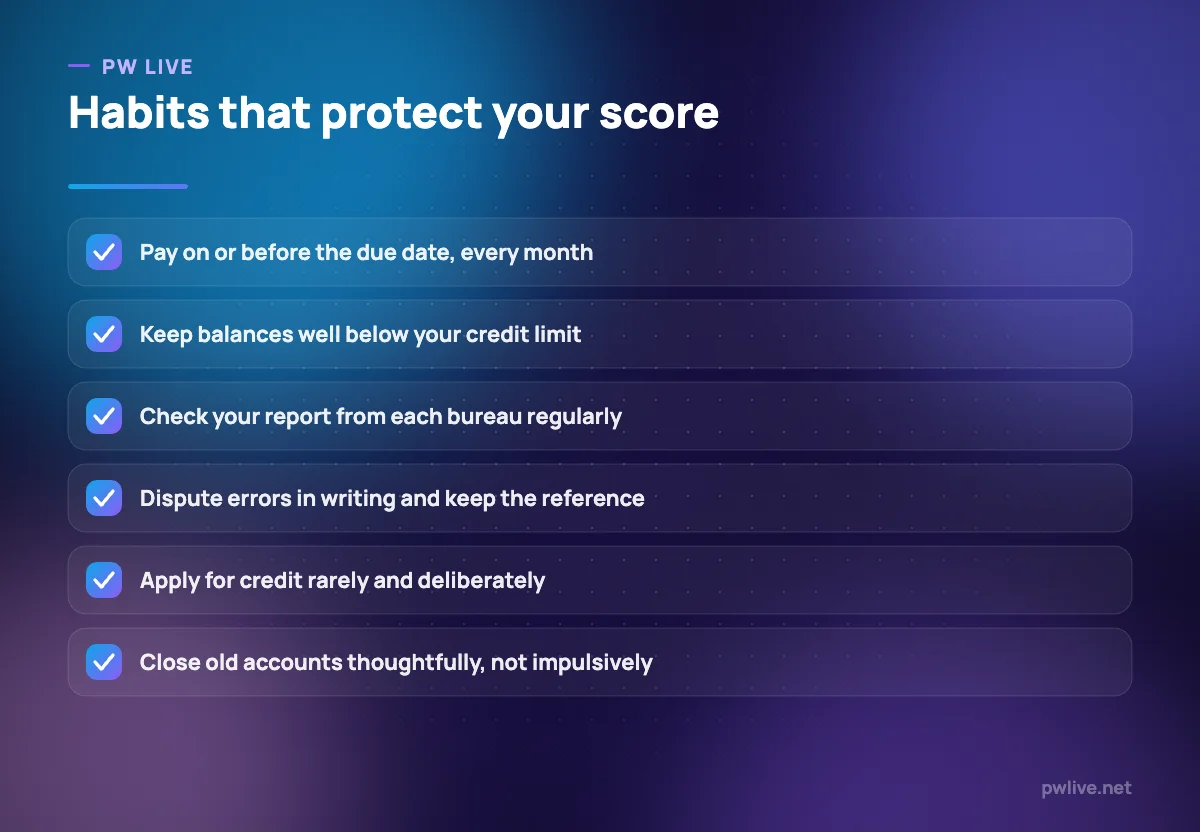
Your report is more useful than your score, because it shows what the score is made of. Get one from each bureau rather than relying on a single source.
Check, line by line:
- Personal details, especially PAN, address and spelling of your name.
- Every account listed, including closed ones. Look for accounts you do not recognise.
- Credit limits and outstanding balances, which are sometimes reported stale.
- Payment status for each month, and whether any month is marked late incorrectly.
- Enquiries, which should match applications you actually made.
Errors are not rare. If you find one, raise a dispute with the bureau through its official process, attach evidence and keep the reference number. The bureau takes it up with the lender, and corrections take time, so do this well before you plan to apply for anything.
An account you do not recognise can be a clerical mix-up or a sign of identity misuse. Treat it seriously and tighten your account security at the same time, as covered in our guide to passwords, two-factor authentication and phishing and to taking control of your digital privacy.
Once the report is clean, the score looks after itself as long as the rest of your money is in order. The finance category covers the budgeting and saving habits that keep repayments comfortable, and the personal finance skill track works through them in sequence.
Key takeaways
- A credit score summarises how you have handled borrowed money, not how much you earn or save.
- Repayment history and how much of your available credit you use carry the most weight.
- Checking your own report is a soft enquiry and does not harm your score.
- Building history takes time, so start small, pay in full and keep old accounts open.
- Negative information cannot legitimately be erased, but consistent repayment gradually outweighs it.
- Read the report itself, not just the number, and dispute errors through the bureau’s official process.
Frequently asked questions
Does checking my own credit score lower it?
No. Checking your own report is recorded as a soft enquiry and does not affect your score. Only formal applications for credit create hard enquiries that lenders can see.
How long does it take to build a credit score from nothing?
You generally need several months of reported activity before a meaningful score exists, and longer before it is strong. There is no way to shortcut it, because length of history is itself one of the inputs.
Will closing an unused credit card improve my score?
Not necessarily. Closing a card removes its available limit, which can push your utilisation up, and closing an old account can shorten your credit history. Weigh the annual fee against those effects before deciding.
Can a company fix my credit score for a fee?
Nobody can legitimately remove accurate negative information. What you can do is dispute genuine errors with the bureau yourself, free of charge, and then rebuild through consistent on-time repayment.
Keep learning with PW Live
Browse every guide in Finance & Investing, or pick a skill track and follow the roadmap step by step.





Leave a Reply