

Understanding how startup funding works matters even if you never raise a rupee. The vocabulary shows up in every article about startups, and the choices behind it shape whether a company stays yours or answers to someone else.
Funding is not a prize for having a good idea. It is a trade: you give up part of the company and take on expectations, in exchange for money that lets you move faster than your revenue alone allows.
This article explains each stage, what changes between them, and how to decide whether raising is the right move. It is a general explanation, not financial or legal advice. Terms, instruments and regulations vary, so speak to a qualified adviser before signing anything.
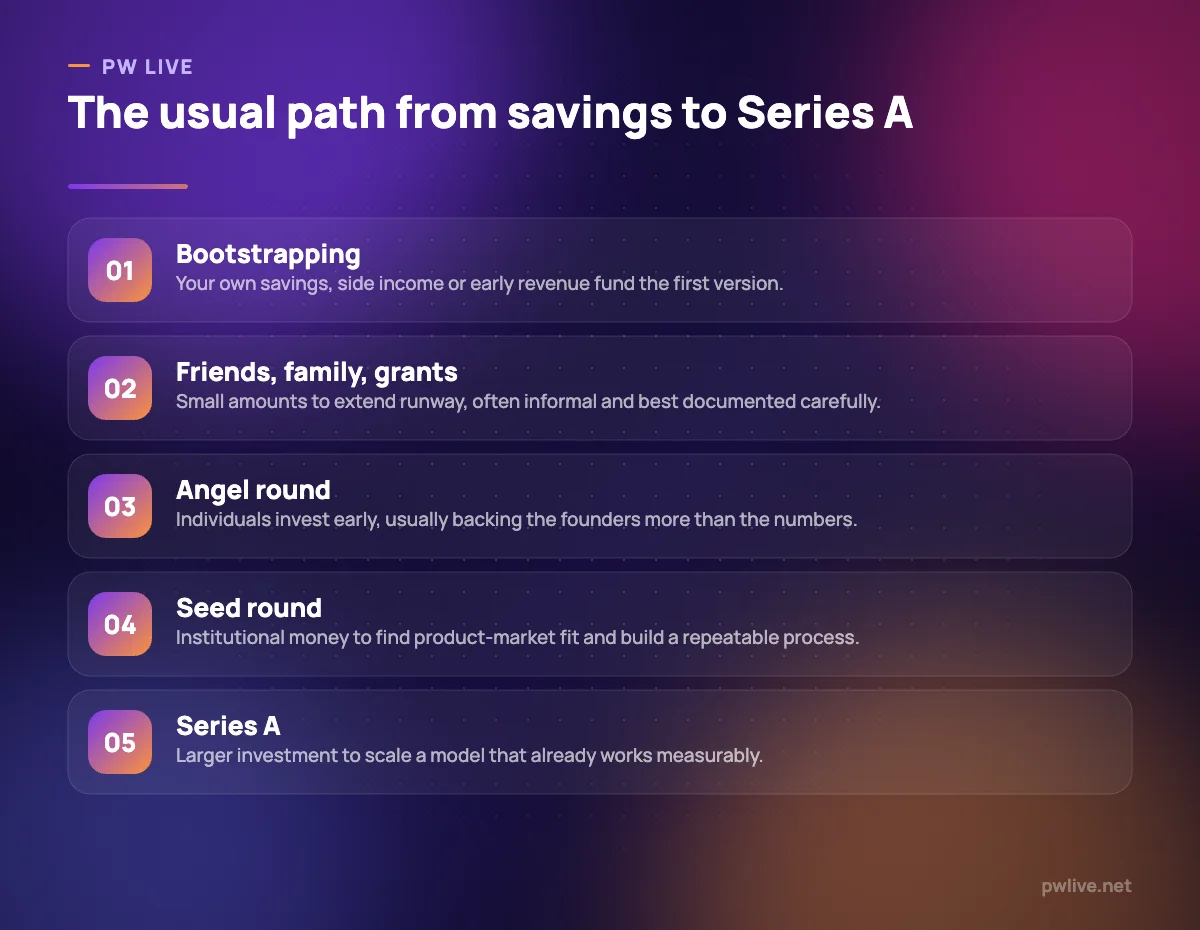
Bootstrapping: funding the company from your own resources
Bootstrapping means growing on savings, personal income and money customers pay you. It is how most businesses in the world are built, and it is a legitimate long-term choice, not just a phase.
What it gives you:
- Full ownership and full control of decisions
- Freedom to grow at a pace that suits your life
- A forced discipline about costs and pricing, since there is no cushion
What it costs you:
- Slower growth, and the risk of a funded competitor moving faster
- Personal financial strain, which is a real risk to manage carefully
- Limits on anything requiring heavy upfront investment
The bootstrapped path lives or dies on cash timing rather than profit. Read cash flow basics before you commit to this route, because running out of cash while technically profitable is one of the most common ways small companies fail.
Friends, family and small early money
The first outside money often comes from people who know you. It can be a genuine help, and it is also the stage where relationships most often get damaged.
If you go this way, be strict about the basics.
- Document everything. Whether it is a loan or an investment, put terms in writing.
- Be explicit about risk. Say plainly that they may lose all of it, and mean it.
- Never take money someone needs. No retirement savings, no emergency funds.
- Decide the instrument. A loan with a repayment schedule is very different from equity, and confusing the two causes lasting disputes.
- Agree on information. How often you will update them, and what you will share.
Grants and competition prizes belong in the same bracket. They are non-dilutive, meaning you give up no ownership, which makes them valuable if the paperwork is not disproportionate to the amount.
Angel investment: individuals backing early founders
Angels are individuals investing their own money, often people who have built or run companies themselves. They typically come in when there is little data, so they are betting largely on the founders and the problem.
What tends to be true at this stage:
- Decisions are fast and personal, sometimes made in a couple of meetings.
- Cheque sizes are small enough that several angels may join one round.
- The most useful angels bring introductions and judgement, not just money.
- Terms are often simpler than later rounds, sometimes using convertible instruments that postpone setting a price.
A convertible instrument is worth understanding. Instead of buying shares now, the investor puts in money that converts into equity at a later round, usually on better terms than the new investors get. It avoids arguing about valuation early, but it is still real dilution arriving later.
Choose angels the way you would choose a long-term colleague. Our guide to what investors actually look for covers how they evaluate you, and the same criteria are useful for evaluating them.
Seed funding: money to find what works
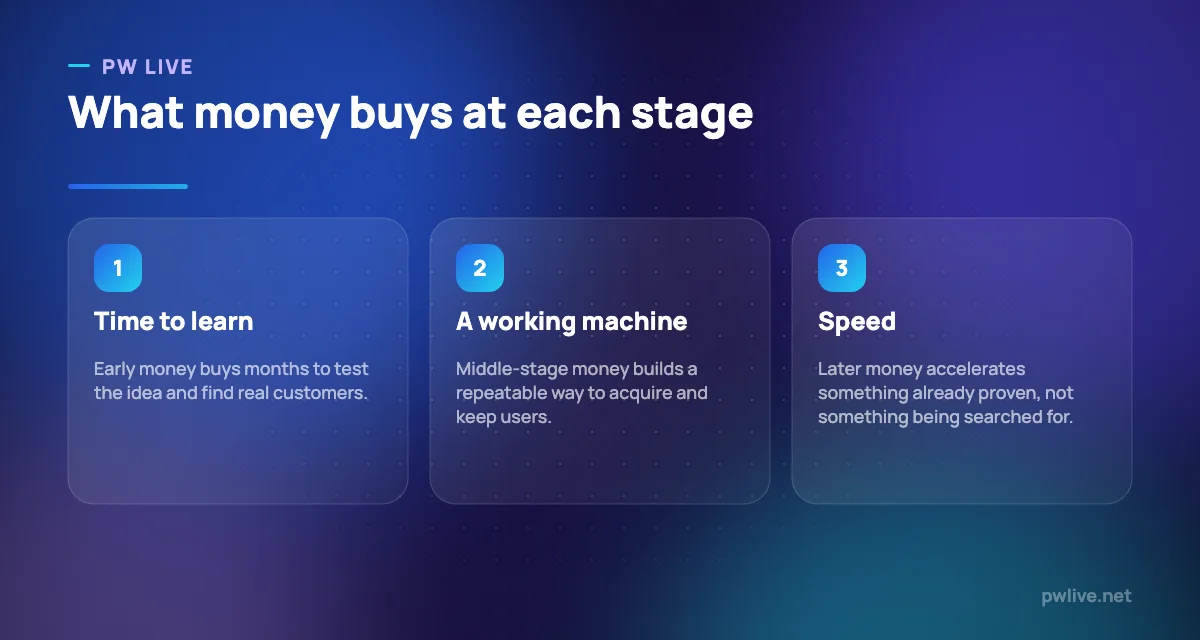
A seed round is usually the first institutional money, often from small funds alongside angels. Its purpose is to buy enough time to find product-market fit and a repeatable way to acquire customers.
At this stage expect:
- More diligence: your metrics, your cap table, your legal documents, references
- Formal share issuance, a shareholders’ agreement and board or observer arrangements
- Reporting obligations, typically a monthly or quarterly update
- Pressure to hit specific milestones before the next round
The natural question is what those milestones should be. Almost always they revolve around evidence of demand, which is why founders spend seed money on customers and product rather than on offices and titles. Our guide to product-market fit and how to know if you have it explains what the evidence looks like.
Series A: money to scale something that already works
Series A is where the question changes. Before it, investors ask whether this can work. At Series A they ask whether it can get much bigger, faster.
That means the bar shifts from potential to proof:
- A model where spending on acquisition reliably produces customers who stay
- Growth that is measurable, repeatable and explainable
- A team capable of hiring and managing more people
- Clear unit economics, since scaling a loss-making model just makes it bigger
Governance tightens too: a proper board, formal reporting, and investor rights over major decisions. This is the stage where a company stops being purely the founders’ project and becomes an institution with obligations.
What you give up when you raise
Every round costs you three things, and only one of them is on the term sheet.
- Ownership. Your percentage falls with each round. That is fine if value grows, but it compounds.
- Control. Investor rights can cover hiring, budgets, further fundraising and sale of the company.
- Optionality. Once you take institutional money, a modest, profitable outcome may no longer satisfy the people who backed you.
There is also a time cost. Raising is a demanding process that pulls founders away from customers for months at a stretch.
Make sure your own finances are stable before adding this pressure. Our guides to setting money goals you will actually stick to and the personal finance track are worth working through, alongside the wider finance and investing archive.
How to decide whether to raise at all
Ask three questions before starting.
- Is capital the actual constraint? If your problem is that you do not know who your customer is, money will not fix it.
- Does the business need scale to work? Some models genuinely require upfront spending. Many service and skill-based businesses do not.
- Do I want the outcome that funding demands? Outside capital expects a large exit, not a comfortable, steady business.
If the honest answers point away from raising, that is a good result. Validate first, as covered in how to validate a business idea before you spend a rupee, and get the structure right with our guide to registering a small business in India.
Key takeaways
- Bootstrapping is a legitimate strategy, not merely the stage before funding.
- Money from friends and family must be documented, honest about risk and never essential to them.
- Angels back founders and problems; seed money buys time to find fit; Series A scales a proven model.
- Convertible instruments delay valuation arguments but still cause dilution later.
- Raising costs ownership, control and flexibility, plus months of founder attention.
- Raise only when capital is genuinely the constraint and the outcome you want fits the expectations.
Frequently asked questions
Do I need to register a company before raising money?
For any formal investment, yes. Investors buy shares in a legal entity, so the structure and paperwork need to exist first.
What is dilution in simple terms?
When a company issues new shares to investors, existing owners hold a smaller percentage of a larger total. Your slice shrinks, ideally of a bigger pie.
Is a bank loan better than giving up equity?
It depends on whether your business has predictable cash flow to repay it. Debt keeps ownership but adds fixed obligations, which can be dangerous for an unproven model.
What happens if a startup cannot raise the next round?
It has to reach profitability, cut costs to extend its runway, raise on tougher terms, or wind down. Planning for that possibility early is normal, not pessimistic.
Keep learning with PW Live
Browse every guide in Startups & Innovation, or pick a skill track and follow the roadmap step by step.





Leave a Reply