
Copywriting fundamentals are simpler than the industry pretends. Good copy explains, to a specific person, why a specific thing solves a specific problem, and makes the next step obvious. That is the whole discipline.
What makes it hard is that clarity requires knowing your customer better than they expect, and honesty requires resisting every shortcut that inflates a claim.
This guide covers the actual mechanics: how to research, how to structure a page, how to turn features into reasons to buy, and how to write a call to action that works without pressure tactics.
Copywriting is research, not wordsmithing
Most bad copy fails before a word is written, because the writer skipped the part where you learn what the customer actually wants.
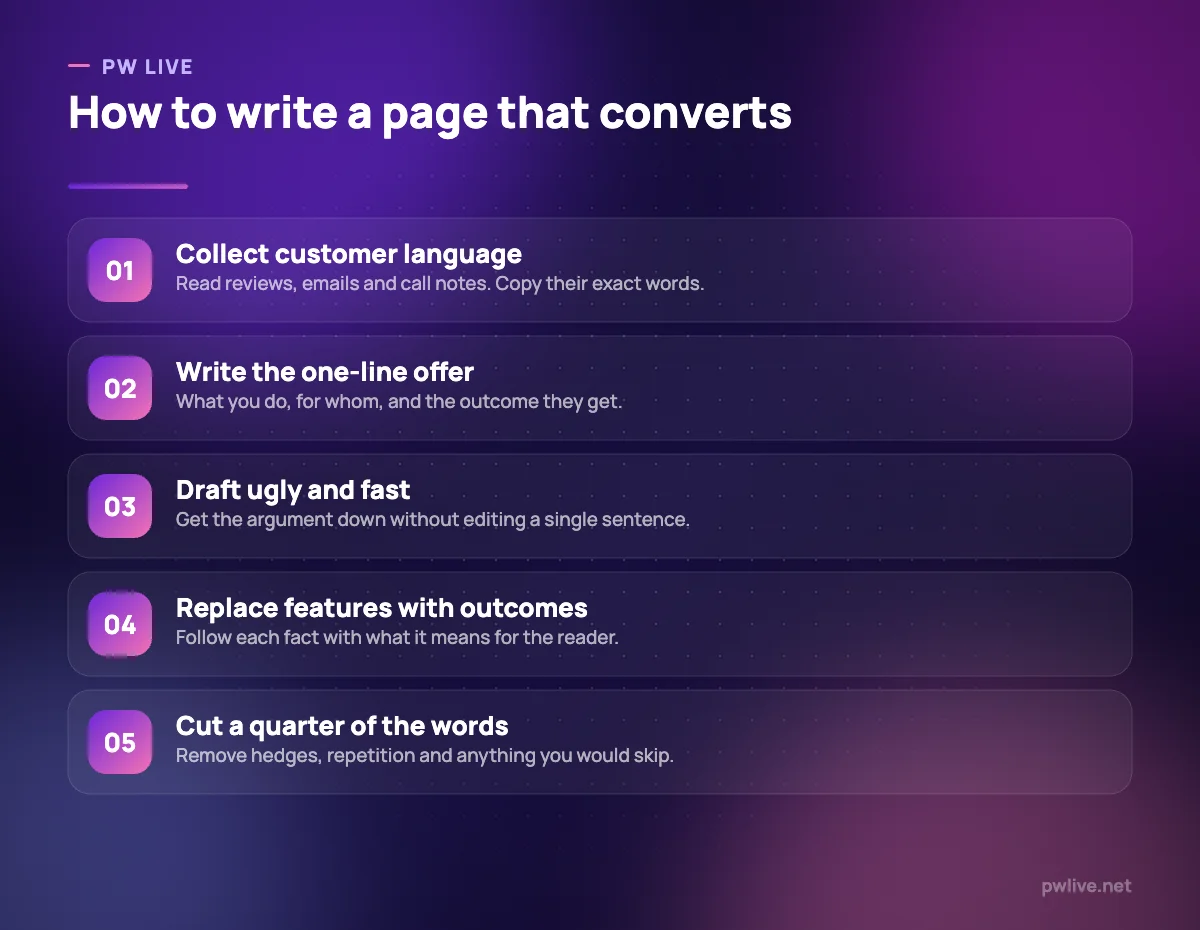
Spend the first hour collecting language rather than producing it. Three sources give you almost everything:
- Reviews, yours and your competitors’. Positive reviews tell you which benefit to lead with. Negative ones tell you which objection to answer.
- Customer emails and calls. The words people use when they describe the problem in their own way are the words that will make your copy feel written for them.
- Support and sales questions. Every question asked twice is a section your page is missing.
Keep a document of exact quotes. When you write, borrow that vocabulary directly. Copy that uses the customer’s own phrasing outperforms copy that translates it into marketing language.
Ask yourself two questions before drafting: what does this person believe right now, and what do they need to believe in order to act? The gap between those is what the page has to close.
Lead with the offer, not the warm-up
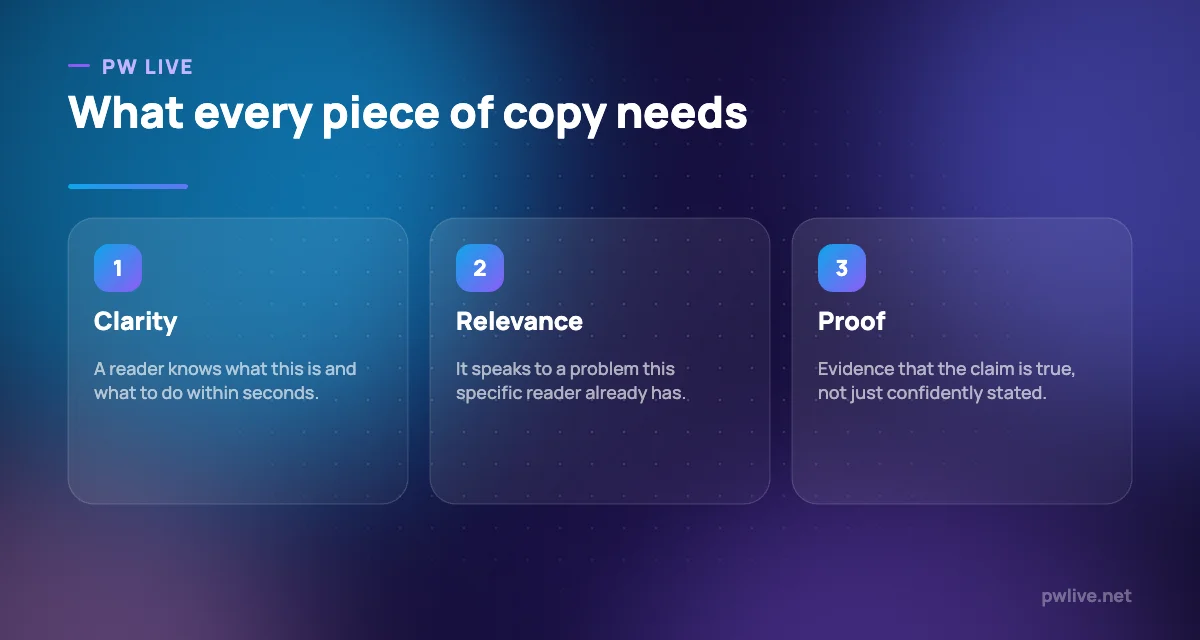
The top of a page carries most of its weight. It has to answer three questions almost instantly.
- What is this?
- Who is it for?
- What do I get?
Write a single sentence that covers all three: what you do, for whom, and the outcome. “We help small clinics in Pune stop losing appointments to missed phone calls” tells a reader more than a paragraph about your values.
Then support it immediately. A short line of detail, then either the action or a piece of proof. Never make a reader scroll past a story about your founding year to find out what you sell.
Turn features into outcomes
A feature is a fact about the product. A benefit is what that fact changes in the reader’s life. Copy that lists only features asks the customer to do the translation, and many will not bother.
The mechanical fix is a phrase: “which means”.
- “Sessions are recorded” — which means you can revise without taking frantic notes.
- “Delivery in two working days” — which means you can order on Monday and photograph the product by Thursday.
- “No lock-in period” — which means you can stop if it is not working, without an argument.
Write the feature list first, run every item through “which means”, and keep the second half. Then check that each benefit is one your specific reader actually cares about, not a generic good thing.
Be careful with superlatives. “Best”, “leading” and “world-class” are unverifiable, so readers discount them automatically. A specific, checkable detail persuades far more than a strong adjective.
Structure a page the way people read it
Nobody reads a sales page top to bottom on the first pass. They scan, form an impression, then read the parts that matter to them. Structure for that.
A reliable order for a service or product page:
- Headline: the outcome, in the customer’s language.
- Sub-headline: who it is for and how it works, in one line.
- The main action, visible without scrolling.
- Proof: results, examples, testimonials with real names and permission.
- How it works: three or four steps so the process feels manageable.
- Objections: price, time, risk, “will this work for me”, answered plainly.
- The action again, with a reminder of the outcome.
Every heading should make sense to someone reading only the headings. If your page is a shop listing rather than a service page, the more specific rules in writing product descriptions that convert apply.
Handle price and objections honestly
Objections do not disappear because you avoided them. They sit in the reader’s head and stop the sale silently.
List the five reasons someone would say no, then answer each in a sentence or two on the page. The common ones are cost, time, trust, fit and effort.
On price: state it if you can. Hiding it creates suspicion and wastes both sides’ time. If pricing genuinely varies, explain what drives it and give a range with the conditions attached. Our guide to pricing your product or service without guessing covers how to set that number in the first place.
Reduce perceived risk with things you can actually honour: a clear refund policy, a short first engagement, a specific guarantee. Do not manufacture urgency. Fake countdown timers, invented stock scarcity and “only two left” claims that reset daily are dark patterns. They damage trust when noticed, and they are increasingly treated as unfair trade practice.
Write calls to action people actually click
A call to action fails for one of three reasons: the reader does not know what happens next, the ask is too big for the stage they are at, or the button says nothing.
Fix all three.
- Describe the outcome, not the mechanic. “Get the pricing breakdown” beats “Submit”.
- Match the ask to the temperature. A first-time visitor may be ready to read a case study, not to book a paid consultation.
- Say what happens after the click. “You will get an email within one working day” removes the hesitation people rarely articulate.
- Use one primary action per page. Competing buttons split attention and reduce both.
The same discipline applies in email, where a single clear action per message consistently outperforms a list of options. Our guide to email marketing basics covers that side of it.
Edit until it earns the reader’s time
The first draft is for thinking. The edit is where copy becomes persuasive.
Work through in passes rather than fixing everything at once:
- Cut: remove a quarter of the words. Hedges, repetition, throat-clearing.
- Specify: replace every vague claim with a concrete detail or delete it.
- Simplify: shorter sentences, plainer words, active voice.
- Read aloud: fix anything you stumble over.
- Check honesty: could you defend every claim on the page if challenged?
That last pass is the important one. Copy that overpromises converts once and creates refunds, complaints and bad reviews afterwards.
For the longer-form writing muscle behind all of this, see how to write content people actually read. The marketing and sales archive covers the channels this copy runs on, and the communication skills track builds the underlying ability in a structured order.
Key takeaways
- Copywriting is mostly research. Collect the customer’s exact words before writing any of your own.
- Lead with what it is, who it is for and the outcome, within the first two lines.
- Run every feature through “which means” and keep the second half.
- Answer price and objections openly. Never manufacture urgency or scarcity.
- Use one clear action per page, describe what happens after the click, then cut a quarter of the words.
Frequently asked questions
How long should a sales page be?
As long as it takes to answer every objection a buyer has, and no longer. Higher-priced or unfamiliar offers usually need more explanation; simple, low-risk purchases need very little.
Do copywriting formulas still work?
They are useful scaffolding when you are stuck, because they encode a sensible order of argument. They are not a substitute for knowing the customer, and copy that reads like a filled-in template rarely persuades.
How do I write copy for something I did not create?
Interview whoever did, read every review, and use the product yourself if at all possible. The quality of your copy tracks the quality of your access to real customer language.
Is it wrong to use urgency in copy?
Real deadlines are fine and helpful. Invented ones, resetting timers and fake stock counts are dark patterns that break trust and can create legal exposure.
Keep learning with PW Live
Browse every guide in Marketing & Sales, or pick a skill track and follow the roadmap step by step.





Leave a Reply