

Every parent supporting a student through school or a competitive exam faces the same tension. You want to help, and most of the ways help is usually delivered, checking, comparing, reminding, reduce performance rather than raise it.
This is not a lecture about being relaxed. Standards matter, and a student with no expectations at home usually drifts. The question is which kinds of pressure produce work and which produce anxiety, avoidance and hidden problems.
What follows is practical: what to say, what to stop asking, what to physically arrange, and how to handle the two hardest moments, a bad test and result day.
Understand what pressure actually does
There is a difference between demand and support, and students need both. Demand without support produces fear. Support without demand produces drift. The combination that works is high expectations paired with visible belief that the child can meet them.
The failure mode in most homes is not too much expectation. It is expectation delivered as surveillance: repeated questions about hours, marks and comparisons, with no accompanying help.
Surveillance has a predictable effect. The student starts managing your anxiety instead of managing their preparation. They report better numbers than are real, avoid telling you about a bad test, and spend energy on appearing to study rather than studying.
The moment a child hides a result from you, the pressure has become counterproductive, whatever the intention behind it.
Change the questions you ask
Most of the damage is done in ordinary daily conversation, and most of the repair is available there too.
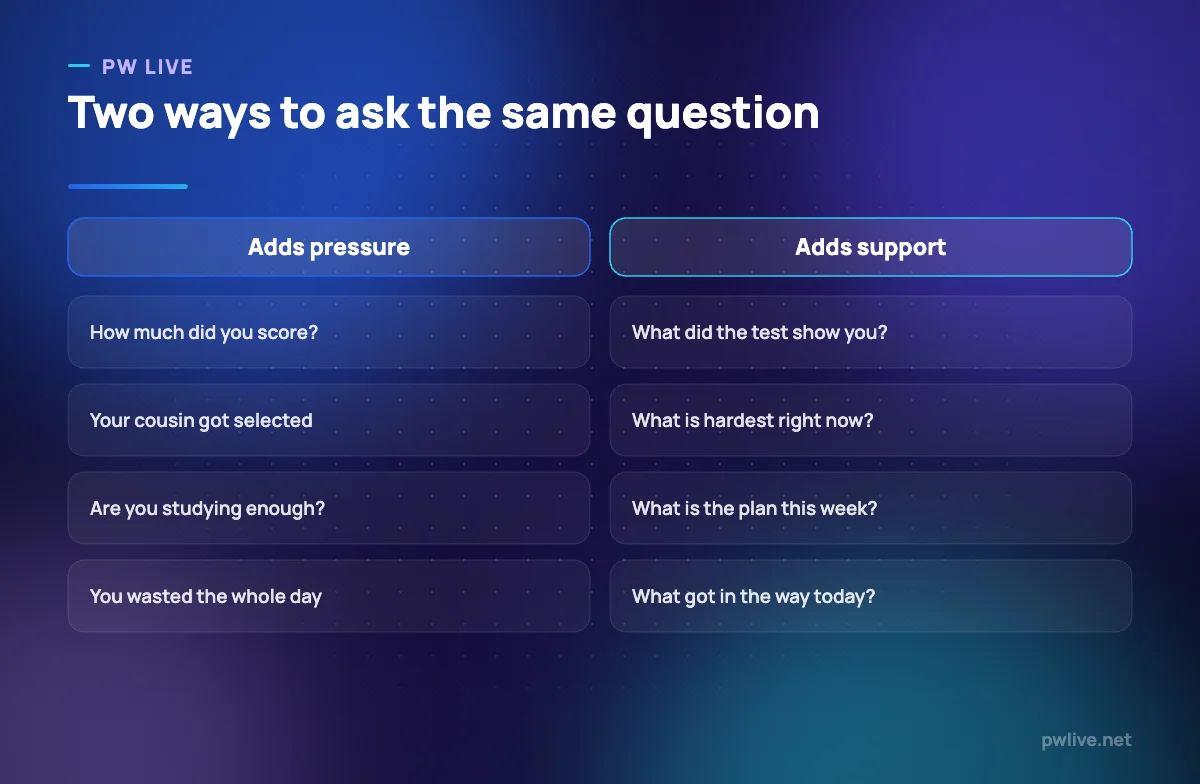
Stop asking, or ask much less often:
- How many hours did you study today?
- What did you score?
- Why is your friend ahead of you?
- Do you think this is enough?
Ask instead:
- What did you work on today?
- What is the hardest topic right now?
- What did that test show you about what to fix?
- Is there anything I can take off your plate this week?
The second set asks about process rather than output. Process is what the student controls, and it is where useful conversation lives. A student who can tell you what they are fixing is preparing well, whatever this week’s mark was.
One more rule worth adopting: not every conversation has to be about studies. A household where the only topic is the exam is exhausting to live in, and the child stops talking altogether.
Handle a bad test the way a coach would
A poor result is the highest-stakes conversation you will have, and the default response makes it worse.
Give it a few hours. A student who has just seen a bad score is not able to analyse anything, and a conversation in that window will be remembered as punishment.
When you do talk, follow three steps.
- Acknowledge it plainly. “That is disappointing, I know” is better than either false cheer or silence.
- Move to diagnosis. Ask what kind of mistakes they were: things not studied, things studied but forgotten, careless errors, or time running out. Each has a different fix.
- Agree one change, not five. One specific adjustment for the coming week is more likely to happen than a total overhaul announced in frustration.
Then let it go. Repeating the disappointment across the following days does not add motivation; it adds a reason to hide the next result. Our guide to recovering after a result that did not go your way is written for the student and is worth reading together, and the actual diagnostic work is covered in how to analyse a mock test.
Stop the comparisons, including the silent ones
Comparison with a cousin, a neighbour’s child or a sibling is the most common source of home pressure and one of the least useful. It supplies no information about what to do next, and it attaches shame to a process that already involves plenty of failure.
Silent comparisons count too. Sighing at a report, mentioning someone’s selection at dinner, or asking about another student’s marks all land the same way.
Replace them with comparison against the student’s own past. “You have gone from four to seven correct in that section” is motivating and actionable. “Your friend got twelve” is neither.
If relatives raise comparisons at gatherings, handle it before the student has to. A parent who deflects those questions is doing something genuinely protective.
Arrange the things you actually control
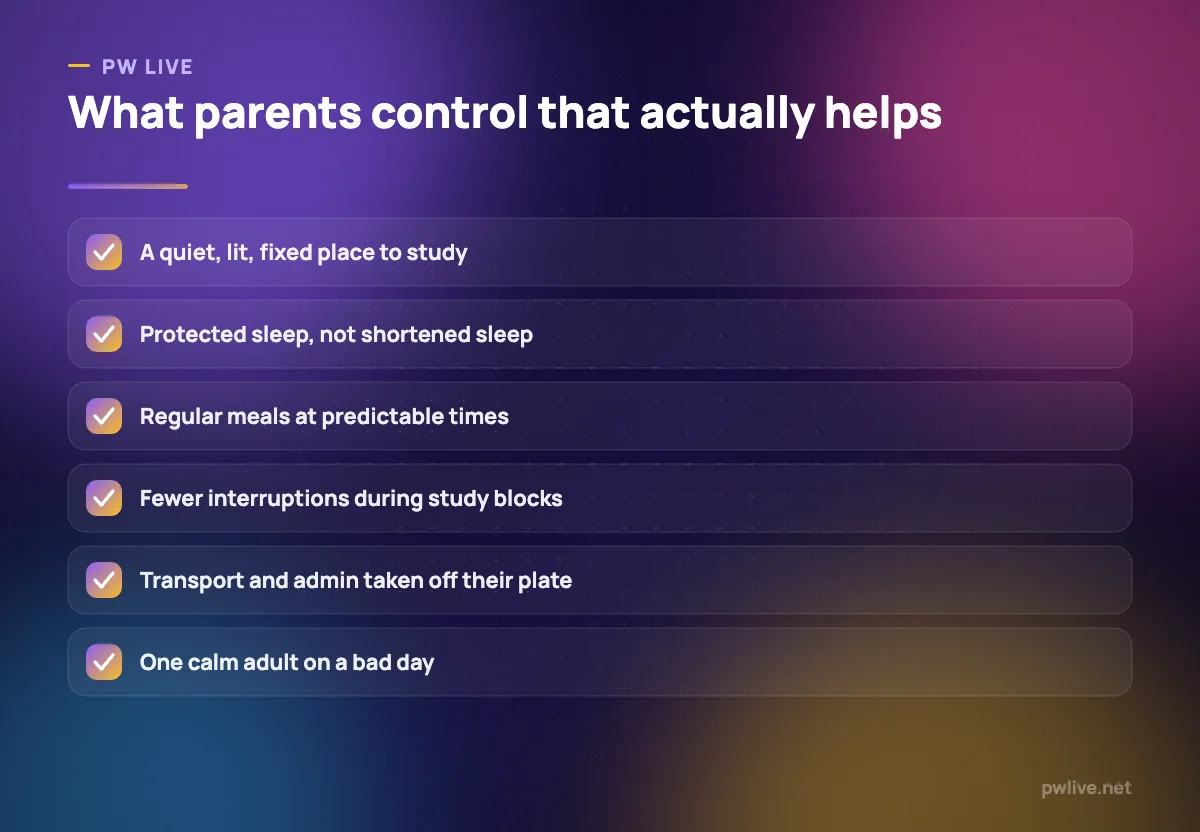
Parents often have less influence over studying than they think and far more influence over the conditions around it. The conditions are where your effort pays off.
- A physical space. A fixed, reasonably quiet, well-lit place with a chair that does not hurt. Our guide to setting up a study space in a small or shared home covers what to do when space is genuinely tight.
- Protected sleep. Late-night studying looks like dedication and costs marks. The link is set out in sleep and study performance.
- Predictable meals. Regular food at regular times removes a daily decision and a daily crash.
- Fewer interruptions. Guests, errands and household requests during a study block are more disruptive than most families realise.
- Logistics taken over. Forms, fees, admit cards, travel to the exam centre. Removing administrative load is real help.
- A calm adult available. Not a fixer, not an interrogator. Someone who can sit with them on a bad evening.
Talk about phones without a war
Phone use is the most common conflict in a preparing household, and confiscation usually produces resentment plus a hidden second device.
A better route is negotiated structure. Agree together on when the phone is away, where it goes during study blocks, and what happens on the weekend. Rules the student helped set are far more likely to survive.
Be realistic about what the phone is for. It carries their study material, their friends and their relaxation, and cutting all three at once is not sustainable through a long preparation. Our digital detox guide has approaches that work without a total ban.
Model it as well. A rule about screens that applies only to the student rarely holds for long.
Watch for the signs that matter
Ordinary exam stress is uncomfortable and normal. Some signs indicate something beyond that and deserve attention rather than encouragement to push harder.
Take it seriously if you see: sleep that has collapsed for more than a couple of weeks, withdrawal from everyone including friends, appetite changes, physical complaints with no cause, a student who has stopped studying entirely rather than studying badly, or any expression of hopelessness.
The response is not more pressure and not more freedom. It is a conversation without an agenda, a reduction in load, and professional help if it persists. Our guides to exam stress and burnout and anxiety before exams describe what helps and what makes it worse.
Keep the long view in the room
One exam does not determine a life, and students under pressure genuinely lose sight of that. Parents are the only people positioned to keep it visible.
Say out loud, more than once, that there are multiple routes forward and that your relationship does not depend on a rank. It sounds obvious; students frequently do not believe it unless it is said directly.
It also helps to know what the alternatives actually are, so the reassurance is concrete rather than vague. Our guide to choosing between JEE, NEET and other paths after Class 12 sets out the realistic options, and the career readiness skill track covers the skills that matter regardless of which route a student takes. More material for students and families is collected in the education and learning archive.
Key takeaways
- High expectations help; surveillance about hours and marks does not
- Ask about process and obstacles rather than scores and comparisons
- After a bad result, wait a few hours, diagnose the error types, agree one change
- Drop comparisons entirely and compare the student with their own past instead
- Focus your effort on space, sleep, food, interruptions and logistics
- Watch for withdrawal, collapsed sleep and hopelessness, and respond with less load, not more
Frequently asked questions
How do I motivate a child who has stopped studying?
Find the cause before applying pressure. Stopping usually signals a topic they cannot get past, a fear of failing, or exhaustion, and each needs a different response than a stricter routine.
Should I check their study hours every day?
Daily hour-counting tends to produce reported numbers rather than real work. A weekly conversation about what got done and what is planned next is more useful and less corrosive.
How involved should I be in choosing their course or exam?
Share information, constraints and experience, then leave the decision with them. A path chosen under parental instruction is much harder for a student to sustain through the difficult months.
What should I say the night before a big exam?
Very little about the exam. Confirm the logistics, make sure they eat and sleep, and say plainly that you are proud of the work regardless of the result.
Keep learning with PW Live
Browse every guide in Education & Learning, or pick a skill track and follow the roadmap step by step.





Leave a Reply