

A result that did not go your way can feel like a verdict on everything, and it usually arrives on a day when you have no capacity to argue with it. If that is where you are right now, start here: this is survivable, it is common, and it is far less final than it feels today.
You are not the first person to open a result and feel the floor go. Many people you admire have been exactly here, and most of them do not talk about it, which is precisely why it feels so isolating.
This guide is about getting through the first week, then working out what actually happened and what to do next. Take it slowly. None of it needs to happen today.
Let the first few days be difficult
The first instinct is often to jump straight to solutions, or to hide it and act as though nothing happened. Both tend to prolong the difficulty.
Disappointment after something you worked hard for is a normal, healthy response. It is not self-pity and it is not weakness. Let it be there for a couple of days without rushing to fix it or explain it.
Do the ordinary things while you do. Eat properly, sleep, get outside, sit with people. You are not required to be productive this week.
Tell one person, early
Silence makes a bad result heavier. The story in your head gets bigger and more permanent when nobody else hears it.
Tell one person you trust: a parent, a friend, a sibling, a teacher, a senior. You do not need to have processed it or have a plan. “It did not go well and I am struggling with it” is enough.
If the reaction you fear most is at home, remember that disappointment from family is usually fear rather than judgement, and it often softens within days. Our guide on how parents can support a student without adding pressure is written to be shared, and our guide to building a support system when studying gets hard covers who else to lean on.
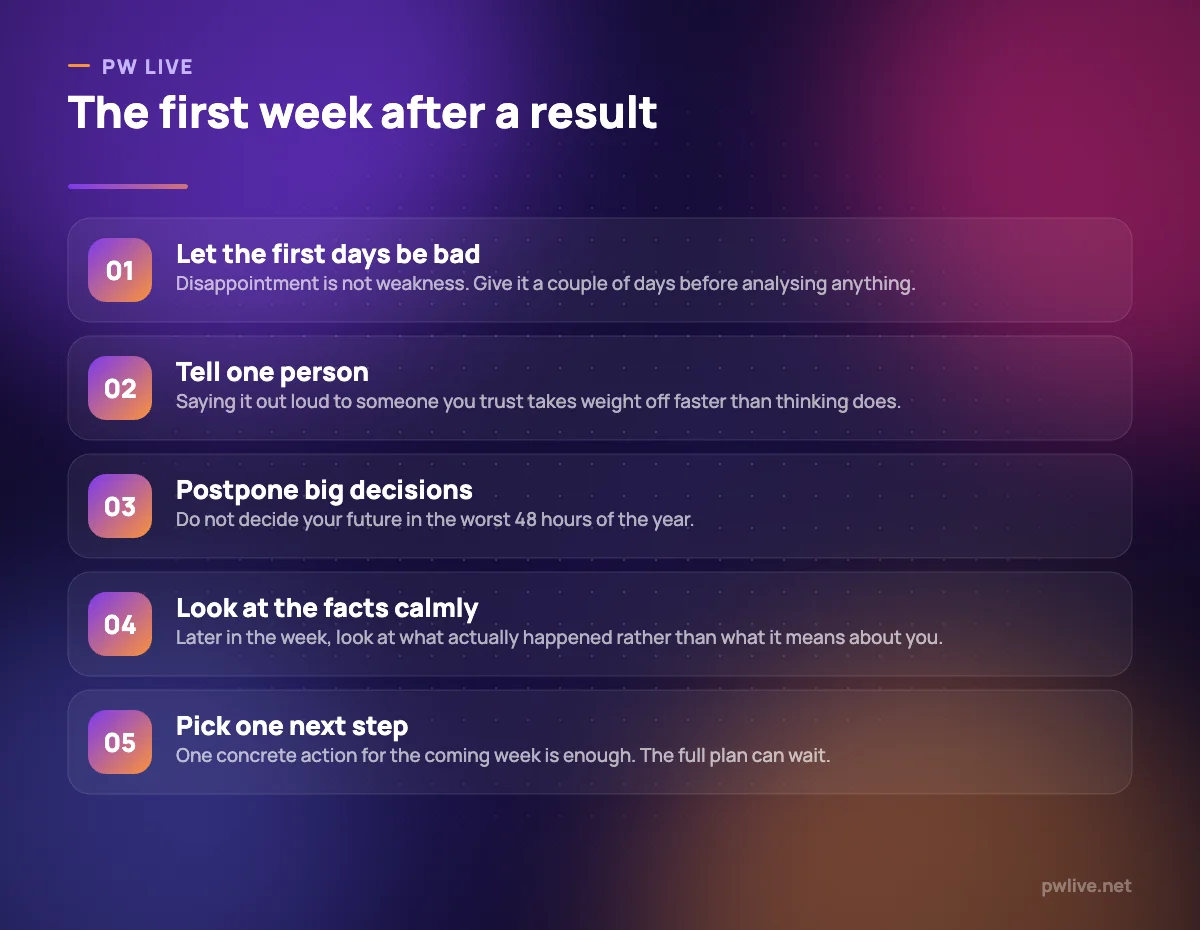
Postpone the big decisions
In the first days after a result, everything looks binary. Quit or repeat. Change everything or nothing. Accept whatever is in front of you immediately.
Almost none of those decisions need to be made this week. Deadlines usually allow more time than panic suggests, and decisions made in the worst 48 hours of the year are rarely the ones you would make a fortnight later.
Write down the actual deadlines. Then park anything that is not due yet, and give yourself permission to be undecided until you have some steadiness back.
Work out what actually happened
Once the sharpest part has passed, usually after several days, it is worth looking honestly at the result. Not to punish yourself, but because vague guilt is useless and specific information is not.
Look at these separately:
- Preparation. Was there enough time on the syllabus, or were whole areas thin?
- Method. Were you re-reading and highlighting, or actually testing yourself?
- Exam execution. Time management, question selection, silly errors, panic.
- Circumstances. Illness, family situations, a disrupted term. These are real and they count.
- Fit. Was this the right target, the right route, or the right moment for it?
Most disappointing results come from method and execution rather than ability. That is genuinely good news, because both are fixable. Our guide to analysing a mock test and actually improving your score gives a structure for this kind of review, and our piece on active recall covers the method problem that catches most students.
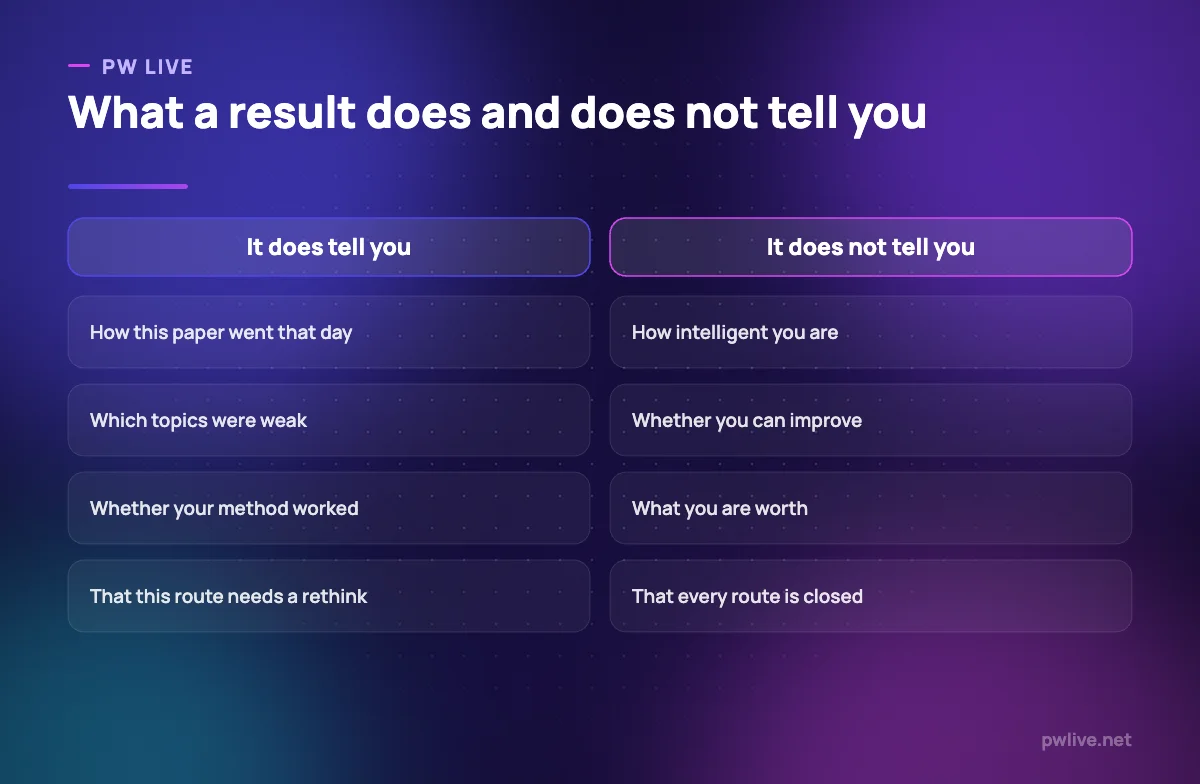
Separate the result from your worth
This is the part that matters most, so it is worth saying plainly. A result measures a slice of your preparation on one particular day, under one particular set of conditions. It does not measure your intelligence, your potential, your character or your value as a person.
The people who love you did not love you for a number. They will not stop now.
Notice the language you are using about yourself. “I failed” describes an event. “I am a failure” is a story, and it is not a true one. If you would not say it to a friend in the same situation, do not say it to yourself.
Comparison makes all of this worse, particularly online. Other people’s results are not information about your future, and stepping away from those feeds for a while is a reasonable thing to do. Our digital detox guide covers how.
Rebuild with one small step
You do not need a full plan yet. You need one thing you can do in the coming week that moves you slightly forward.
That might be a conversation with a teacher, a list of options with their deadlines, a single study session on the weakest topic, or an honest look at alternative routes. One step is enough to break the stuck feeling, and momentum builds from there.
When you are ready for a full plan, build it from what the review told you rather than from guilt. Our guide to catching up when you have fallen behind in a subject is a good starting point, and if you are rebuilding a longer preparation, the six-month exam preparation timeline gives you a structure.
Deciding whether to repeat, switch or continue
Three questions help more than any general advice.
- Do you actually want this outcome, or do you want the approval that comes with it? Both are understandable, but only one sustains another year of work.
- Do you know what you would change? Repeating with the same method usually produces a similar result. Repeating with a different method is a different proposition.
- What does the honest alternative look like? Not the imagined worst case, but the real options, with their actual entry routes and outcomes.
There is no universally right answer, and the people insisting there is usually have no stake in your life. Plenty of successful paths run through a repeat year, a different course, a different entrance route or a completely different field. Our guide to choosing between JEE, NEET and other paths after Class 12 lays out how the options connect, and the career readiness track covers building skills alongside whichever route you choose.
Look after yourself while you decide
Disappointment that stays for a long time deserves attention, not endurance.
Please speak to a doctor, a school or college counsellor, or a trusted adult or friend if low mood, hopelessness or exhaustion persists beyond the first weeks, if it is affecting your sleep, appetite, health or daily life, if you are withdrawing from everyone, or if you have any thoughts of harming yourself. If that last one is present, tell someone you trust straight away rather than waiting. Help exists, it works, and asking for it is one of the strongest things you can do.
For related reading, our exam anxiety guide covers the pressure side, and the wider career archive covers what comes after.
Key takeaways
- Let the first few days be difficult. Analysis works better once the sharpest part has passed.
- Tell one person early. Silence makes a bad result heavier than it needs to be.
- Postpone big decisions. Write down the real deadlines and park everything not yet due.
- Review preparation, method, execution and circumstances separately. Most causes are fixable.
- A result describes a day’s performance, not your intelligence, your future or your worth.
- Rebuild with one small step, and speak to a doctor or counsellor if difficulties persist or affect daily life.
Frequently asked questions
How long does it take to feel normal after a bad result?
For most people the sharpest feelings ease within a couple of weeks, though disappointment can come and go for longer. If low mood persists or starts affecting your sleep, eating or daily life, speak to a doctor or counsellor.
Should I take a drop year and repeat the exam?
Only if you genuinely want the outcome, you know specifically what you would do differently, and you have looked honestly at the alternatives. Repeating with the same preparation method rarely produces a different result.
How do I face my family and friends after this?
Say the plain version early rather than managing everyone’s expectations in silence. Most reactions soften quickly, and the people who matter are far more interested in how you are doing than in the number.
Does one bad result close off my career options?
Very rarely. Most fields have several entry routes, and employers care far more about skills, projects and experience than about a single result from years earlier, as our guide on switching careers without starting from zero shows.
Keep learning with PW Live
Browse every guide in Health & Wellness, or pick a skill track and follow the roadmap step by step.





Leave a Reply