

Insurance is the least enjoyable part of personal finance and one of the most consequential. It is the only tool that protects everything else you are building, because a single uninsured event can wipe out years of saving.
It is also the area where people are sold the most and understand the least. Policies that bundle protection with investment, cover that is too small to matter, and claims rejected over a form filled in carelessly are all common.
This article is general educational information, not personalised financial advice. Products, premiums, tax treatment and regulations change, so read the current policy wording and speak to a qualified adviser before buying or cancelling any cover.
What insurance is actually for
Insurance transfers a risk you cannot afford to carry to someone who can. You pay a small, certain amount so that a large, uncertain loss becomes somebody else’s problem.
That definition has a useful consequence: insure what would be financially catastrophic, not what would be annoying. A hospital stay, the loss of the family’s main income, or a serious accident belong in that category. A cracked phone screen or an extended warranty on a small appliance generally do not, because you could absorb those from savings.
It also means insurance is not an investment and should not be judged like one. If a policy returns you money, you paid for that feature somewhere. Keeping the two separate usually makes both clearer, a theme we pick up in our comparison of mutual funds and fixed deposits.
Health cover: the first policy most people need
Medical costs are the most common cause of financial damage for households that were otherwise doing fine. Health insurance is where most people should start.
What to understand before you compare policies:
- Sum insured. The maximum the insurer will pay in a policy year. Costs at private hospitals in cities have risen over time, so a figure that felt generous some years ago may not be now.
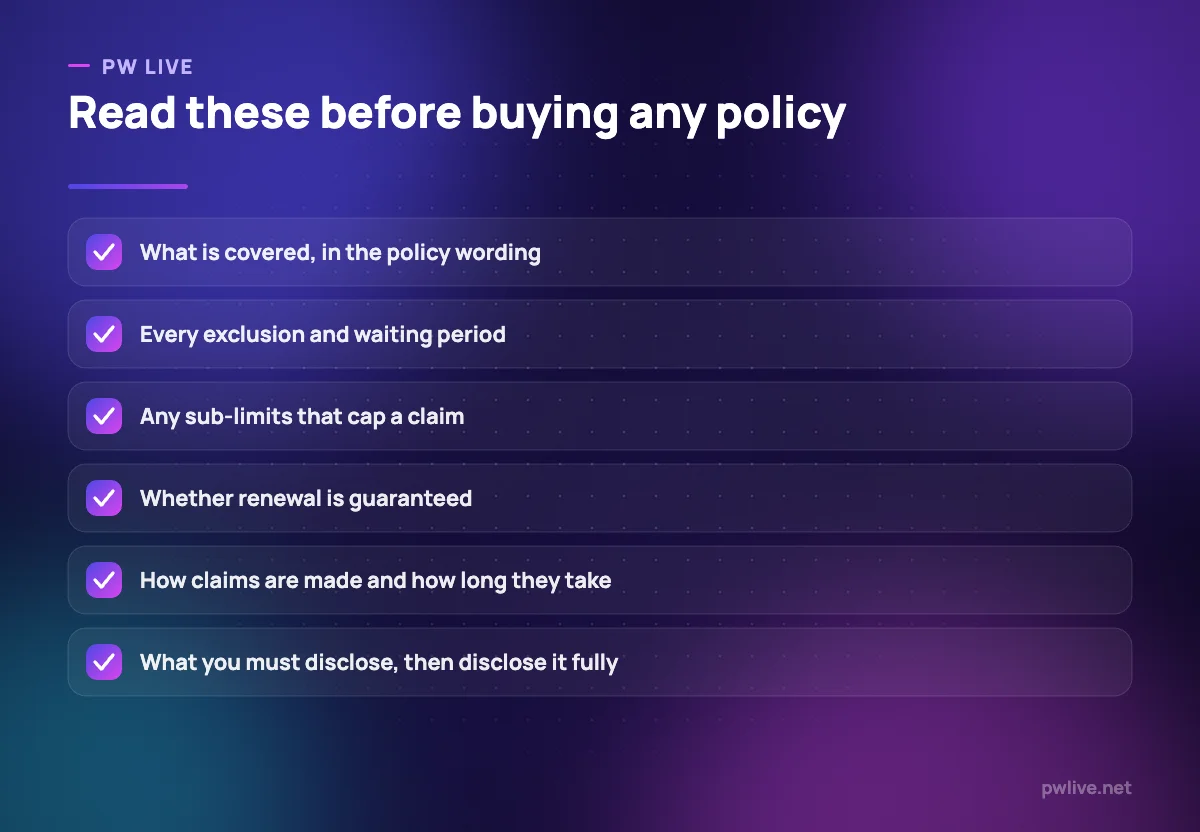
- Waiting periods. Most policies do not cover pre-existing conditions immediately, and some treatments have their own waiting period. These are defined in the wording.
- Sub-limits. Caps on specific items such as room category, particular procedures or consumables. A high sum insured with tight sub-limits can still leave you paying a lot.
- Cashless network. Which hospitals near you have a cashless arrangement, and what happens if you use one that does not.
- Renewability and premium changes. Whether renewal is guaranteed and how premiums move with age and claims.
- Exclusions. The list of what is never covered. Read it fully.
Family floater policies cover several people under one sum insured, which is efficient but means one large claim can exhaust the cover for everyone. Ageing parents often need a separate policy, and premiums for older members are typically higher.
Term life cover: who needs it and who does not
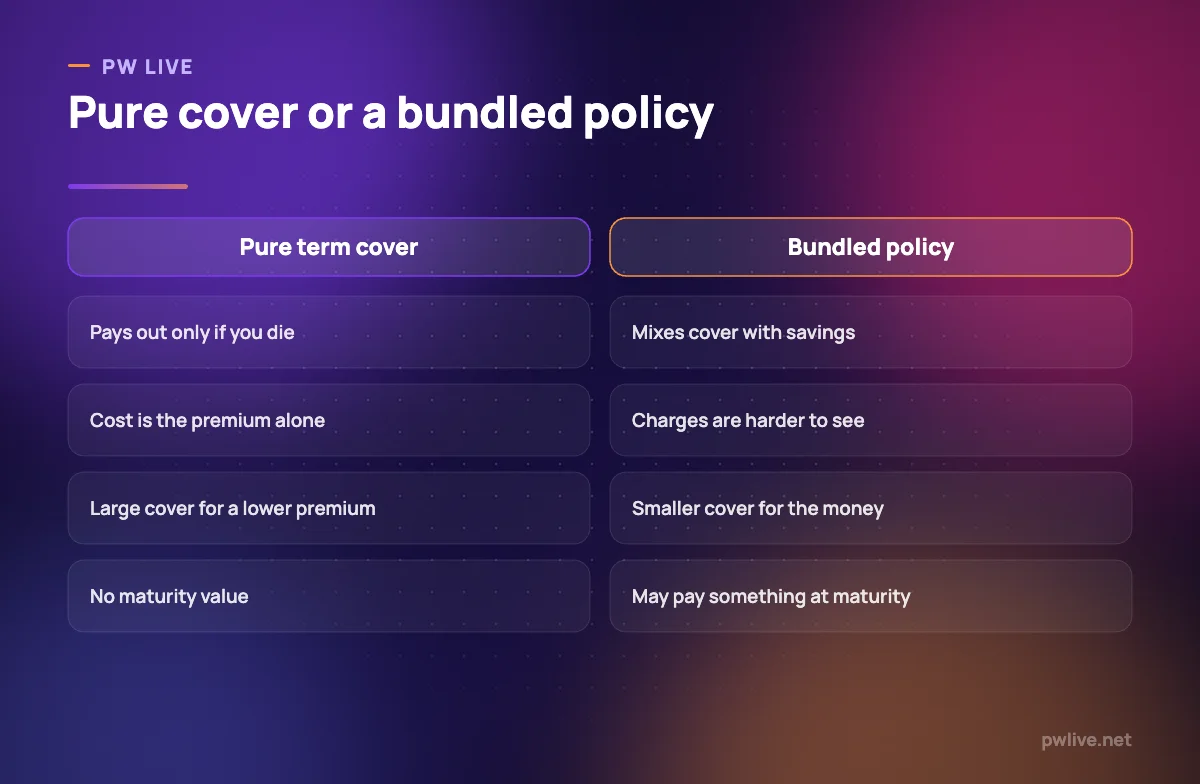
Term insurance pays a fixed sum to your nominee if you die during the policy period. There is no maturity payout. That is why the cover per rupee of premium is far higher than in policies that also return money.
The test for whether you need it is simple: does anyone depend on your income? If a partner, children, parents or a joint loan would be in difficulty without your earnings, you need cover. A single earner with no dependants and no debts usually does not, though buying earlier generally means a lower premium locked in for longer.
On sizing, a commonly cited rule of thumb is a multiple of annual income, often quoted somewhere between ten and fifteen times. Treat that as a starting point rather than an answer. A more considered approach adds up what the money must actually do: replace income for a set number of years, clear outstanding loans, and fund specific future costs such as education.
Two practical points. Name a nominee and tell that person the policy exists, because unclaimed policies are more common than they should be. And keep the policy document somewhere the family can find it.
What employer-provided cover does and does not do
Group health cover through your employer is a genuine benefit and appears in your compensation package, as we explain in how to read your salary slip.
It has three limitations worth planning around. It ends when the job does, usually at the worst possible moment. The sum insured is chosen by the employer, not by you. And relying on it means you first buy your own cover later in life, when premiums are higher and any condition you have developed may face a waiting period.
Treating group cover as a supplement to your own policy, rather than a replacement for it, avoids all three.
Policies that mix insurance with investment
Endowment plans, money-back policies and unit-linked plans combine protection with a savings or investment element. They are legitimate products, and they are also the ones most often sold to people who did not go looking for them.
Before buying any bundled product, ask three questions and get the answers in writing:
- How much cover am I actually getting for this premium, and how does that compare with a pure protection policy for the same money?
- What are the charges, including allocation, administration, fund management and mortality charges, and how do they change over the policy’s life?
- What happens if I stop paying, or need to exit in a few years?
Illustrations of future value are projections based on assumed rates, not promises. Read what the assumption is. If the product is being recommended primarily for tax reasons, remember that tax rules change and a policy typically runs for decades.
Getting the practical details right
- Disclose everything. Medical history, habits, existing policies and income. Non-disclosure is one of the most common reasons a claim is refused, and the family finds out at the worst time.
- Read the wording, not the brochure. The brochure sells; the policy document decides.
- Use the free-look period. Regulations provide a window after purchase during which you can return a policy. Check the current period and terms in your document.
- Keep documents accessible. Policy numbers, insurer helpline, nominee details and hospital network lists, saved somewhere your family can reach.
- Review annually. Marriage, children, a home loan or a significant income change all alter what you need.
- Do not cancel old cover before new cover is active, particularly health policies where waiting periods restart.
Insurance sits alongside, not instead of, an emergency fund, because claims take time to settle and many costs are not covered at all. For the wider plan, see how to set money goals you will actually stick to, the finance category and the personal finance skill track.
Key takeaways
- Insure what would be financially catastrophic; absorb what would merely be inconvenient.
- Health cover is usually the first priority, and sub-limits and waiting periods matter as much as the sum insured.
- Term cover is for people whose income others depend on, and it is sized by need, not by a rule of thumb alone.
- Employer cover ends with the job, so treat it as a supplement to your own policy.
- Bundled insurance and investment products need explicit answers on cover, charges and exit terms.
- Full disclosure at the application stage is the single biggest protection against a rejected claim.
Frequently asked questions
How much health cover do I actually need?
It depends on where you live, the hospitals you would realistically use and your family’s medical history, since treatment costs vary widely. Look at actual costs at hospitals near you rather than at a generic figure, and review the amount every few years.
Is term insurance a waste if nothing happens?
No claim means the risk you paid to transfer did not occur, which is the intended outcome. Judging protection by whether it paid out is like calling a seatbelt wasteful because you did not crash.
Should I buy insurance to save tax?
Tax treatment can be a secondary benefit, but it is a poor primary reason, because rules change while policies run for decades. Decide first whether you need the cover, then check the current tax position with a qualified adviser.
Do I still need my own health policy if my employer provides one?
Group cover ends when your employment does and its sum insured is set by the employer. Many people keep a personal policy alongside it so they are never uninsured during a job change.
Keep learning with PW Live
Browse every guide in Finance & Investing, or pick a skill track and follow the roadmap step by step.





Leave a Reply