

Inventory management basics are what separate an online business that runs smoothly from one that lurches between overselling and dead stock. Every rupee sitting in unsold goods is a rupee you cannot spend on marketing, and every stockout is a sale that quietly went to somebody else.
You do not need warehouse software to fix this. For most small sellers, a disciplined spreadsheet and a weekly routine will do the job for a long time.
This guide covers the practices that matter: coding your products, tracking movement, knowing when to reorder, counting honestly and keeping multiple sales channels in step.
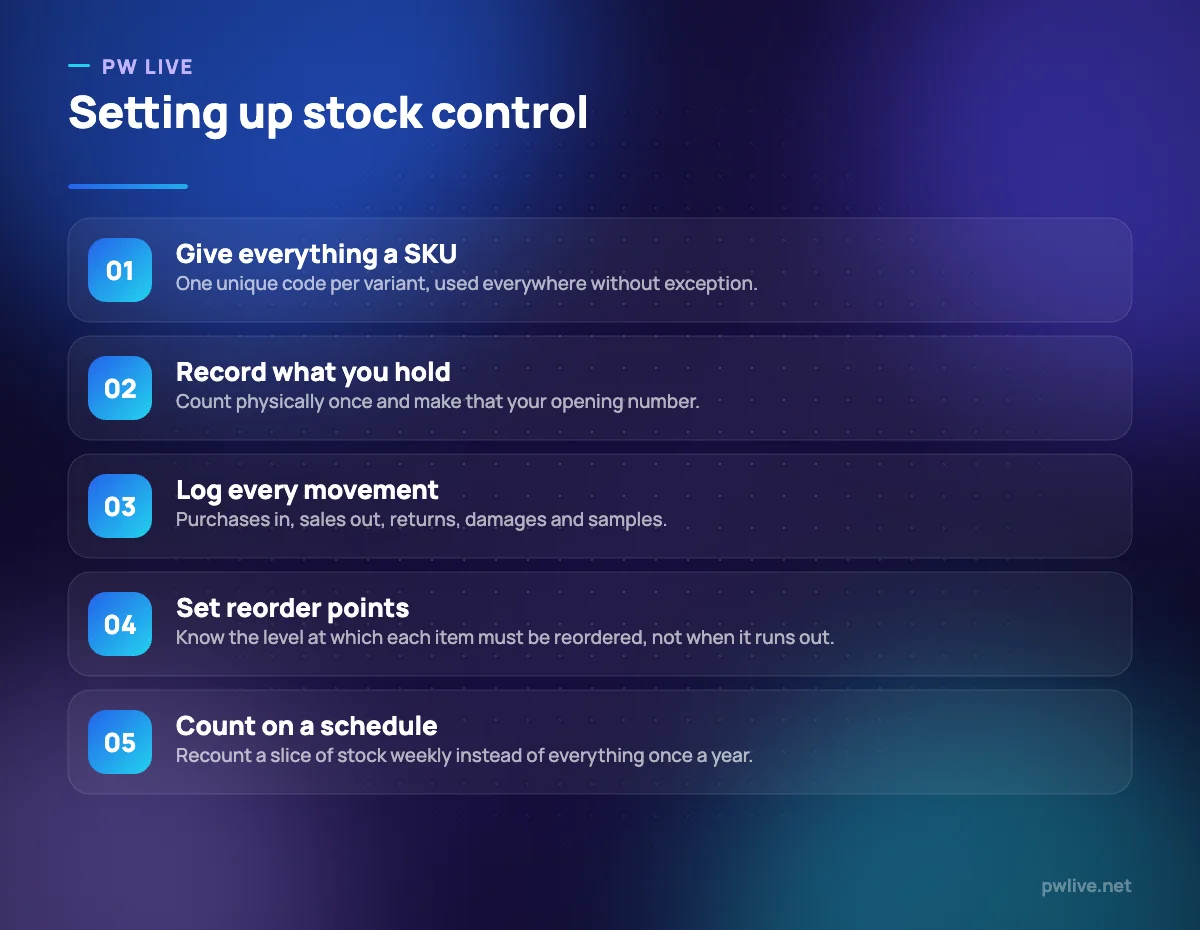
Give every product a SKU and use it everywhere
A SKU is a unique code for one specific sellable item. Not the product, the variant. A shirt in blue, size M is a different SKU from the same shirt in blue, size L.
Without SKUs, nothing else in this article works, because you can never be certain which physical thing a number refers to.
Build codes that a human can read at a glance:
- Keep them short, uppercase and free of spaces.
- Encode meaning in sections: category, product, variant. For example, TSH-BLU-M.
- Never reuse a retired code for a different item.
- Use the same SKU in your spreadsheet, on your shelf labels, in your marketplace listings and on your purchase orders.
Print the SKU on a label and stick it to the shelf or bin where that item lives. Picking errors, which are a common cause of returns, fall sharply when the bin says what it holds.
Track movement, not just what you have
A stock number is only trustworthy if every change is recorded. Four movements matter and three of them are commonly forgotten.
- In: goods received from a supplier, counted against the purchase order rather than assumed correct.
- Out: items sold and dispatched.
- Returns: items coming back, sorted into resellable and write-off.
- Shrinkage: damages, samples, giveaways, items used for photography and anything that simply disappeared.
Record each with a date, the SKU, the quantity and a reason. A single sheet with those four columns is enough to begin. What you must not do is adjust a number without noting why, because unexplained corrections hide the problems you need to find.
Work out how much to hold
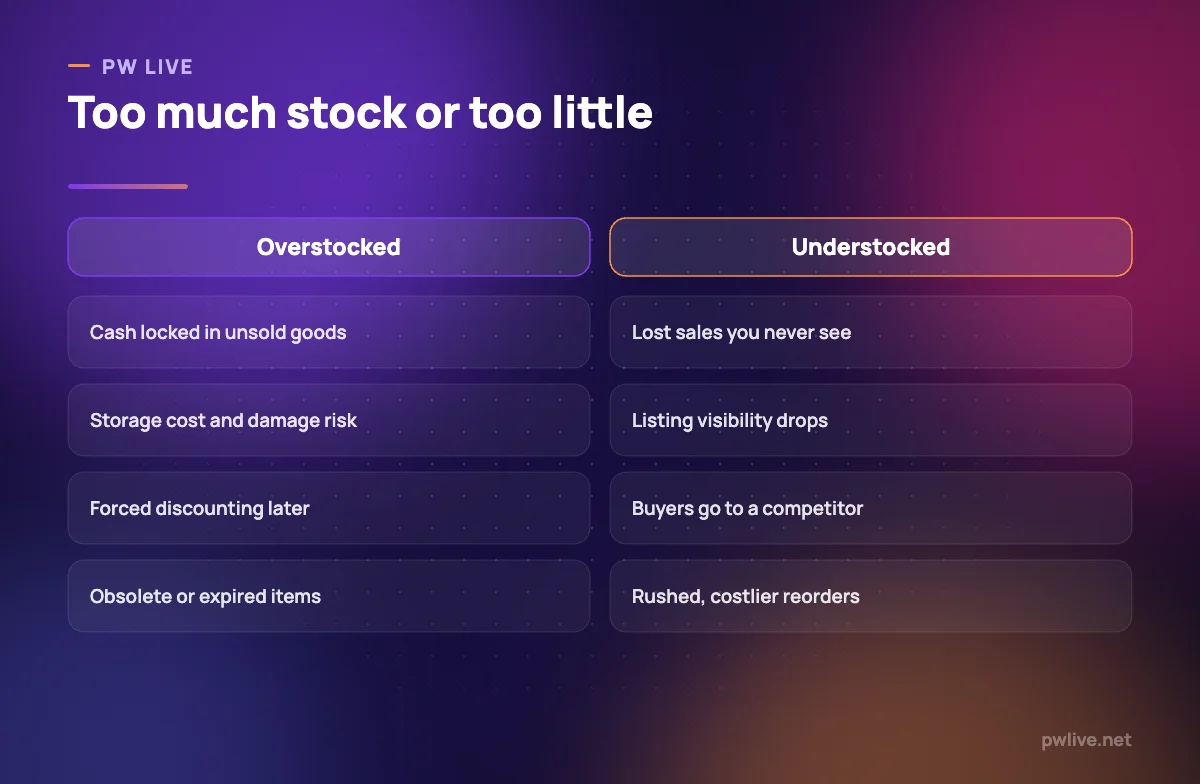
Holding stock is a bet. Too much and your cash is trapped in cartons. Too little and you lose sales you never even see.
Three concepts settle most decisions.
Lead time. How many days from placing an order with your supplier to having it on your shelf, including transport and any inspection. Measure the real figure, not the promised one.
Average daily sales. Total units sold over a period, divided by the days in that period. Calculate it per SKU, because fast and slow movers behave nothing alike.
Safety stock. A buffer for the weeks when demand spikes or your supplier is late. Set it in days of cover rather than a fixed number of units.
Your reorder point is roughly the units you expect to sell during the lead time, plus your safety stock. When stock on hand hits that level, you place the order. Waiting until an item is nearly gone guarantees a stockout, because the goods cannot arrive instantly.
Review reorder points every couple of months, and before any seasonal peak.
Know which items deserve your attention
Not all stock deserves equal effort. In most catalogues, a small number of SKUs generate most of the revenue.
Sort your products by revenue over the last quarter and split them into three groups.
- Top group: your best sellers. Never allow these to go out of stock. Check them weekly, hold generous safety stock and build good supplier relationships for them.
- Middle group: steady but unspectacular. Check monthly, keep modest cover.
- Bottom group: slow movers. Hold little or nothing, order only against demand, and be willing to discontinue.
The bottom group is where cash goes to die. Be honest about items that have not sold in months. Discount them, bundle them with a fast mover, or write them off and move on. The storage, the attention and the trapped cash cost more than the loss you are avoiding.
Count physically, on a schedule
Your recorded numbers will drift from reality. Miscounted deliveries, unlogged damages and picking errors all accumulate.
Rather than one exhausting annual count, adopt cycle counting: count a small slice of your stock frequently. For example, count your top sellers every week and work through the rest of the catalogue over a month.
When you find a discrepancy, do two things. Correct the number, and write down the likely cause. After a few weeks the causes repeat, and fixing the cause is what stops the drift.
Count when you are not dispatching, keep a fixed count sheet per shelf, and have someone else recount anything that looks badly wrong before you adjust it.
Keep multiple channels in step
Selling on a marketplace and your own website at once creates the classic problem: two buyers purchase the last unit within minutes of each other.
Overselling is expensive. You cancel an order, disappoint a buyer, and on most marketplaces cancellations damage your seller metrics.
Options, from simplest to most capable:
- Split stock between channels. Crude but safe. Allocate units to each channel and never let either sell beyond its allocation.
- Buffer the fast channel. Keep a small reserve unlisted so the last few units are never sold twice.
- Use a syncing tool. Multi-channel inventory tools update every channel when a sale happens anywhere. Worth the cost once volume rises.
Whichever you choose, keep one place that is the single source of truth for stock. If two sheets disagree, you have no stock system, only two guesses. Our comparison of marketplace vs own website selling covers the wider channel decision.
Watch the numbers that reveal trouble early
Four simple measures tell you almost everything about stock health.
- Days of cover: stock on hand divided by average daily sales. Tells you how long until you run out.
- Stock turnover: how many times you sell through your average inventory in a period. Higher usually means healthier cash use.
- Stockout days: how many days each top SKU was unavailable. This is lost revenue you would otherwise never notice.
- Ageing stock: value of goods held longer than a chosen period, such as ninety days.
Put these in one sheet and review them monthly. Inventory is where cash flow problems begin, so read them alongside cash flow basics and unit economics explained. Our guide to using spreadsheets covers the formulas if you are building this yourself.
Grow into tools, do not start with them
Start with a spreadsheet. It is free, flexible and forces you to understand your own numbers.
Move to dedicated inventory software when you hit specific pain: several sales channels, more than a few dozen SKUs, batch or expiry tracking, or more than one person handling stock. Look for multi-channel sync, purchase order handling, low-stock alerts and reports you will actually read.
Whatever you use, the discipline matters more than the tool. Log every movement, count on a schedule, and act on reorder points. Browse the e-commerce and retail archive for related guides, or build the underlying habits through the productivity skill track.
Key takeaways
- Give every variant a unique, readable SKU and use it on shelves, listings and purchase orders.
- Log all four stock movements: goods in, sales out, returns and shrinkage, always with a reason.
- Set reorder points from real lead time plus average daily sales plus a safety buffer, not from an empty shelf.
- Rank SKUs by revenue and protect the top group; be ruthless about slow movers tying up cash.
- Cycle count a slice of stock weekly and record the cause of every discrepancy, not just the correction.
- Keep one source of truth for stock across channels, and buffer or sync to avoid overselling.
Frequently asked questions
How much safety stock should I hold?
Enough to cover normal variation in demand and supplier delay, expressed in days of cover rather than units. Hold more for your best sellers and for suppliers with unreliable lead times, and less for slow movers.
Do I need inventory software from the start?
No. A well-maintained spreadsheet handles a small catalogue on one or two channels. Upgrade when you have several channels, many SKUs, expiry tracking or more than one person touching stock.
What should I do with stock that will not sell?
Try a discount, a bundle with a popular item or a clearance push first. If it still does not move, write it off and free the space and attention, because holding it costs more than the loss you are postponing.
How often should I count stock physically?
Count your top sellers weekly and rotate through the rest so everything is counted at least monthly. Frequent partial counts catch errors early and are far less disruptive than an annual full count.
Keep learning with PW Live
Browse every guide in E-commerce & Retail, or pick a skill track and follow the roadmap step by step.





Leave a Reply