

Most people do not fail at money goals because they lack discipline. They fail because the goal was never specific enough to act on. “Save more” and “start investing” cannot be scheduled, measured or finished, so they quietly lose to everything that can.
A money goal that works has four properties: a name, a price, a date and a monthly amount. Once those exist, the goal stops being an intention and becomes a line in your calendar.
This article is general educational information, not personalised financial advice, and a qualified adviser is the right person to consult before decisions about your own money.
Why vague goals lose
A goal competes for your money against everything else that wants it, and vagueness makes it lose every time. “Save for the future” has no deadline, so there is never a month in which not saving is a visible failure.
There is a second problem. Without a defined target you cannot tell whether you are on track, so there is no feedback and no sense of progress. Progress is what keeps a habit alive.
The fix is unglamorous. Convert each goal into a number and a date, then work backwards.
Make each goal specific enough to act on
Write goals the way you would write a task, not a wish.
- Not “save for travel” but “trip home in December, flights and gifts”.
- Not “buy a laptop someday” but “replacement laptop for freelance work by August”.
- Not “invest for the future” but “retirement, monthly, no withdrawals”.
- Not “build savings” but “three months of essential expenses in an accessible account”.
The specificity does real work. It tells you the amount, the deadline and, later, whether a purchase counts as raiding the goal or fulfilling it. That last point is why your emergency fund needs a written definition of what counts as an emergency.
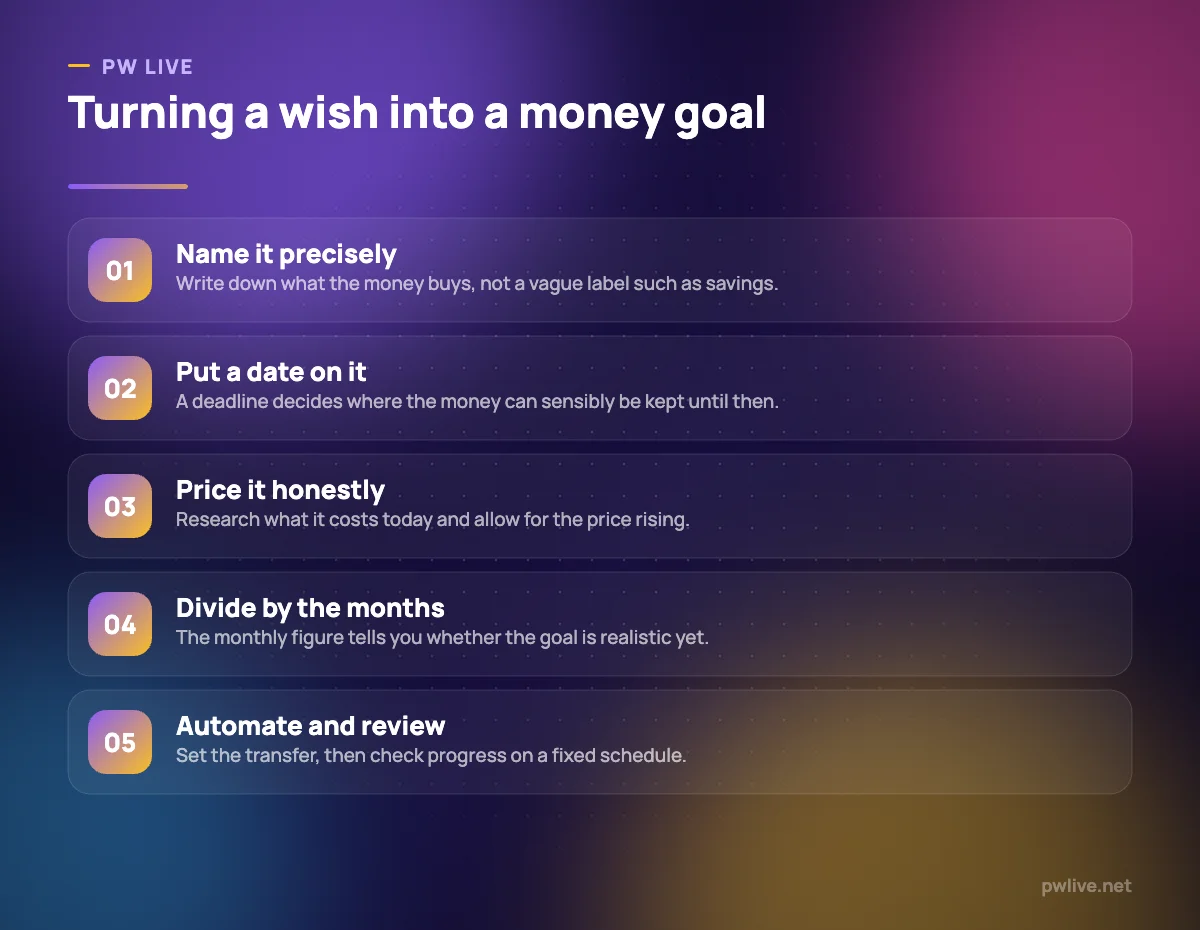
Price it, then divide by the months
Now make it arithmetic. Take a hypothetical example with round numbers: a laptop you have priced at 60,000, which you want in ten months. That is 6,000 a month. The moment you see that figure, you learn something you could not learn from the wish.
One of three things is true.
- The number fits. Set the transfer and move on.
- The number is close but tight. Adjust one lever: extend the date, reduce the target, or fund part of it from irregular money like a bonus or a refund.
- The number is impossible. Then the goal as stated is not real yet, and pretending otherwise is how people end up borrowing for it. Change the timeline, change the target, or park it and work on income.
Always price the goal at today’s cost with some allowance for prices rising over the period, particularly for anything years away such as education or a home deposit.
Rank your goals instead of running all of them
Running six goals at once usually means finishing none. Ranking them feels restrictive and is the reason people actually complete things.
A sequence many people find workable:
- Cover essential expenses reliably, so the month balances before saving begins.
- Build a small starter cushion for emergencies.
- Clear expensive debt, especially anything on a credit card, because paying that interest usually outweighs what saving earns. Our guide on how to avoid debt traps covers the order of attack.
- Grow the emergency fund towards a few months of expenses.
- Fund long-term goals such as retirement, consistently and boringly.
- Then medium-term goals: a car, a course, a trip.
Your order may differ, and life events can reshuffle it. What matters is that an order exists, so that when money is short you know what pauses and what does not.

Give every goal the right home
Money for different horizons should not sit in the same place. The date drives the choice.
Short-term money needs to be there in full on the day you need it, which rules out anything whose value can fall. Long-term money can accept fluctuation in exchange for the possibility of growth, which is the argument behind investing regularly and letting time do the work, as explained in what a SIP is and how compounding works.
Two practical habits help enormously. Keep goals in separate accounts or clearly labelled buckets, because a single pot of undifferentiated savings gets spent. And do not keep a goal you will fund next year in something you cannot access for five, however attractive the return looks.
Rates, product rules and tax treatment change, so confirm current terms with the provider or an official source rather than relying on figures from an article.
Automate the part that relies on willpower
The transfer should not be a monthly decision. Set a standing instruction for the day after your income arrives, so saving happens before spending starts.
- Automate one transfer per goal where your bank allows it, so you can see progress separately.
- Give accounts obvious names, because “Dec trip” is harder to raid than “Savings 2”.
- Increase the amount whenever your income rises, before you adjust to the higher pay.
- Route irregular money, such as refunds, bonuses and freelance payments, straight to a named goal.
If sticking to routines is your weak point, the mechanics in building habits that stick transfer directly to money.
Review on a schedule, not on a mood
Checking your progress every day creates anxiety without changing anything. Checking once a year means problems compound quietly.
A short monthly review works for most people: confirm the transfers went through, note the balance of each goal, and flag anything drifting. A longer review two or three times a year is the place to ask bigger questions. Is this goal still what I want? Has the price changed? Has my income changed? Should the ranking shift?
Folding this into an existing routine makes it survive, and the weekly review habit is a natural home for the monthly money check.
When a goal should change
Changing a goal deliberately is not the same as abandoning it. Circumstances move, and a plan that cannot bend gets broken instead.
Adjust when the price genuinely changed, when your income or responsibilities changed, or when you have honestly concluded the goal no longer matters. Do not adjust because of one difficult month, because of what someone else is doing with their money, or because a headline made you anxious.
When you do change something, write down what you changed and why. A short record of your own reasoning is surprisingly useful the next time you are tempted to abandon a plan. For the fundamentals underneath all of this, see personal finance for students and first earners, browse the finance category, or follow the personal finance skill track in order.
Key takeaways
- A usable money goal has a name, a price, a date and a monthly amount.
- Dividing the target by the months tells you immediately whether the goal is realistic.
- Rank your goals so you know what pauses when money is short.
- Match each goal to a home that suits its horizon, keeping near-term money stable and accessible.
- Automate the transfer for the day after income arrives, and label accounts by goal.
- Review monthly for tracking and a few times a year for the bigger questions.
Frequently asked questions
How many money goals should I have at once?
Most people manage two or three active goals well, plus one long-term goal running quietly in the background. Beyond that, the monthly amounts get so small that nothing visibly progresses.
Should I save or clear debt first?
A common approach is to build a small emergency cushion, then focus on expensive debt, then return to saving. The right balance depends on the cost of your debt and how secure your income is, which is worth discussing with a qualified adviser.
What if I miss a month?
Missing a month is a data point, not a reason to stop. Resume the transfer, and if you have missed several, treat that as a sign the amount was set too high rather than a sign you lack discipline.
How do I stop spending money I have saved for a goal?
Keep it in a separate, clearly named account that is not linked to your everyday spending card, and write down in advance what the money is and is not for. Friction and a written rule do more than willpower.
Keep learning with PW Live
Browse every guide in Finance & Investing, or pick a skill track and follow the roadmap step by step.





Leave a Reply