

Building a startup while studying full time is possible, but only if you are honest about arithmetic. You do not have forty hours a week. You have the gaps between lectures, assignments and exams, and those gaps shrink without warning.
The students who make it work are not the ones with the most ambitious plans. They are the ones who pick a small enough idea, protect a small number of hours, and design around the academic calendar instead of pretending it does not exist.
This guide covers how to choose what to build, how to structure your weeks, what campus gives you for free, and when to stop.
Be honest about the hours you actually have
Before deciding anything, count. Write down your fixed commitments for a normal week: classes, labs, travel, assignments, sleep, meals, family obligations, any part-time work.
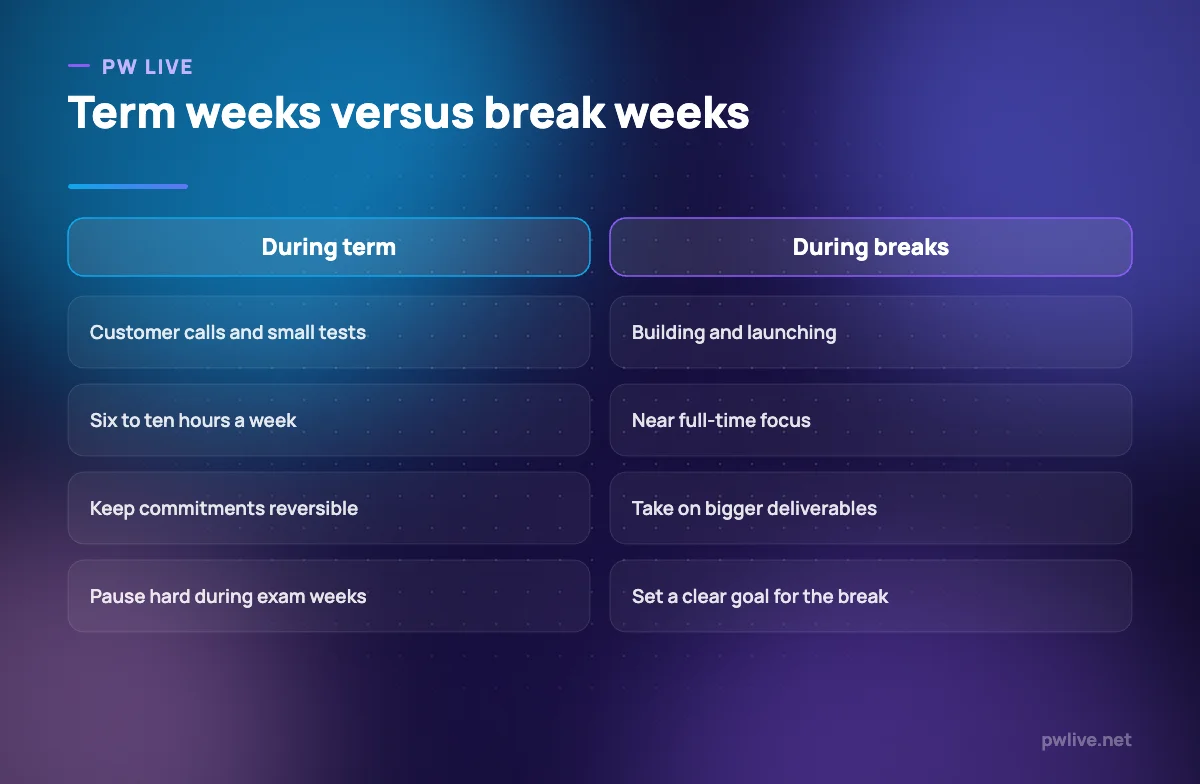
What remains is your real budget, and for most students it is somewhere between six and fifteen hours a week during term. That is enough to make meaningful progress on a narrow idea and not enough to build a complex platform.
Then map the year, not just the week. Mark exam periods, submission deadlines and breaks. Most academic years contain a few weeks of near-zero availability and a few weeks of near-full availability. Planning for both is the single biggest advantage a student founder has.
Decide now what happens during exam weeks. “I will pause everything except replying to existing customers” is a real plan. “I will figure it out” is not.
Choose an idea that fits a student’s constraints
A part-time schedule rules out some ideas and suits others very well.
Ideas that tend to work while studying:
- Service businesses using a skill you already have, such as design, tutoring, writing, video editing or web work. Revenue arrives early and costs almost nothing to start.
- Narrow tools for a community you belong to, where you are the customer and can reach users on campus.
- Content or teaching businesses built around a subject you are already studying deeply.
- Small marketplaces within a defined group, where manual matching is acceptable at first.
Ideas that usually do not:
- Anything needing heavy upfront capital or long regulatory approval
- Products requiring a large team before the first version exists
- Businesses where customers expect responses during your class hours
Our guide to finding a startup idea worth working on covers how to generate candidates, and building a business around a skill you already have is the fastest route for most students.
Protect a small number of hours, fiercely
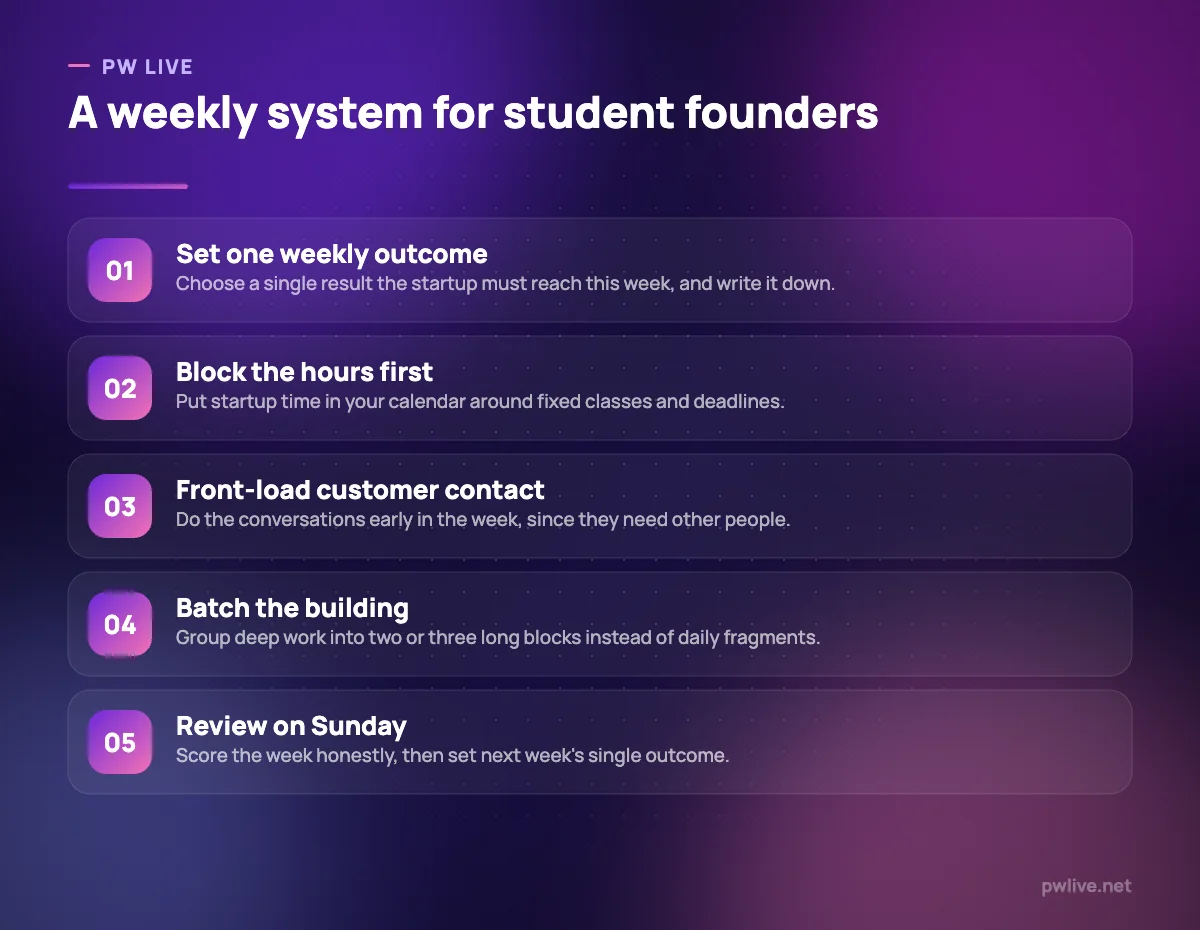
Fragmented time is the enemy. Twenty scattered twenty-minute slots produce far less than four focused two-hour blocks.
A structure that works:
- Two deep blocks a week of two to three hours each for building or writing. Same days, same times, treated as unmissable.
- One customer block of about an hour, scheduled early in the week because it depends on other people replying.
- Daily admin, capped. Fifteen minutes for messages, invoices and follow-ups. Not more.
- One weekly review, thirty minutes, to decide what the next week’s single outcome is.
Put these in the same calendar as your classes. If it is not scheduled, it will be displaced by whatever is due tomorrow.
Two supporting guides are worth reading alongside this: time blocking and how to plan a day that actually works and how to build a weekly study timetable that survives real life. The productivity track covers the underlying habits.
Use what your college already gives you
Campus is a genuinely useful startup resource, and most students underuse it.
- Users on tap. You are surrounded by people who share a context. Testing a student-facing idea is a walk across the corridor.
- Faculty knowledge. Teachers in your department often have industry contacts and are usually willing to help if you come with a specific question.
- Facilities and societies. Labs, meeting rooms, entrepreneurship cells and competitions can supply space, mentorship and small non-dilutive prize money.
- A credible identity. Being a student makes cold outreach easier. People answer a student asking to learn far more often than they answer a salesperson.
- Low fixed costs. No office, no rent, no salary pressure. Your burn rate will never be lower.
Check one thing early: your institution’s policy on work created using its facilities or during a formal project, since some carry ownership implications. Our roadmap for turning a college project into a startup covers that transition.
Sequence the work so it survives an interruption
Design your work so that a sudden two-week disappearance does not destroy anything.
Practical rules:
- Prefer reversible commitments. Short contracts, trials and pilots over long-term guarantees.
- Set expectations openly with customers. Telling a client “I reply within a day, except during exam weeks in December” is professional, not weak.
- Write things down. If a co-founder must cover for you, they need documentation, not your memory.
- Automate anything repeated. Every recurring manual task is a liability during a busy month.
- Keep one thing alive. During intense periods, maintain the single most important activity, usually serving existing customers, and pause the rest deliberately.
Cash discipline matters here too. Keep the business and your personal money separate from the first rupee, and do not fund the venture with money you need for fees or living costs.
Manage the workload before it manages you
Doing two demanding things at once is sustainable only with recovery built in. Sleep is not a variable you can borrow against for long, and the first thing tired students lose is judgement, which is exactly what a founder needs.
A few guardrails:
- One genuinely free day a week, with no startup work at all.
- A hard stop each night, so work does not expand to fill every hour.
- One person you can be honest with about how it is going.
- Regular checks on whether your marks are moving, not just your revenue.
Our guides to sleep and study performance and the exam stress and burnout guide cover the warning signs. The lifestyle and productivity archive has more on building a routine that holds.
Decide in advance when to stop, scale or pause
Ambiguity is exhausting. Set explicit rules at the start, while you are calm.
Useful ones:
- If my marks fall below a level I set now, the startup pauses for a term.
- If I have no paying customers after a set number of months, I stop and pick a new problem.
- If revenue passes a level that makes a break in studies genuinely worth considering, I will discuss it properly with people I trust, not decide it alone at 2am.
Also decide what success means to you. A profitable side business that funds your independence is a good outcome. So is a failed attempt that teaches you to sell, build and talk to strangers. Both look far better than an unfinished degree and an abandoned company.
Key takeaways
- Count your real weekly hours before choosing an idea, and plan around the academic calendar.
- Pick ideas that fit part-time constraints: services, campus tools, teaching, narrow marketplaces.
- Protect two or three long blocks a week rather than scattering the work daily.
- Use campus users, faculty, societies and low fixed costs while you have them.
- Keep commitments reversible and document everything so interruptions do not break the business.
- Write your stop, pause and scale rules in advance, and protect sleep and marks.
Frequently asked questions
Should I drop out if my startup starts working?
Rarely, and never quickly. Test whether the business survives a full term of limited attention first, and treat a break in studies as a considered decision with people you trust, not an impulse.
How do I find a co-founder on campus?
Work with someone before committing to anything. A short project together reveals far more about reliability and communication than any conversation, and settle roles and vesting before you build.
What if my parents do not support the idea?
Show progress rather than plans. A small amount of real revenue, a satisfied customer or a stable set of marks tends to change the conversation more than any argument.
Can I run a startup during a competitive exam year?
It is very difficult, and usually a poor trade. A better approach is to keep a written list of ideas and observations during that year, then start properly once the exam is behind you.
Keep learning with PW Live
Browse every guide in Startups & Innovation, or pick a skill track and follow the roadmap step by step.





Leave a Reply