

Deciding to hire your first employee is the point where a business stops being just you. It is also where small mistakes get expensive, because a bad hire costs money, time and the goodwill of everyone around them.
The good news is that most first-hire mistakes are predictable. People hire too early, define the role vaguely, interview badly and then leave the new person to work it out alone.
This guide walks through each stage, from testing whether you are ready to getting the first month right.
This article is general information, not legal, tax or employment advice. Employment obligations, registrations and payroll rules vary by state, sector and business size, and they change. Confirm your specific duties with a qualified professional or the relevant official portal before you make an offer.
First check whether you actually need an employee
Hiring is not the only way to get more done, and it is the least reversible. Before you write a job advertisement, test three things.
- Is the work steady? A permanent role needs permanent work. If demand swings, a contractor or part-time arrangement fits better.
- Can the work be removed instead? Look for tasks that could be automated, dropped, or handed to a tool. Our guide to automation for non-programmers covers a surprising amount of what people hire juniors to do.
- Can you afford it for a year? Not this month. A year, including the months where sales dip.
Run the numbers before the emotions. Add up the full annual cost of the role and check it against your forecast using cash flow basics. A salary is a fixed monthly outflow that arrives whether or not customers pay you on time.
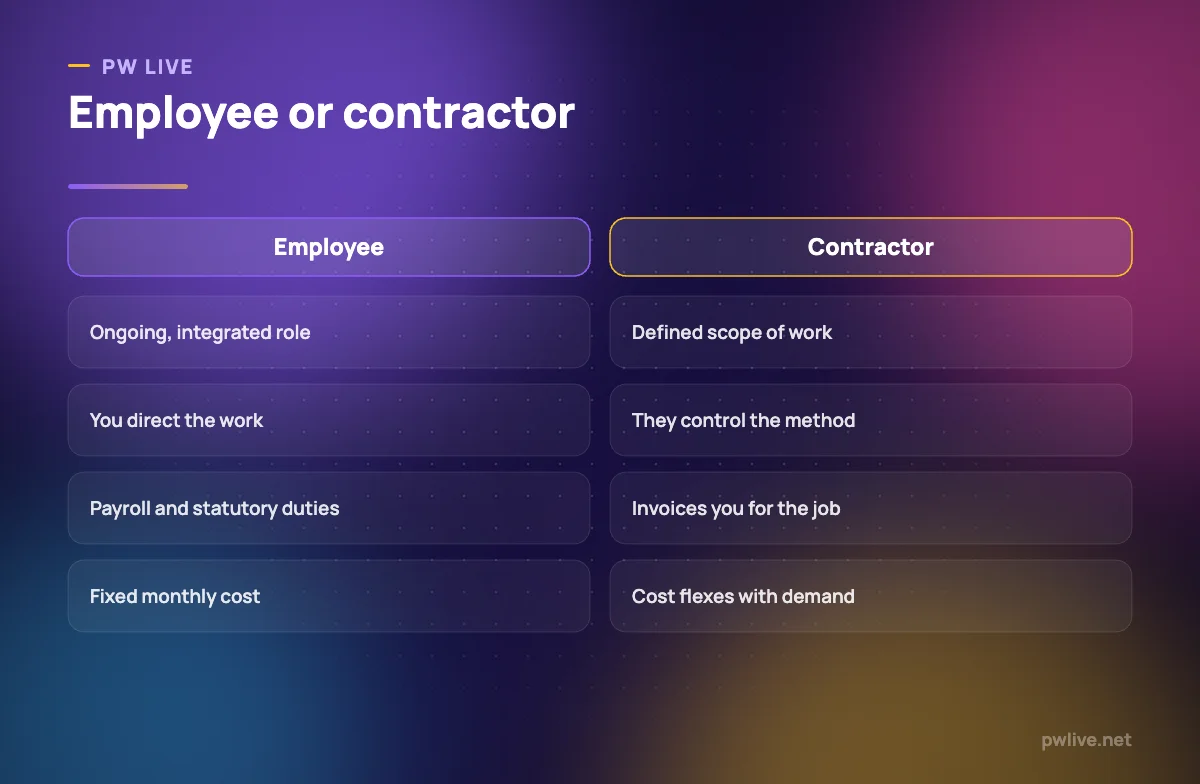
If the answer is that you need help but not a permanent employee, a contractor, a part-time hire or a freelancer is a legitimate answer rather than a failure of ambition.
Define the role by outcomes, not by tasks
The vaguest job descriptions produce the worst hires. Write the role as a set of results.
Answer these on one page:
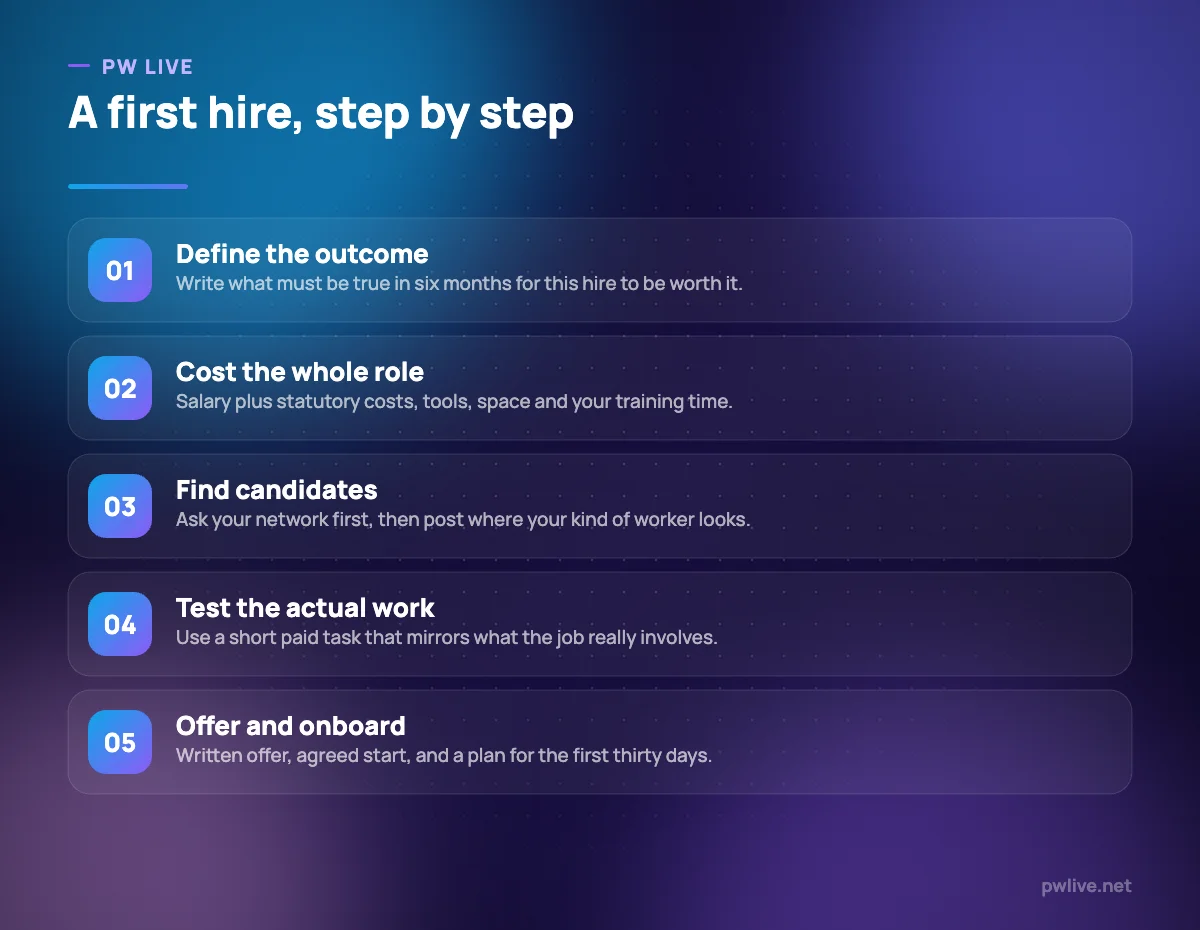
- What must be true in six months for this hire to have been worth it? Two or three specific outcomes.
- What will they own completely, with no need to ask you?
- What does a normal week look like, hour by rough hour?
- What must they already be able to do on day one, and what can they learn here?
- Who do they work with, and who decides when there is a disagreement?
That last one matters more than people expect in a small team. Ambiguity about who decides is the most common source of early friction.
Separate genuine requirements from preferences. Most first roles need one or two real technical abilities and a set of behaviours: reliability, clear communication, willingness to ask when stuck. Our guide to hard skills vs soft skills is a useful lens for splitting the two.
Cost the role honestly
The salary is not the cost. Build the full picture before you commit:
- Gross salary
- Employer statutory contributions and any payroll-related obligations that apply to your business
- Any insurance you provide
- Equipment, software licences and phone or internet allowances
- Workspace, if applicable
- Recruitment costs
- Your own time training and supervising, which is real and often the largest hidden cost in month one
Then add a cushion for the ramp-up period, when the person is being paid but not yet fully productive.
Note that employment obligations, thresholds for registrations and payroll deductions differ by state, sector and headcount, and they change. Get your specific list confirmed by a chartered accountant or a payroll professional before the first payday, not after.
Find candidates in the right places
Your network is the highest quality source and the one people skip because it feels like asking a favour.
- Tell everyone you know what you are looking for, with the specific outcome, not a job title.
- Ask former colleagues and suppliers, who see people working every day.
- Post where your kind of candidate actually looks, which varies enormously by role: professional networks, local groups, college placement cells, trade communities.
- Consider people currently doing adjacent work who want to move into your field. They are often more motivated and less expensive than exact-match candidates.
Write the advertisement like a real description of the job, including the parts that are hard. Honest listings attract fewer applicants and far better ones. Understanding what candidates are looking for helps too; our overview of what employers say they want from graduates works in both directions.
Run a process that tests the actual work
Interviews reward people who interview well. Work samples reward people who do the work well.
A structure that fits a small business:
- A short screening call. Fifteen minutes. Confirm interest, availability, expectations and whether the basics match.
- A structured interview. The same questions in the same order for every candidate, focused on what they have actually done. “Tell me about the last time you handled X. What did you do, and what happened?”
- A paid work sample. A small, realistic task of a couple of hours, paid at a fair rate. This is the single most informative step in the process.
- A reference conversation. Speak to a previous manager or client with the candidate’s permission, and ask what the person needs from a manager to do their best work.
Score against the criteria you wrote in the role definition, not against your gut feeling after each meeting. Writing your scores down before you discuss them keeps the loudest opinion in the room from deciding.
Candidates preparing for their side of this process may find our job interview preparation checklist useful; reading it also sharpens the questions you ask.
Make the offer clear and in writing
Verbal offers cause disputes. Put it in a written document that covers, at minimum:
- Job title and reporting line
- Start date and place of work
- Salary, how it is calculated, and the pay date
- Working hours and leave arrangements
- Any probation arrangement and notice periods
- Confidentiality and who owns work created in the job
- Anything you have promised in conversation
Have a professional review your standard employment letter once. It costs little and prevents the most common problems. The same care applies to your customer-facing paperwork, covered in invoices, quotes and contracts.
Do not verbally promise things you have not written down: a bonus, a review, a title change. In a small business, promises made informally are remembered exactly and forgiven rarely.
Get the first thirty days right
Most first hires who fail were set up to fail. Plan the start before they arrive.
- Have everything ready on day one. Access, tools, a place to sit, and a person to ask.
- Give them one real, finishable task in week one. An early completed piece of work builds confidence in both directions.
- Write down how things are done as you explain them. Your first employee is the reason your business gets its first documented processes.
- Meet weekly for thirty minutes, with the same three questions: what got done, what is blocked, what do you need from me.
- Give feedback in the first fortnight, while small habits are still easy to change.
- Review honestly at the end of the probation period, and be willing to end it if the outcomes are clearly not being met.
Learning to manage is a distinct skill from doing the work, and it is worth building deliberately. The leadership and management skill track is a good place to start, and the career and jobs archive gives useful perspective on what employees are weighing up.
Key takeaways
- Confirm the work is steady and affordable for a full year before creating a permanent role.
- Define the role by outcomes and ownership, not by a list of tasks.
- Cost the whole role, including statutory contributions, equipment and your own training time.
- Use a paid work sample; it predicts performance far better than an interview does.
- Put the offer in writing and never rely on verbal promises.
- Plan the first thirty days, meet weekly, and give feedback early rather than at the review.
Frequently asked questions
Should my first hire be a generalist or a specialist?
For most small businesses a reliable generalist who can own a broad area is more useful early, because the work changes month to month. Hire a specialist when a single skill is clearly the bottleneck and there is enough of that work to fill a role.
What paperwork and registrations do I need before hiring?
Employers typically take on payroll obligations and, past certain headcounts or thresholds, additional registrations related to provident fund, state insurance and professional tax. These depend on your state, sector and size, so confirm your exact list with a qualified professional before the first payday.
Can I hire someone on a contract basis instead?
You can engage a contractor for defined work, but an arrangement that looks like employment in practice may be treated as employment regardless of what the paperwork says. Take professional advice on how the distinction applies to your situation.
What if the hire is not working out?
Address it early and specifically, with written feedback about the outcomes not being met and a clear timeframe. If it still does not work, follow the notice and process terms in the contract and take professional advice before ending the employment.
Keep learning with PW Live
Browse every guide in Business & Entrepreneurship, or pick a skill track and follow the roadmap step by step.





Leave a Reply