

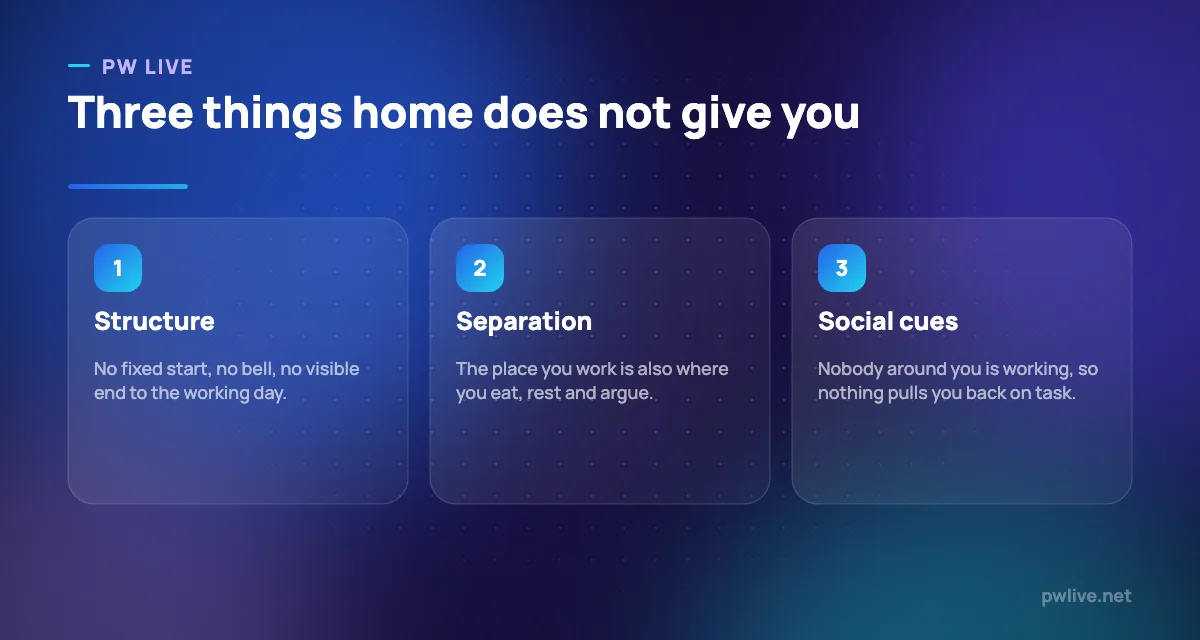
Losing focus while working from home is not a discipline failure. Home does not supply the three things a classroom or office gives you for free: a fixed structure, a separation between work and rest, and other people visibly working nearby.
Once you see it that way, the fixes become practical rather than moral. You are rebuilding, by hand, the scaffolding that a campus provided automatically.
This guide covers how to start, how to survive a busy household, how to stop devices from eating the day, and how to finish so work does not spread across every hour you are awake.
Give the day a start you can feel
The hardest part of a home day is that it never clearly begins. Without a boundary, the morning dissolves into messages and half-attention, and by noon you have been busy without working.
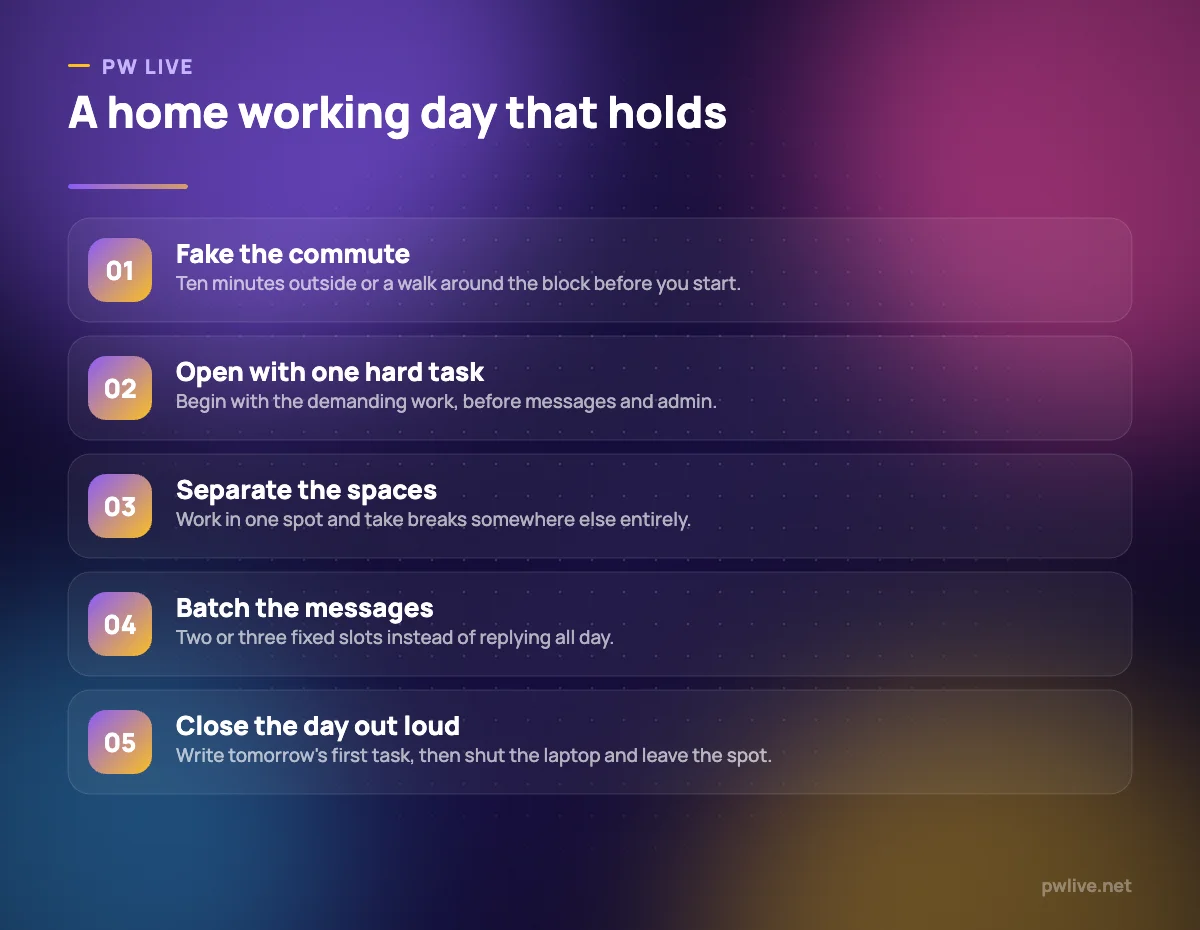
Build a start ritual that takes ten minutes and always looks the same.
- Step outside or walk around the block, then come back in
- Change out of what you slept in, even into other comfortable clothes
- Set up the workspace in the same order every time
- Write the one task that will be finished first
The walk is doing real work here. A short trip out and back gives your brain the transition that a bus ride or corridor used to provide.
Open with the hard thing, not the inbox
Messages feel like work and are usually the easiest thing available, which is exactly why they colonise the morning.
Start with the demanding task while your attention is fresh. Give it forty-five to ninety minutes before you look at anything that other people have sent you.
If you are worried about missing something urgent, agree a rule: genuinely urgent people will call. Everything else waits until your first message slot.
Our deep work routine for students covers what to do inside that first block, and our guide to time blocking explains how to place it in a day with fixed commitments around it.
Separate where you work from where you rest
At home, the same square metre can be a desk, a dining table and a place to watch something. That overlap is what makes it hard to switch on, and equally hard to switch off.
You do not need a separate room. You need a difference your body can notice.
- Work in one specific spot and take breaks anywhere except that spot
- Face a different direction for work than for relaxing
- Pack the setup away at the end of the day, into a box or a drawer
- Keep the bed for sleeping, if it is at all possible
Our guide to setting up a study space in a small or shared home has the full arrangement, including light, chair height and storage in one shared room.
Handle interruptions from the people you live with
Interruptions at home are constant partly because your work is invisible. Nobody can see the difference between deep concentration and casually holding a laptop.
Three practical moves:
- Publish your windows. Tell the household at the start of the week which two or three blocks are protected.
- Give end times, not prohibitions. “I am free at 12:30” is easy to respect; “do not disturb me” is not.
- Use a physical signal. Headphones, a closed door, a card on the table, a lamp switched on.
Then honour the boundary from your side. If you emerge at 12:30 as promised, the next block is much easier to protect. If you disappear all day and answer nothing, the boundary collapses within a week.
For the wording that works with parents, siblings and flatmates, see our guide to saying no and protecting your study time.
Tame the devices, especially the second screen
At home the phone is always within reach and nobody is watching. That combination beats most people’s willpower, so change the setup rather than testing yourself.
- Put the phone in another room during work blocks. Face down on the desk is not enough.
- Keep a scrap sheet for stray thoughts, so “let me just check something” never needs a device.
- Use separate browser profiles or windows for work and everything else.
- Turn off all notifications except calls from a short list of people.
- Log out of the two apps you drift to most, so re-entry takes a deliberate choice.
If the phone is a persistent problem rather than an occasional one, our digital detox guide has changes that do not require giving up your accounts. For tools that support focus rather than fragment it, see our roundup of free apps and tools for studying and staying organised.
Replace the social pull you have lost
Working alongside other people creates a quiet pressure to stay on task. Alone at home, nothing pulls you back when your attention drifts.
You can rebuild some of that deliberately.
- Work alongside someone. In person or on a silent video call with a friend who is also working. Agree a start time, work in silence, check in at the end.
- Report to one person. A short daily message saying what you intend to do and what you did. Even an unanswered message works.
- Go out once or twice a week. A library, a college reading room or a quiet cafe, especially for tasks you keep avoiding at home.
- Join a fixed group session. A weekly problem-solving session with classmates creates an external deadline.
Hybrid patterns like these are now standard for a lot of work, and our overview of where remote and hybrid work stand now puts the shift in context.
Take breaks that are not just a different screen
At home the natural break is another screen, which leaves your eyes, posture and attention in exactly the state they were in.
Set a rhythm rather than waiting to notice fatigue: roughly every 50 to 60 minutes, five to ten minutes away from the desk.
Good home breaks are physical and short: stand and stretch, hang the washing, fill your bottle, step onto the balcony, look at something far away. One useful test is whether you would be able to explain what you did in the break. If the answer is “scrolled”, it was not one.
If most of your day is on video lectures or calls, the fatigue accumulates faster, and our guide to studying from video lectures without wasting hours covers how to make that time active rather than passive.
End the day on purpose
Without a clear end, work spreads across the evening at a low, ineffective level, and you never fully rest. That is the fastest route to feeling permanently behind.
Build a shutdown that takes five minutes:
- Write what you finished today
- Write the first task for tomorrow, specifically
- Note anything you promised to someone else
- Close the laptop, pack the setup away and physically leave the spot
Say to yourself that the day is done. It sounds trivial and it works, because the point is a signal, not a ceremony.
Some days will end badly, with the plan half done. Write the leftover on tomorrow’s list and stop anyway. More guides on structuring days at home sit in the lifestyle and productivity archive and the productivity skill track.
Key takeaways
- Home lacks structure, separation and social cues, so build each one deliberately.
- Start with a ten-minute ritual, including a short walk out and back.
- Do the hard task before messages, for at least forty-five minutes.
- Work in one spot only and take breaks anywhere else.
- Publish protected windows with end times, and honour them from your side.
- Close the day with a five-minute shutdown so evenings are genuinely off.
Frequently asked questions
How many focused hours can I realistically expect at home?
Most people manage three to five hours of genuinely focused work in a day, with the rest going to admin, communication and recovery. Judging yourself against eight solid hours guarantees you feel like you are failing.
What should I do when the house is too noisy to concentrate?
Move demanding work to the quietest reliable hour, use earplugs or steady wordless sound, and save familiar practice for the noisy periods. If it is possible once or twice a week, working from a library removes the problem entirely for the hardest tasks.
Is it bad to work from bed or the sofa?
For short, light tasks it is fine, but it works poorly for demanding work because posture collapses and those spots are strongly associated with rest. Keep at least your hardest block at a table.
How do I stop working in the evening?
Use a fixed five-minute shutdown that ends with writing tomorrow’s first task and packing the setup away. Leftover work goes on tomorrow’s list rather than into your evening.
Keep learning with PW Live
Browse every guide in Lifestyle & Productivity, or pick a skill track and follow the roadmap step by step.





Leave a Reply