

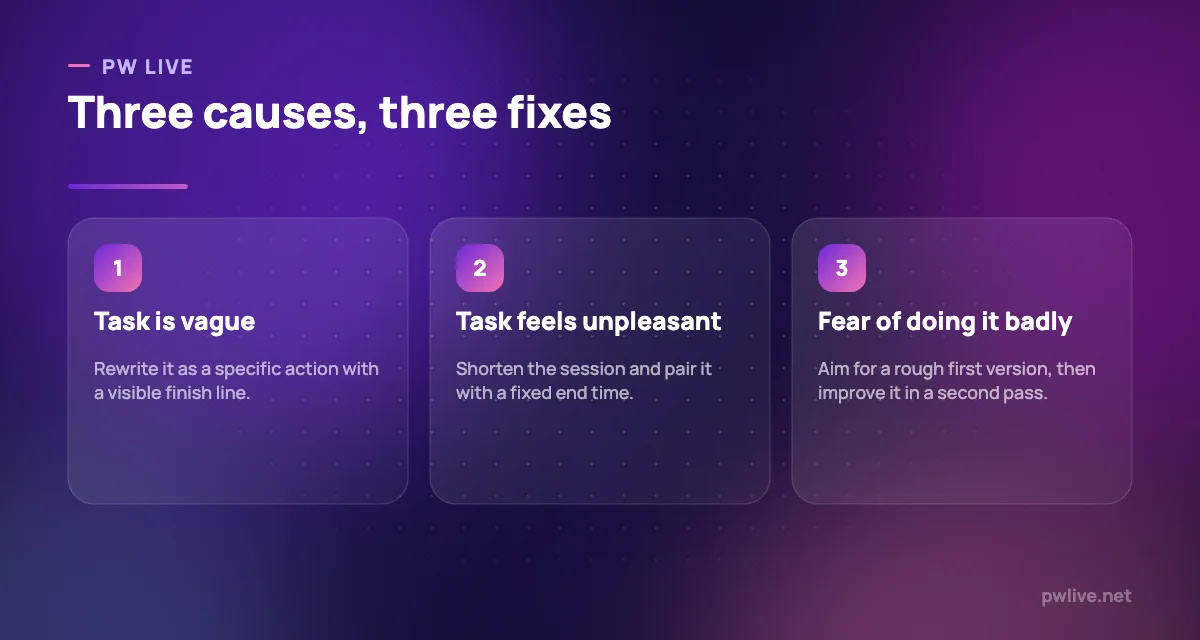
If you want to beat procrastination, stop treating it as laziness. People rarely avoid work because they do not care. They avoid it because the task is unclear, unpleasant, too large, or attached to a fear of doing it badly.
That matters because the fix depends on the cause. Motivational pressure does nothing for a vague task, and better planning does nothing for dread. What works is diagnosing which one is in front of you, then applying a small, specific tool.
This toolkit gives you those tools. Nothing here requires a personality change, and none of it assumes you have unlimited quiet hours.
Work out what kind of stalling this is
Before reaching for a technique, spend thirty seconds on the diagnosis. Ask yourself which of these is true right now.
- I do not know what the first step is. The task is a category, not an action.
- I know exactly what to do and I do not want to do it. Boredom or dislike.
- It feels too big to fit anywhere. Scale.
- I am worried it will not be good enough. Perfectionism or fear.
- I am too tired to think. Energy, not avoidance.
The last one is important and often misread as laziness. If you have slept four hours and worked a shift, the answer is rest, not a productivity system. Our guide to managing your energy rather than only your time covers how to tell the two apart.
Shrink the task until starting is boring
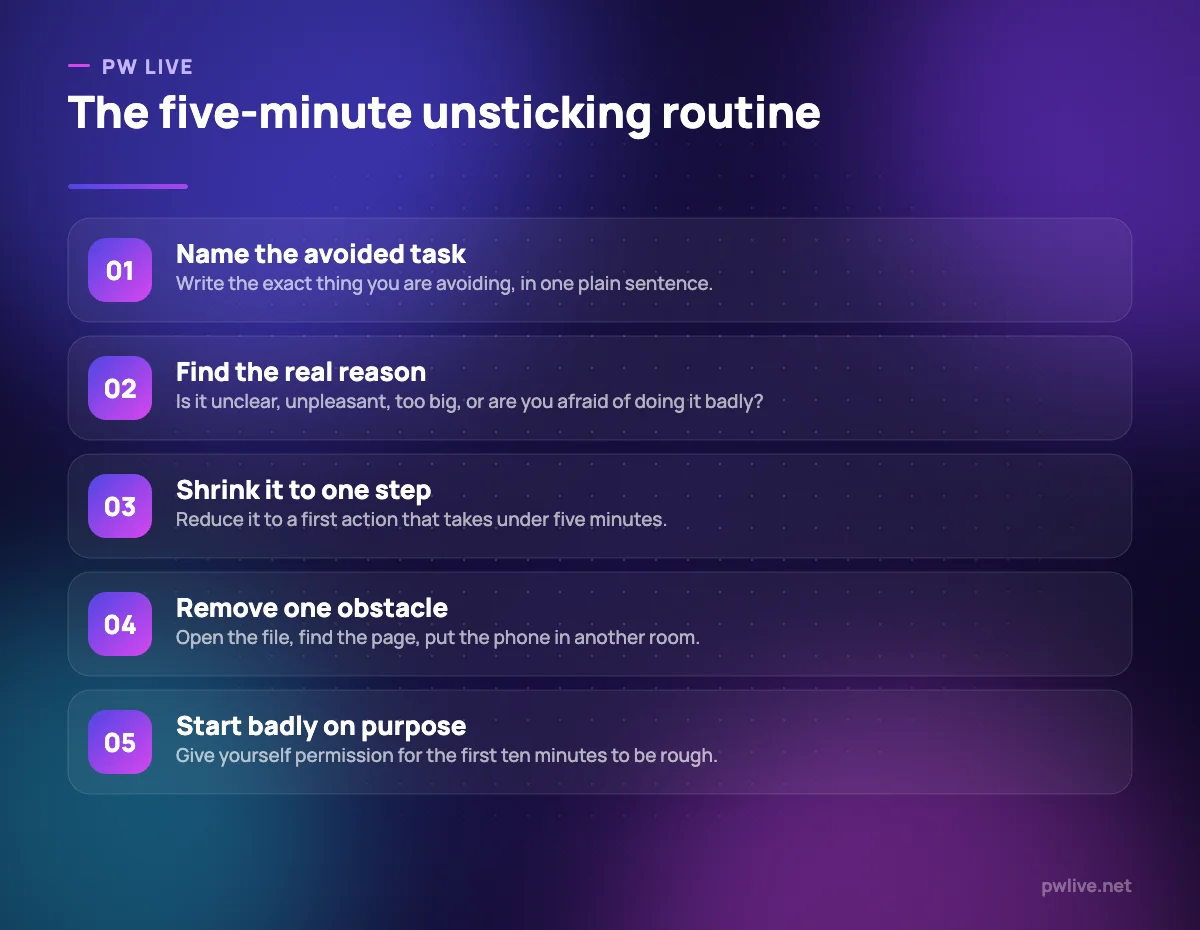
A task you avoid is almost always too big to hold in your head. The cure is to shrink it to something so small it feels silly to refuse.
Not “study accounts”. Instead: “open the ledger chapter and read the first worked example”. Not “write the assignment”. Instead: “write the three headings I already know”.
Two rules make this work:
- The first step must be doable in under five minutes.
- It must be physical or visible, so you can tell when it is done.
Once you are in, continuing is usually easier than starting. The point of the small step is not the step itself; it is that you are now sitting in front of the work.
Remove friction before you need willpower
Willpower is what you spend when the setup is bad. Fix the setup and you need less of it.
- Put the book, file or laptop on the desk the night before, open at the right page
- Keep the phone out of the room, not just out of your hand
- Log out of the sites you drift to, so re-entry needs a deliberate choice
- Keep one workspace where the only thing that happens is work, even if it is one end of a shared table
If your space is the obstacle, our guide to setting up a study space in a small or shared home has arrangements that work without a spare room.
Use short, honest sessions
Long sessions are easy to promise and hard to start. Short ones are the opposite.
Set a timer for 20 or 25 minutes and agree with yourself that you may stop when it rings. That agreement has to be real, or your brain stops believing it and the trick stops working.
Most of the time you will continue. When you do not, you still did 25 minutes on the thing you were avoiding, which is 25 minutes more than the plan that required an hour.
For longer, deeper sessions once you are moving again, the deep work routine for students shows how to extend a working block without burning out.
Handle the fear version of procrastination
Some avoidance is not about effort at all. You put off the mock test because a bad score would mean something. You delay the application because a rejection would hurt. You avoid the subject you are behind in because opening it confirms how far behind you are.
Three things help here.
- Separate drafting from judging. Produce a deliberately rough version first, and evaluate later. A bad first attempt is a working object; a blank page is not.
- Make the feedback smaller. Do five questions rather than a full paper. Small tests give information without a verdict attached.
- Name the worst case out loud. Usually it is “I lose an afternoon” or “I find out I need more revision”, which is survivable and useful.
If avoidance comes with a knot in your stomach before exams specifically, our guide to what helps with exam anxiety is the better starting point, and the wider health and wellbeing archive covers stress and burnout.
Give the avoided task a place in the day
A task with no scheduled slot competes with everything, all day, and loses. A task with a slot only has to survive one appointment.
Put the thing you avoid into a fixed block, early, when your attention is best and the day has not yet been eaten. Our guide to time blocking explains how to size and protect those blocks.
Two more scheduling habits that help:
- Decide the first task tonight. Removing the morning decision removes the morning negotiation.
- Pair the task with a fixed event. “After the bus, twenty minutes of vocabulary” is stickier than “sometime today”.
Stop the small leaks
Not all procrastination is a dramatic avoidance of one big task. Often it is a slow leak: fifteen minutes here, a video there, a chat that becomes an hour.
- Keep a scrap sheet for stray thoughts so you do not open a browser to check something
- Batch messages into one or two slots rather than replying continuously
- Notice your personal drift trigger, which is usually the moment a task gets hard or boring, and treat it as a signal to shrink the step rather than to leave
- Put a note where your phone lives that says what you are meant to be doing
If the phone is the main leak, our digital detox guide offers changes that do not require deleting everything.
When you have already lost weeks
Sometimes procrastination has compounded and there is a genuine backlog. Pretending otherwise makes it worse.
Do a written inventory: what is actually outstanding, and roughly how many hours each item needs. The list is usually smaller and more finite than the dread suggested. Then rank by deadline and by what unlocks other work.
Accept that some of it will be done at a lower standard than you would like. Finishing four things adequately beats finishing one perfectly and abandoning three. Our guide to catching up when you have fallen behind in a subject has a full recovery sequence, and the productivity skill track collects the habits that stop the backlog rebuilding.
Key takeaways
- Diagnose the cause first: vagueness, dislike, scale, fear or plain tiredness.
- Shrink every avoided task to a first step under five minutes.
- Reduce friction in advance so you do not have to spend willpower on setup.
- Use short timed sessions with a genuine permission to stop.
- Treat fear-based avoidance with rough drafts and smaller feedback, not pressure.
- Give the avoided task a scheduled slot in your best hours.
Frequently asked questions
Is procrastination a discipline problem?
Usually not. It is more often a sign that the task is unclear, too large, or carries some fear attached to it, and each of those has a specific fix that pressure does not provide.
What should I do when I have only fifteen minutes and a huge task?
Use the fifteen minutes to make the task easier to start later: write the first three steps, gather the materials, or open the file at the right page. Preparation counts as progress.
Does the two-minute rule actually help?
It helps with starting, which is where most people get stuck. Its weakness is that it does nothing for tasks you are avoiding out of fear, so pair it with a rough first draft instead.
How do I stop procrastinating on the same task every week?
Look for what is repeatedly unclear about it and rewrite it as a specific action, then give it a fixed slot early in the day. A task that keeps sliding is usually badly defined rather than badly resisted.
Keep learning with PW Live
Browse every guide in Lifestyle & Productivity, or pick a skill track and follow the roadmap step by step.





Leave a Reply