

If you have used an AI chat tool and wondered what is actually happening behind the text box, this guide explains how large language models work without a single equation. No neural network diagrams, no maths notation, just the ideas that matter.
The short version: a large language model is a very sophisticated system for predicting the next piece of text. That sounds too simple to explain something that can draft an essay or debug code, and yet it is the honest description. What makes it powerful is the scale it operates at and the patterns it has absorbed.
Understanding this changes how you use the tool. You stop treating it like an encyclopedia and start treating it like a fast, capable, slightly unreliable assistant that needs good instructions.
A language model is a prediction machine
Give the model the words “the capital of France is” and it will produce “Paris”. Not because it looked up a fact in a database, but because in the enormous amount of text it learned from, that sequence almost always ends that way.
Everything else follows from this. Summarising, translating, writing code, answering a question about your notes: all of it is the same operation repeated, one small piece of text at a time, each new piece shaped by everything that came before it.
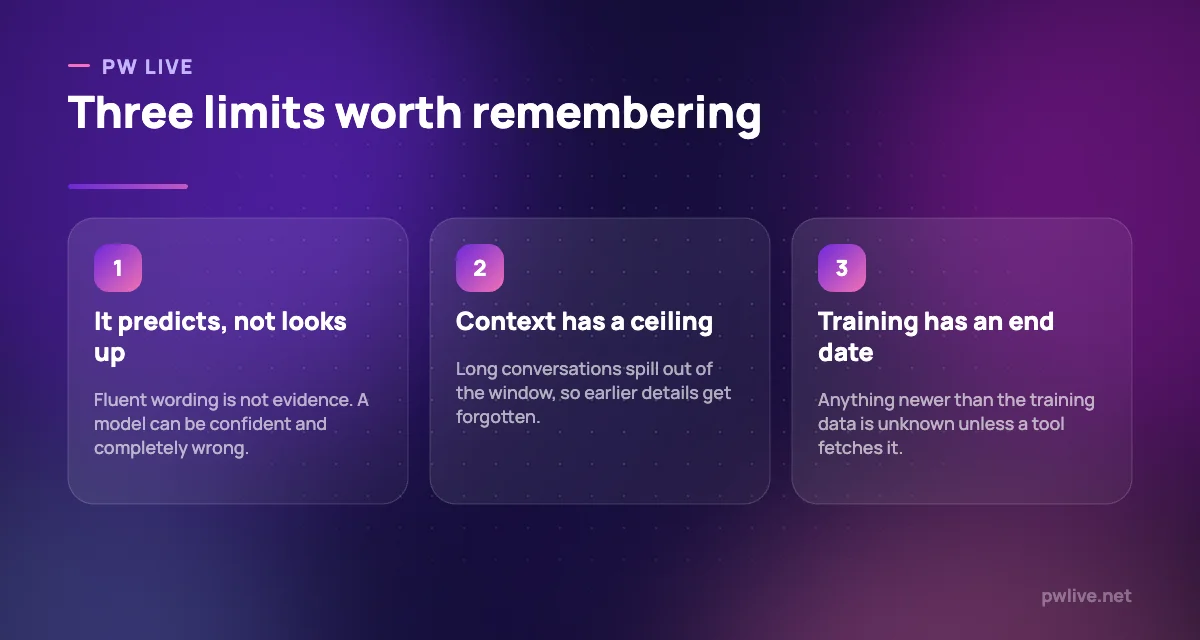
The model never pauses to check whether the sentence it is building is true. It checks whether it is likely. Most of the time likely and true overlap, which is why the output is so often useful. When they come apart, you get a confidently written mistake.
Tokens: how a model reads and writes
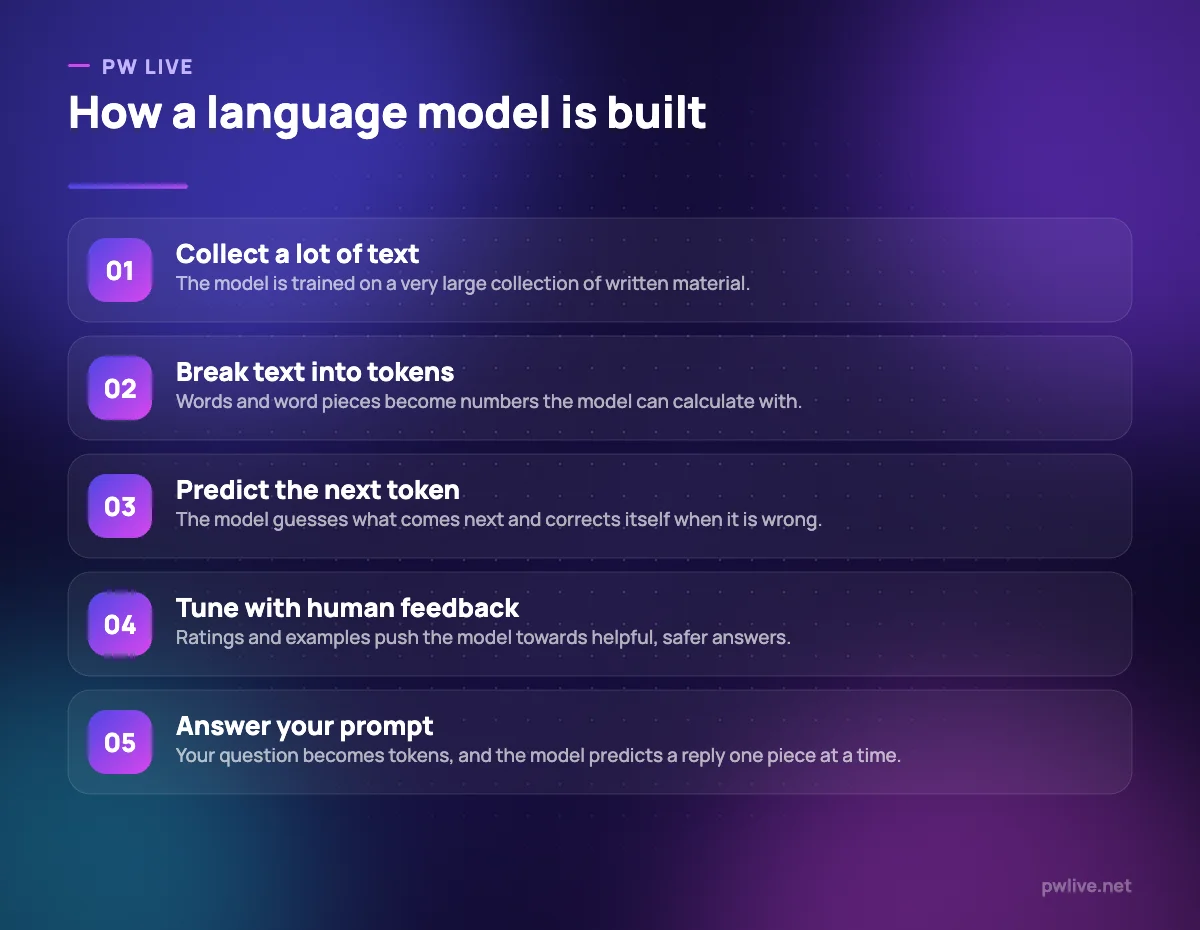
Models do not see letters or words the way you do. Text is chopped into tokens, which are roughly word fragments. A common word may be one token; an unusual name might be split into three or four.
Every token is turned into a list of numbers, which is the only form the model can work with. It processes those numbers, produces a set of probabilities for what token should come next, picks one, adds it to the text and repeats.
Two practical consequences fall out of this:
- Length is measured in tokens, not words. Limits on how much you can paste in, and how much the model can write back, are token limits.
- Character-level tasks are surprisingly hard. Counting letters in a word or reversing a string is awkward for a system that never sees individual letters clearly.
Training happens in two very different stages
The first stage is pre-training. The model is shown vast quantities of text and asked, over and over, to predict the hidden next piece. When it guesses wrong, its internal settings shift slightly. Repeat this an enormous number of times and the model ends up encoding grammar, facts, writing styles, code conventions and a great deal of reasoning structure.
At the end of pre-training you have something that can continue text but is not much use as an assistant. It will happily continue a question with more questions.
The second stage is tuning. Here the model is trained on examples of good instruction-following, and human reviewers compare candidate answers so the model learns which style of response people actually want. This is where “helpful assistant” behaviour comes from, along with the refusals and the caveats.
Neither stage gives the model beliefs or intentions. It is still predicting text, just steered towards a shape you find useful.
Context is its short-term memory, and it runs out
Everything the model can currently “see” — your instructions, the document you pasted, the earlier turns of the conversation — sits in something called the context window. It is finite.
When a conversation grows past that limit, the earliest material stops being visible. That is why a long chat can suddenly forget the rule you set at the start, or contradict something it said an hour ago.
Two habits fix most of this:
- Start a fresh conversation for a genuinely new task rather than continuing an old thread out of convenience.
- Restate the important constraints when the conversation gets long. A short recap is cheaper than a wrong answer.
The context window also explains why pasting the actual source material works so much better than asking from memory. If you want a summary of a chapter, give it the chapter. Our guide to studying from video lectures without wasting hours makes a similar point about working from the source rather than a vague recollection.
Why models make things up
When a model produces something plausible and false, people call it a hallucination. It is not a bug that was accidentally left in. It is the direct result of a system that optimises for plausible text.
Made-up material clusters in predictable places:
- Specific numbers, dates and statistics
- Citations, page references and book titles
- Names of people attached to quotes
- Details about niche, local or very recent topics
- Anything where the true answer is rare in written text
The defence is simple and unglamorous: treat any specific claim as unverified until you check it. For anything that carries consequences — an exam answer, a legal deadline, a medical question, a number in a business plan — go to the primary source. The same scepticism we recommend in how to read education news without falling for rumours applies here.
What models can and cannot do well
They are genuinely strong at transformation: rewriting, summarising, translating, changing tone, converting a mess of notes into a structured outline, explaining a concept at three different levels of difficulty, and drafting a first version of almost anything.
They are weaker at precise arithmetic, at knowing what happened after their training data ends, at admitting uncertainty, and at tasks where being 95% right is the same as being wrong.
Many tools now bolt on extras — a calculator, a web search, a code runner, access to your documents. These help a lot, but the underlying behaviour does not change. The model is still predicting text; it just has better material to predict from. If you are weighing up where these tools fit in your week, how AI study tools are changing the way students learn covers the practical side.
How to get noticeably better answers
- Give the role and the audience. “Explain this to a Class 11 student” produces a different answer to “explain this to a colleague”.
- Supply the source material. Paste the text, the data, the error message. Do not make it guess.
- State the format you want. Number of points, length, structure, tone.
- Ask for the reasoning, then check it. A visible chain of steps is easier to audit than a bare conclusion.
- Iterate instead of restarting. “Shorter, and drop the third point” is faster than rewriting your prompt.
If you want to go deeper into the mechanics rather than the usage, the data science and AI skill track is the natural next step, and the wider technology section covers the surrounding tools.
Key takeaways
- A large language model predicts the next piece of text, repeatedly. Everything it does is built on that.
- Text is processed as tokens, which is why length limits and letter-level tasks behave oddly.
- Pre-training gives it knowledge and structure; tuning gives it assistant behaviour.
- The context window is its working memory, and long conversations quietly fall out of it.
- Fluency is not accuracy. Verify anything specific, especially numbers, citations and recent events.
- The biggest quality gains come from giving better inputs, not from finding magic prompt phrases.
Frequently asked questions
Does a language model understand what it is saying?
It has an extremely detailed statistical map of how language and ideas fit together, which lets it behave as though it understands. Whether that counts as understanding is a genuine open debate, but it has no experience, memory of you, or awareness of being right or wrong.
Why does it give a different answer each time I ask?
The model picks the next token from a set of probabilities, and most tools introduce a little randomness so answers feel natural rather than mechanical. Asking the same question twice samples two different paths through the same probabilities.
Is my data used to train the model?
That depends entirely on the tool and the plan you are on, and the setting is usually buried in the privacy or data controls. Check it before pasting anything confidential, and see our digital privacy guide for how to audit these settings properly.
Do I need to learn maths to work with these models?
Not to use them well. To build or fine-tune them, you need linear algebra, probability and programming, which is where the coding and programming track is a sensible starting point.
Keep learning with PW Live
Browse every guide in Technology & Software, or pick a skill track and follow the roadmap step by step.





Leave a Reply