

Most people never finish a business plan because they imagine a thick document full of charts nobody asked for. A one-page business plan solves that. It fits on a single sheet, takes an afternoon, and forces you to answer the handful of questions that actually decide whether a business works.
The point is not to impress a bank manager. The point is to make your own thinking visible, so you can spot the weak link before you spend money on it.
This guide walks through each block of the page, what belongs in it, and how to use the finished sheet as a working tool rather than a keepsake.
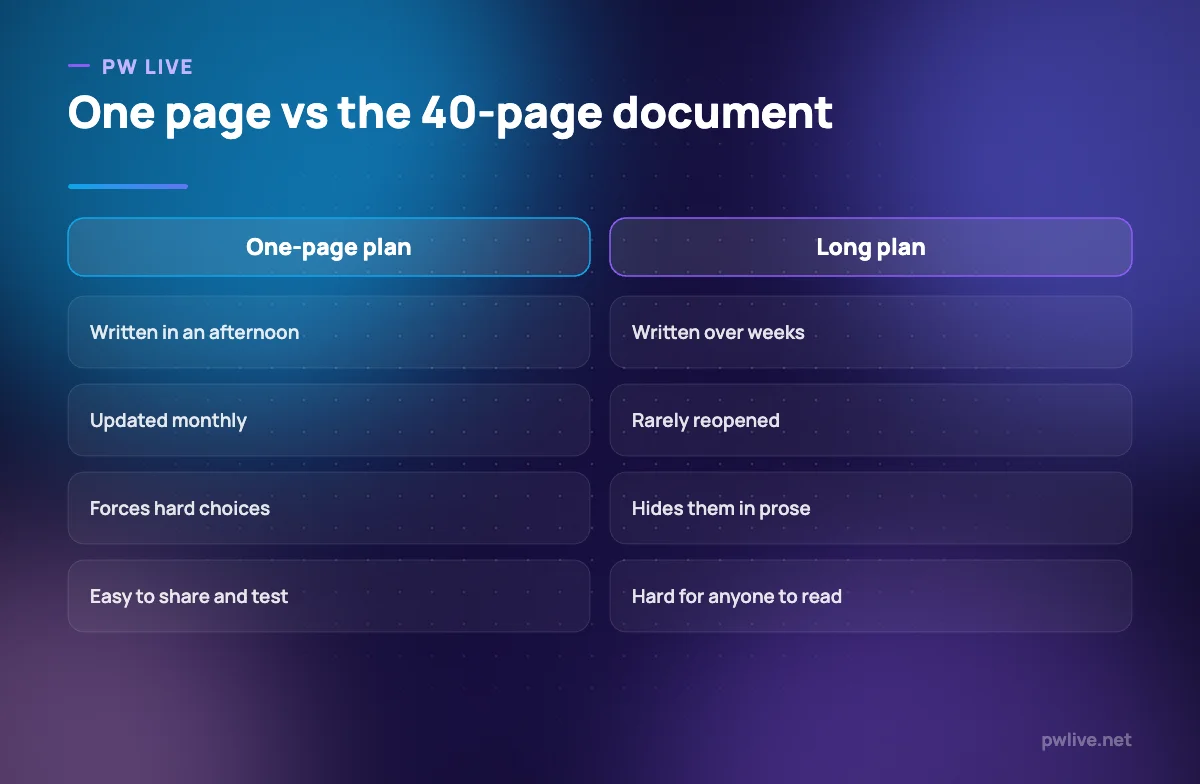
Why one page beats a long document
A long plan hides vagueness. You can write three paragraphs about “the growing demand for wellness services” and never once say who pays you, how much, or how they find you.
One page removes that escape route. When you have four lines for your customer, you have to name a real group of people.
Short plans also get updated. A plan you can rewrite in twenty minutes stays accurate; a plan that took three weeks becomes a museum piece the moment reality changes.
If you have not yet checked whether anyone wants what you are planning, start with our guide to validating a business idea before you spend a rupee and come back once you have talked to a few potential buyers.
Block 1: The customer and the problem
Write one sentence naming a specific group of people, and one sentence naming the problem they already know they have.
Specific means specific. “Small businesses” is not a customer. “Salon owners in my city with two to five chairs” is.
The problem should be something the customer would say out loud themselves. If you have to explain to them why it is a problem, you have a much longer and more expensive road ahead.
A quick test: can you name three real people or businesses that fit your description? Not categories, actual names. If you cannot, your customer definition is still too broad.
Block 2: What you actually sell
This block has four short parts:
- The offer. The thing a customer receives. A haircut, a monthly bookkeeping service, twenty printed tote bags.
- The delivery. How they receive it. In person, by courier, over a video call, as a file.
- The price. A number, not a range. You can change it later.
- The promise. What is true after they buy that was not true before.
Resist the urge to list five offers. Early on, one clear offer sold well beats five offers explained badly. You can add the others once the first is running.
If you are stuck on the price line, work through our guide to pricing your product or service without guessing before you fill it in.
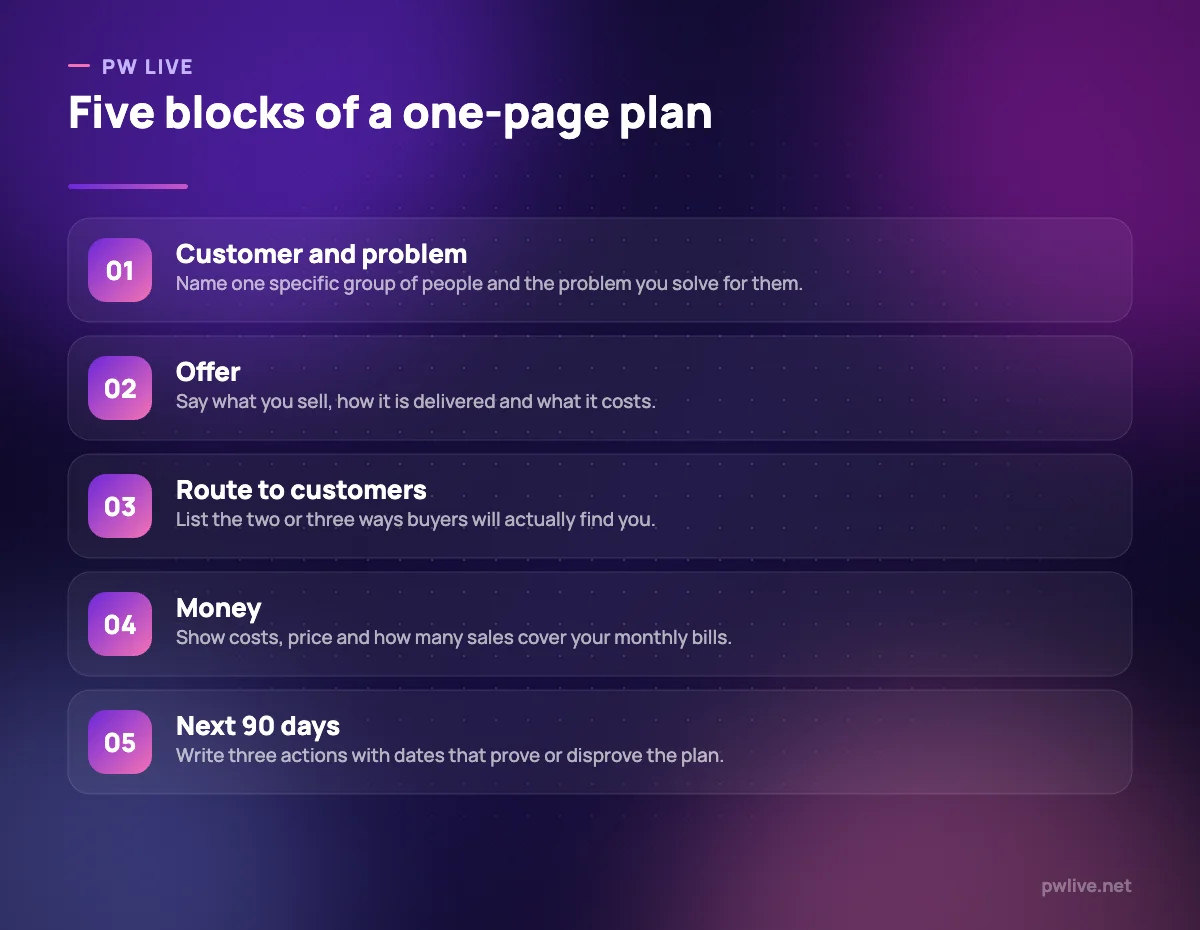
Block 3: How customers will find you
This is the block most first plans get wrong. People write “social media and word of mouth” and move on, which is another way of saying “I have no idea”.
Pick two or three specific routes and describe the first step of each:
- A place your customers already gather. A local market, a WhatsApp group, a college notice board, an industry association meeting.
- A person who already has their trust. A supplier, a complementary business, a trainer, a shop owner.
- A search or listing route. People typing a need into a search engine, or browsing a marketplace or map listing.
For each route, write what you will do this week, not what you will do eventually. “Ask the three salons on my street if I can leave cards” is a plan. “Build brand awareness” is not.
Once the basics are working, our guide to social media strategy for small businesses on a small budget covers how to make the online routes pull their weight.
Block 4: The money, in six lines
You do not need a five-year forecast. You need to know whether the business can pay for itself. Six lines is usually enough:
- Price per sale
- Direct cost per sale (materials, delivery, payment charges, your subcontractor)
- Gross margin per sale (price minus direct cost)
- Fixed monthly costs (rent, software, phone, transport, your own minimum income)
- Sales needed per month to cover fixed costs (fixed costs divided by gross margin)
- Cash you need to start, and where it comes from
Say your price is 1,000 rupees, direct cost is 400, so margin is 600. If fixed costs are 30,000 a month, you need 50 sales a month to break even. Those numbers are made up for illustration, but the arithmetic is the same for any business.
That single division is the most useful number on your page. If the answer is a volume you cannot picture reaching, change the price, the cost or the offer now, before you sign a lease.
To go deeper on those numbers, read unit economics explained, and to understand why a profitable month can still leave you short of cash, read cash flow basics.
Block 5: The next 90 days
Finish the page with three actions, each with a date and a visible result. Not “start marketing” but “list ten possible clients by the 10th, contact all ten by the 20th, close two by month end”.
Choose actions that test your riskiest assumption. If you are unsure people will pay, the test is a sale, not a website. If you are unsure you can deliver at that cost, the test is one full delivery, timed and costed.
How to use the page after you write it
Print it. Put it where you work. Then set a recurring half-hour on the last day of each month to sit with it and change what reality has disproved.
Three habits make the plan pay for itself:
- Mark what you were wrong about. Wrong assumptions are data, not failures.
- Keep the old versions. A folder of monthly plans shows you how your thinking matured, and where you keep repeating the same mistake.
- Show it to one honest person. A supplier, a former manager, someone who runs a similar business. Ask what they would attack first.
The plan is not the business. It is the shortest possible description of what you believe and what would prove you wrong. Treat it that way and it stays useful.
For more on the surrounding decisions, browse the business and entrepreneurship archive or work through the leadership and management skill track as your business grows past you.
Key takeaways
- A one-page business plan forces the specific answers a long document lets you avoid.
- Name a customer you could ring today, not a market category.
- One clear offer with one price beats a menu of half-formed ideas.
- The break-even calculation, fixed costs divided by gross margin, is the single most useful line on the page.
- Finish with three dated actions that test your riskiest assumption.
- Rewrite the page monthly and keep the old copies.
Frequently asked questions
Is a one-page plan enough to get a loan?
Usually not on its own, since lenders ask for their own formats and financial statements. It is still the right starting point, because everything a lender asks for is easier to write once the one-pager is clear.
What if I have more than one business idea?
Write a separate page for each, then compare the break-even lines and the 90-day tests. The idea you can test fastest and most cheaply is normally the one to start with.
How long should each block be?
Three to five lines. If a block runs longer, you are explaining rather than deciding, which is a sign the underlying choice has not been made yet.
Should I write the plan before or after talking to customers?
Write a rough version first so you know what you are testing, then rewrite it after five or ten conversations. The second version is the one worth printing.
Keep learning with PW Live
Browse every guide in Business & Entrepreneurship, or pick a skill track and follow the roadmap step by step.





Leave a Reply