

Founders often ask what investors look for as if there were a secret checklist. There is a checklist, but it is not secret, and most of it is unglamorous. Early-stage investors are making a judgement under heavy uncertainty, so they look for reasons to believe rather than proof.
At the earliest stage there is little data to inspect. That means the founders, the clarity of the problem and any early evidence of demand carry most of the weight.
This article explains the recurring patterns in how early-stage investors evaluate startups, and how to prepare honestly. It is a general explanation, not financial or legal advice; take specific decisions with a qualified adviser.
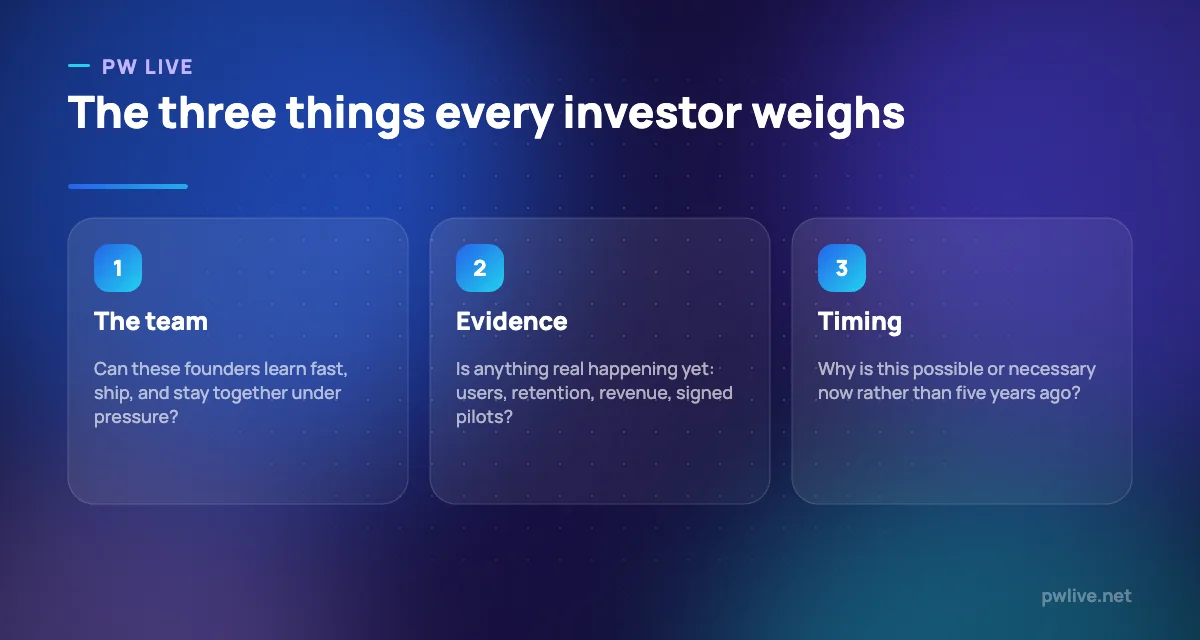
They are judging the team more than the idea
Ideas change. Most early-stage companies look different a year in. So investors spend a lot of attention on whether these particular founders can survive that change.
What they are actually reading:
- Speed of learning. How much have you changed your view in the last three months, and why? Founders who cannot describe a single thing they got wrong tend to worry investors.
- Ability to ship. Have you built, sold or launched something already, even small? Evidence beats intent.
- Founder fit. Why you, for this problem? Domain experience, access to customers, or a technical skill the problem requires.
- How you handle a hard question. Defensiveness is a signal. So is a calm “I do not know yet, here is how I would find out.”
If you are a student founder, inexperience is expected, but vagueness is not. Our roadmap for taking a college project to a startup covers how to build a track record before you have a company.
They want evidence, not projections
A five-year revenue forecast built in a spreadsheet is not evidence. It is arithmetic. Early-stage investors discount projections heavily and look instead for anything real that has already happened.
Evidence, roughly in order of strength:
- Paying customers who renew. Even a handful, even at a small price.
- Retention or repeat usage. People coming back without being nudged.
- Signed pilots or letters of intent from organisations that had to make a decision.
- Waitlist and usage data with a clear source of traffic you can explain.
- Deep customer conversations with specific quotes and observed behaviour.
The last one counts more than founders expect, especially before launch. If you can describe twenty conversations in detail, and what changed in your product because of them, that reads as rigour. Our guide to talking to users and finding problems worth solving shows how to gather that material properly.
They test whether you understand the problem better than they do
Investors meet many founders in the same space. The ones who stand out explain something the investor did not already know: a quirk of how the buying decision really works, a hidden cost in the current workaround, a reason previous attempts failed.
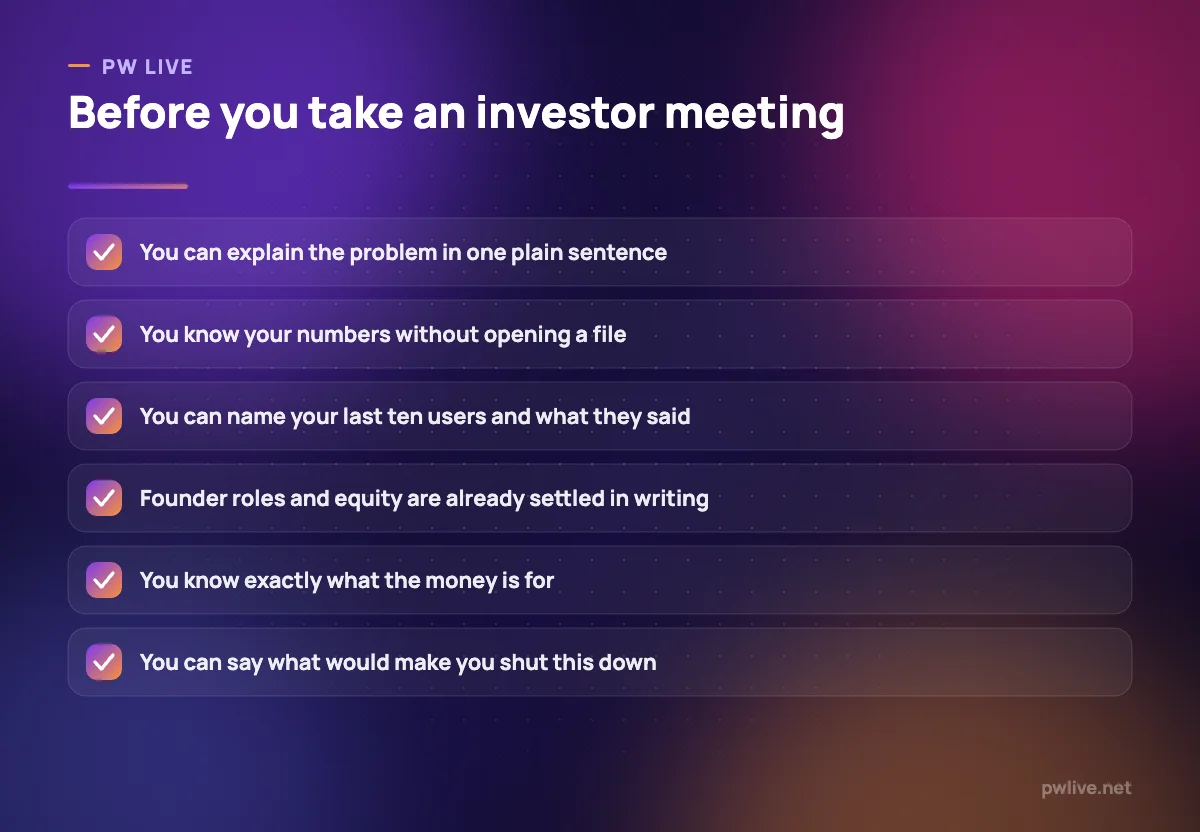
Prepare three specifics before any meeting.
- The workflow today. Describe exactly what your user does now, step by step, including the parts they hate.
- The failed alternatives. What has been tried and why it did not stick.
- The real buyer. Who signs off, who uses it, and who blocks it. These are often three different people.
This is the difference between explaining a market and explaining a customer. The second is far more persuasive.
They check whether the numbers can ever work
Nobody expects an early-stage company to be profitable. They do expect founders to know how the economics could work eventually.
Be ready to talk through, in plain terms:
- What it costs you to acquire one customer today, and how you know.
- What a customer is worth over the time they stay.
- Your gross margin, and what would move it.
- Your monthly cost of running the business, and how many months of money you have.
You do not need polished dashboards. You need honest arithmetic you can do out loud. Our explainer on unit economics and the numbers behind a healthy business is a good place to build that fluency, and cash flow basics explains the trap of being busy and still running out of money.
They look for a reason this works now
“Why now” is one of the most common questions and one of the least prepared answers. Investors are looking for a shift that opened the opportunity: a regulation, a cost that fell, a behaviour that changed, a platform that became widely available.
A weak answer is “this market is large and growing”. A strong answer names the specific change and shows why an earlier attempt would have failed.
If your answer is that nothing has changed and everyone else simply missed it, you need to be very convincing about why.
They pay attention to how the company is set up
Structural mess is a common reason a promising conversation stalls. Before raising, get the boring things in order.
- Founder equity settled, with vesting, in writing. Investors are wary of unresolved splits and absent founders holding large stakes.
- A clean cap table, with no long list of tiny holders from early favours.
- Clear ownership of the work, especially code, designs and anything built while employed or enrolled elsewhere.
- Basic compliance appropriate to your structure and stage.
Settle these early, when they are cheap conversations rather than expensive disputes. Our guide to equity and co-founder agreements covers what to decide before you raise, and invoices, quotes and contracts covers the paperwork habits that keep a young company tidy.
They are deciding whether they trust you
Most of a first meeting is a trust assessment. Everything you claim will later be checked, so exaggeration is expensive and hard to undo.
Practical rules that consistently help:
- Give the number, then the caveat, in that order. Do not bury the caveat.
- Distinguish clearly between what you have done, what you are doing, and what you plan.
- Send what you promised, when you promised it. Follow-through is data.
- Say “that is a fair concern” when it is, and then answer it.
How you communicate is part of the product at this stage. Building that muscle through the communication skills track pays off in fundraising, hiring and sales at once. If you want the wider context on stages, terms and expectations, read how startup funding works from bootstrapping to Series A, and browse the startups and innovation archive for related guides.
Key takeaways
- At the earliest stage, investors bet on founders and evidence, not projections.
- Real signals include paying users, repeat usage, signed pilots and detailed customer research.
- Show that you understand the customer’s current workflow better than anyone in the room.
- Know your unit economics and runway well enough to explain them without notes.
- Settle founder equity, ownership of work and basic compliance before you raise.
- Trust is built by precision and follow-through, not by optimism.
Frequently asked questions
Do I need revenue before raising money?
Not always, but you need some evidence. Without revenue, strong retention, signed pilots or unusually deep customer research can carry the conversation.
How much traction is enough?
There is no fixed threshold, and it varies by type of business. The more useful test is whether your numbers are growing for a reason you can explain and repeat.
Should I raise money at all?
Only if capital is the actual constraint. Many small businesses grow better without outside investment, since raising adds obligations, dilution and pressure for a particular kind of growth.
What is the most common mistake in investor meetings?
Talking about the market instead of the customer. Investors can look up market size themselves; they cannot look up what you learned from your last twenty user conversations.
Keep learning with PW Live
Browse every guide in Startups & Innovation, or pick a skill track and follow the roadmap step by step.





Leave a Reply