

If you want to be found on Google, SEO for beginners comes down to a simple exchange: you help a search engine understand your page, and you help a human get what they came for. Do both consistently and traffic arrives without you paying for every click.
Most people overcomplicate this. They chase tactics, plugins and scores instead of the two things that actually decide rankings for a small site: matching a real search need, and being the clearest answer to it.
This guide walks through the whole loop, from picking your first search phrase to reviewing results three months later. No tricks, no paid links, nothing that puts your site at risk.
What SEO actually is
Search engine optimisation is the work of making your pages easy to find, easy to understand and worth showing to someone who searched. It has three parts.
- Content: what the page says, and whether it answers the question behind the search.
- Technical: whether search engines can reach, read and render the page quickly.
- Authority: whether other credible sites and people reference you.
You control content and technical almost entirely. Authority you earn slowly. Beginners get the fastest results by fixing the first two properly, because most small sites have obvious gaps there.
It also helps to understand the machinery you are dealing with. Our explainer on how search engines work covers crawling, indexing and ranking in plain language, and it will save you from a lot of bad advice.
Start with search intent, not keywords
Every search has an intent behind it. Someone typing “how to fix a leaking tap” wants instructions. Someone typing “plumber near me” wants a phone number. Someone typing “best water heater” wants a comparison.
If your page format does not match the intent, no amount of optimisation rescues it. A sales page will not rank for an instructional query, and a 2,000-word guide will not rank for a local hire query.
Sort your target phrases into four buckets before you write anything:
- Informational — they want to learn. Write a guide or tutorial.
- Comparison — they are weighing options. Write an honest comparison.
- Transactional — they are ready to act. Write a clear service or product page.
- Navigational — they want a specific brand or page. Make sure yours is easy to find.
How to choose your first search phrases
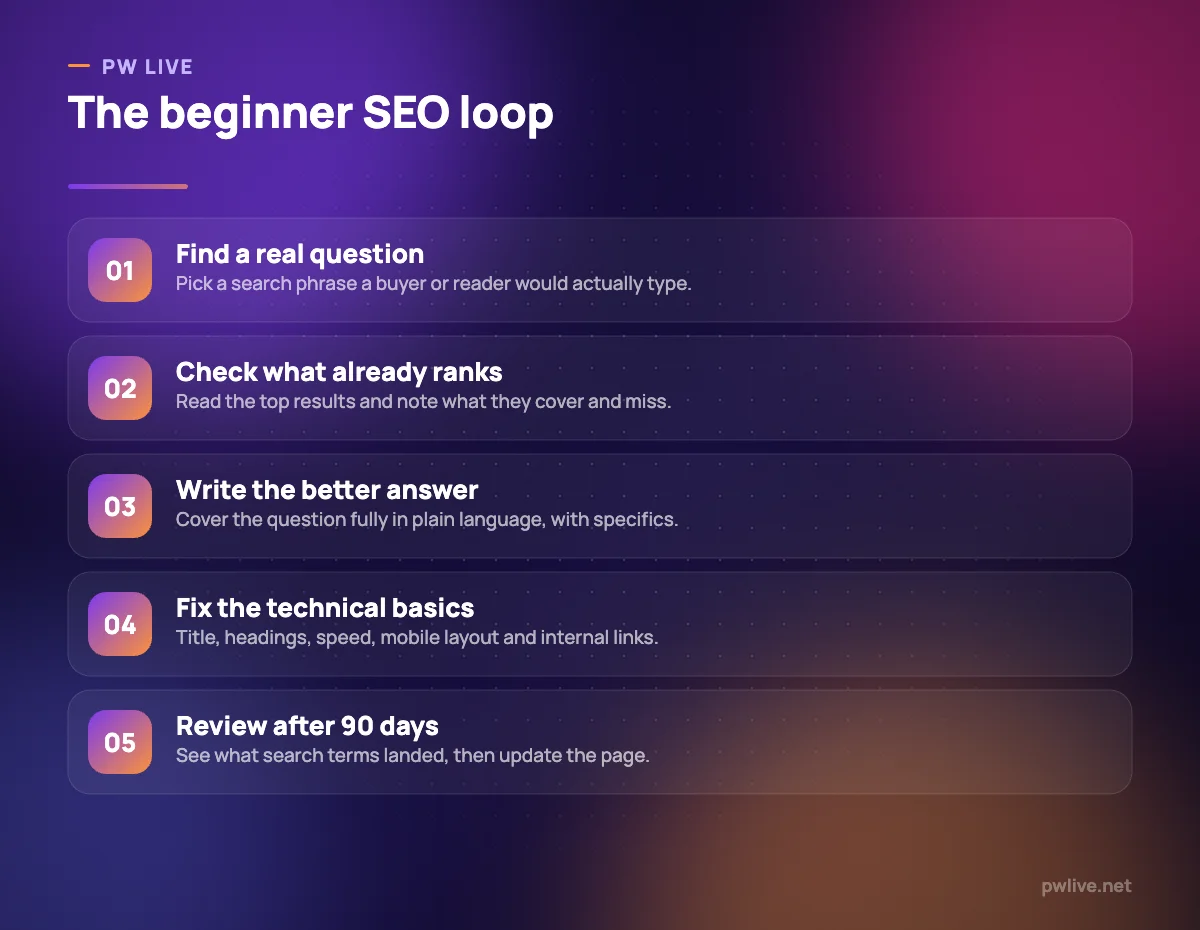
New sites rarely win broad, competitive phrases. You want specific phrases where the intent is clear and the existing results are weak or generic.
Look for phrases that are long enough to be unambiguous, close enough to what you sell to be useful, and answerable with something you genuinely know. “Marketing” is useless. “How to price a freelance logo design in India” is workable.
You do not need a paid subscription to find these. Search suggestions, the “people also ask” boxes, your own customer emails and the questions in relevant forums will give you more than you can write in a year. Our walkthrough of keyword research without expensive tools shows the exact process.
Then check the competition by reading, not by scoring. Open the top handful of results and ask: what does each cover, what does each skip, and what could I say that comes from real experience rather than summarising?
Write the page that deserves to rank
A page that ranks and keeps ranking usually does four things well.
- Answers the main question in the first two or three sentences, before any preamble.
- Covers the follow-up questions a reader will have next, in a logical order.
- Uses specifics: real steps, real numbers from your own work, real examples.
- Reads easily, with short paragraphs, descriptive headings and lists where they help.
Use your focus phrase naturally in the title, the opening, one or two headings and where it genuinely fits in the body. That is enough. Repeating it mechanically makes the page worse for humans and gains nothing.
The craft side of this matters more than the technical side. Our guide on writing content people actually read and share goes deeper on structure, openings and edits.
Get the technical basics right
You do not need to be a developer. Handle these and you are ahead of most small sites.
- One clear title tag per page, roughly 50 to 60 characters, with the main phrase near the front.
- A useful meta description that summarises the page and gives someone a reason to click.
- A logical heading structure: one H1, then H2s for sections, H3s beneath them.
- Readable URLs: short, lower case, hyphenated, no dates or random strings.
- Fast, mobile-friendly pages: compress images, avoid heavy scripts, test on a real phone.
- Descriptive alt text on images, written for someone who cannot see them.
- Internal links from related pages, using link text that describes the destination.
Internal linking is the most underrated item on that list. It tells search engines which of your pages matter and helps readers go deeper instead of bouncing back to the results page.
Earn authority without breaking the rules
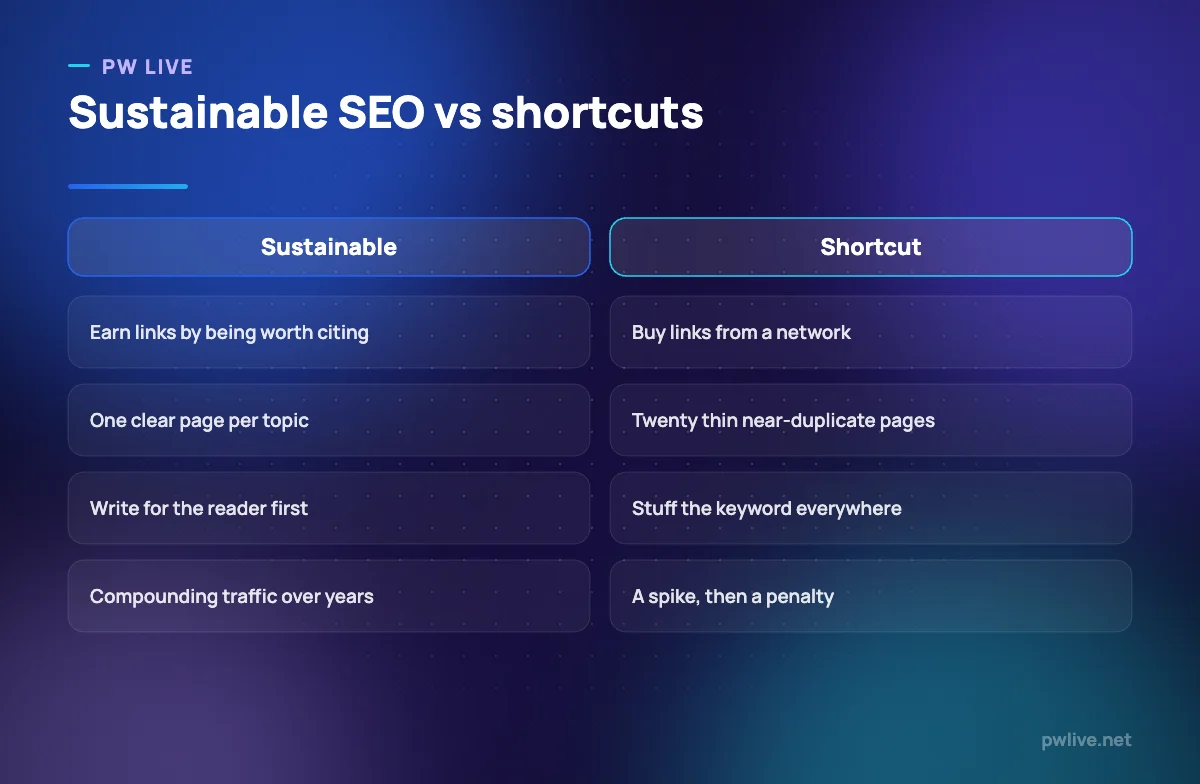
Links from other sites still signal that a page is worth showing. The safe way to get them is slow and boring, and it works.
- Publish something genuinely citable: original data from your own business, a template, a clear explainer nobody else wrote well.
- Answer questions publicly where your expertise is real, and link only when it actually helps.
- Write guest articles for publications your audience already reads, including our own write for us page if the topic fits.
- Get listed accurately in directories, associations and supplier pages that genuinely apply to you.
Do not buy links, swap links in schemes, or pay for placements presented as editorial. These violate search engine guidelines, and the recovery from a penalty costs far more time than the links ever saved.
Measure the right things
Rankings for one phrase are a vanity metric. Track outcomes instead.
Set up a free search analytics account for your site and look monthly at which queries bring impressions and clicks, which pages get them, and where you sit on the second page. A page ranking eleventh for a good phrase is usually the fastest win you have: improve it rather than writing something new.
Then connect that to business results — enquiries, signups, sales — so you can tell traffic from value. Our guide to the marketing metrics that matter explains how to build that view without drowning in dashboards.
SEO fits inside a wider plan, so it is worth reading it alongside the digital marketing fundamentals roadmap and browsing the rest of the marketing and sales archive. If you want a structured path, the digital marketing skill track sequences these topics for you.
Key takeaways
- SEO is matching a real search need and being the clearest answer to it. Everything else is support.
- Sort target phrases by intent first, then choose specific phrases where you have genuine knowledge.
- Fix titles, headings, speed, mobile layout and internal links before worrying about anything advanced.
- Earn links by publishing things worth citing. Never buy them.
- Review search performance every quarter and improve existing pages before writing new ones.
Frequently asked questions
How long does SEO take to work?
Longer than most people expect, usually months rather than weeks for a new site. Individual pages can move sooner if the competition is weak, but treat SEO as a compounding asset, not a campaign.
Do I need to pay for SEO tools as a beginner?
No. A free search analytics account for your own site plus careful reading of the existing results will carry you a long way. Paid tools save time once you have enough pages to manage.
How often should I publish new content?
Consistently rather than frequently. One well-researched page a month that fully answers a real question beats four thin posts, and updating an existing page is often worth more than publishing a new one.
Does keyword density still matter?
No. Use your main phrase naturally in the title, opening and a heading or two, then write for the reader. Forcing a target percentage makes pages worse and does not help rankings.
Keep learning with PW Live
Browse every guide in Marketing & Sales, or pick a skill track and follow the roadmap step by step.





Leave a Reply