

“Tell me about yourself” is the first question in most interviews and the one candidates most often waste. It is not small talk. It is the interviewer asking you to make the case for yourself in the first ninety seconds, before they have formed any other impression.
Handled badly, it becomes a rambling autobiography that begins in Class 10 and never arrives anywhere. Handled well, it sets the agenda for the rest of the conversation and steers the interviewer towards the parts of your background you most want discussed.
This guide gives you a structure, a script you can adapt truthfully, and the specific mistakes that make otherwise strong candidates sound unprepared.
What the interviewer is actually asking
They are not asking for your life story. Behind the question sit three practical concerns.
- Can you communicate? If you cannot summarise your own background clearly, they will assume you cannot summarise a project either.
- Are you relevant? They want to hear whether your experience connects to the role, without having to dig for it.
- Do you know why you are here? A candidate who applies to everything sounds different from one who chose this role deliberately.
Every part of your answer should serve one of those three. Anything that serves none of them is filler you can cut.
The four-part structure that works
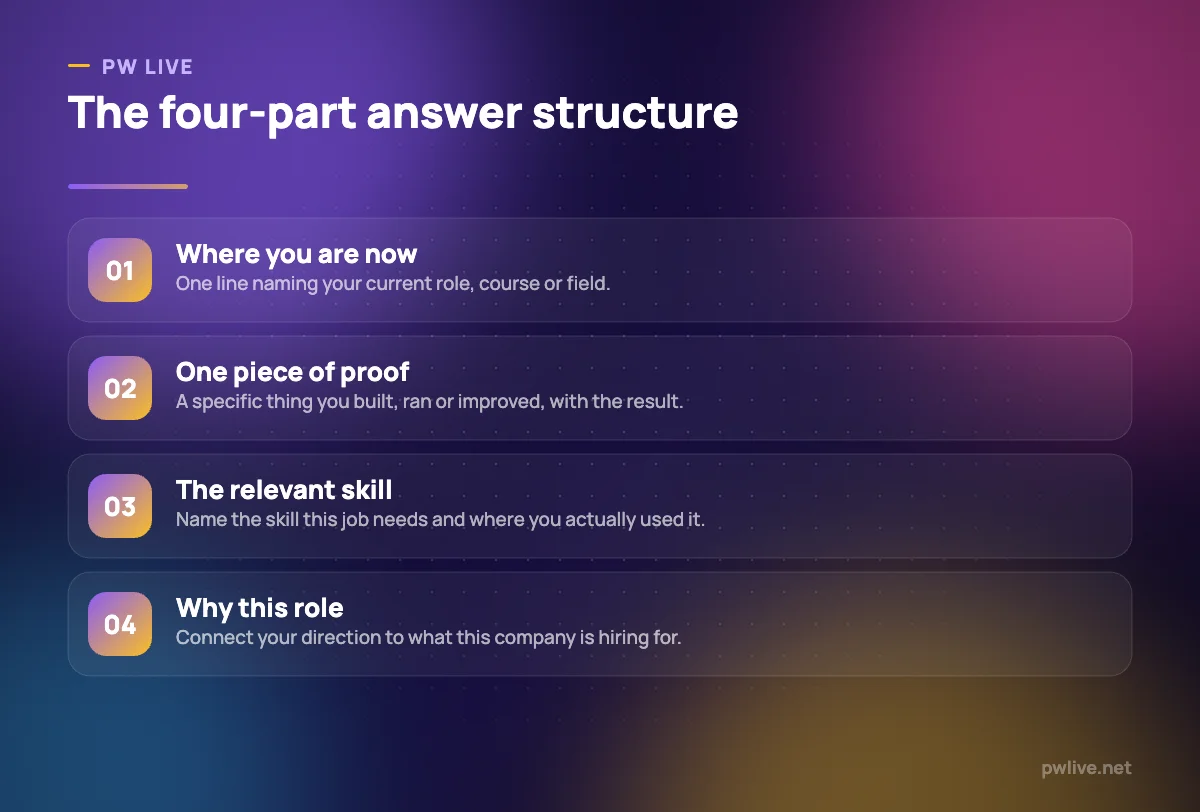
Use this shape. It fits freshers, career switchers and experienced candidates alike, because it starts from the present rather than the past.
- Where you are now. One sentence: your current course, role or field.
- One piece of proof. A specific thing you did, with a result attached. This is the sentence that separates you from other candidates.
- The relevant skill. Name the capability the job description emphasises and say where you built it.
- Why this role. Close by connecting your direction to what they are hiring for.
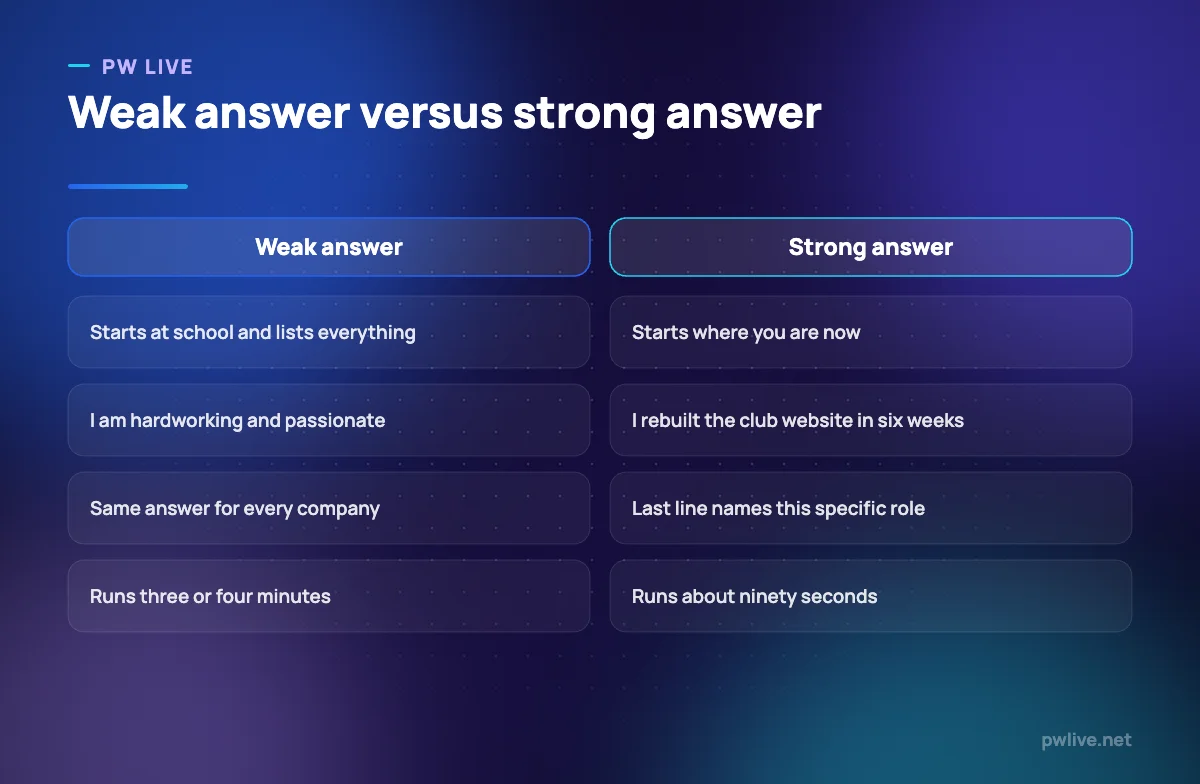
The whole thing should take sixty to ninety seconds. That is roughly 150 to 200 spoken words. Anything longer and you are answering a question they did not ask.
A template you can adapt
Here is a template for a final-year student. Treat it as a shape to fill with your own true details, not a script to copy.
“I am in my final year of a computer applications degree, and most of my practical experience has come from projects rather than internships. The one I am most proud of is a college event registration system I built with two classmates. It replaced a spreadsheet process and handled registrations for our annual technical fest, so I learned a lot about handling real users and unglamorous edge cases. Along the way I got comfortable with backend work and databases, which is why this role caught my attention. It is the first junior backend position I have seen that says you will actually own a service rather than only fix tickets, and that is the kind of learning I am looking for.”
And here is one for someone with two years of work experience switching functions.
“I have spent the last two years in customer support at a logistics company, handling escalations for business clients. Somewhere in the middle of that I started building dashboards to track why the same complaints kept recurring, and that analysis ended up changing how our team triaged tickets. That work is what pulled me towards analytics, so I taught myself SQL and spreadsheet modelling properly over the last year and did a few projects on public datasets. I am applying here because this role sits between operations and data, which is exactly the ground I already know.”
Notice what neither version does. Neither claims a title they did not hold. Neither invents a number. Neither says “passionate” or “hardworking”. The specifics do that work instead.
How to adapt it truthfully when you have little experience
If you have no internships and no job history, the structure does not change. Your proof simply comes from somewhere else.
Legitimate sources of proof include:
- A substantial academic or self-directed project, especially one with real users
- Freelance or paid tasks, however small
- Organising something: a fest, a club, a fundraiser, a study group
- A course you completed and then applied to build something
- Tutoring, family business work, or volunteering
The rule is that it must be true and it must be yours. Describe the part you personally did. “I handled the registration desk and the vendor coordination for a two-day event with about four hundred attendees” is far stronger than a vague claim of having “led” the fest.
If your evidence base feels thin, that is a preparation problem rather than an interview problem. Our guide to building a portfolio with no experience and the piece on writing a resume that gets interviews when you have no experience both cover how to create proof from scratch.
Six mistakes that sink this answer
- Starting from childhood. Nobody needs your Class 10 percentage in the opening answer. Start with the present.
- Reciting your resume. They have read it. Repeating it line by line adds nothing and burns your best minute.
- Adjective stacking. “Sincere, dedicated, quick learner” tells them nothing. One concrete example proves more than ten adjectives.
- Going personal. Family details, hobbies and hometown belong later, if at all, unless they connect directly to the role.
- Running long. If you are still talking after two minutes, the interviewer has stopped listening and started planning their next question.
- Using the same answer everywhere. The final line must change for every company. If it does not, you sound like you are applying in bulk.
How to rehearse without sounding rehearsed
The aim is a memorised structure, not a memorised paragraph. If you learn it word for word, you will sound flat, and one interruption will derail you.
Try this over three short sessions:
- Write the four beats as four bullet points, not sentences.
- Say the answer out loud from those bullets and record it. Listen back once.
- Say it again the next day from the same bullets, deliberately using different words.
By the third pass you will be able to deliver it naturally at any length the moment demands. This is the same principle as active recall: retrieving the content rather than re-reading it is what makes it stick.
Speaking clearly under pressure is a trainable skill in itself, and the communication skills track covers the wider set. For the rest of your interview preparation, our complete interview preparation checklist covers what to do before, during and after, and you can find more on the whole hiring process in our career and jobs section.
Key takeaways
- The question is asking whether you can communicate, whether you are relevant, and why you applied here.
- Use four beats: where you are now, one piece of proof, the relevant skill, and why this role.
- Keep it to sixty to ninety seconds and start from the present, not from school.
- Replace adjectives with one specific, honest example that you can defend under follow-up questions.
- Memorise the structure and rehearse aloud, but never memorise the exact wording.
Frequently asked questions
Should I mention personal details or hobbies?
Only if they connect to the role or make you memorable for a good reason. A hobby that shows a relevant skill is worth one short line; family background and hometown usually are not.
What if the interviewer asks it in a casual, friendly way?
Answer with the same structure, just in a warmer tone. A relaxed delivery still needs the same content, because the interviewer is still assessing relevance.
How do I explain a gap in my studies or career here?
State it briefly and without apology, say what you did during it, and move on to the next beat. One honest sentence closes the topic far better than avoiding it.
Can I use the same answer for a second interview at the same company?
Adjust it. The second interviewer usually has a different focus, so shift your proof example towards their area and keep the rest of the structure intact.
Keep learning with PW Live
Browse every guide in Career & Jobs, or pick a skill track and follow the roadmap step by step.





Leave a Reply