

Ecommerce logistics basics decide whether your online business is profitable or merely busy. Shipping, returns and cash on delivery are where margin quietly leaks, where customer complaints originate, and where a first-time seller is most likely to be caught out.
The good news is that logistics is a solved problem. Courier aggregators, marketplace fulfilment and prepaid payment options mean a one-person business can ship across the country from a spare room.
What you need is an understanding of how the pricing and risks work, so you can plan for them rather than discover them on your first settlement statement.
How courier pricing actually works
Shipping is not a flat fee. Rates change constantly by courier and by route, so always price your product using your own current rate card. What stays stable is the structure of the charge, and that is what you should learn.
Most courier pricing is built from these components:
- Weight slabs. Charges step up in bands, commonly in half-kilogram increments. A parcel just over a slab boundary costs the same as one at the top of the next band.
- Volumetric weight. Couriers calculate a weight from the parcel’s dimensions and charge on whichever is higher, actual or volumetric. Bulky light goods are penalised.
- Zones. Local, regional, national and special zones such as the north-east or islands are priced differently.
- Forward and reverse legs. A return usually costs a second shipping charge, so a returned order can cost you twice.
- COD handling. Cash on delivery typically carries an extra fee, often the higher of a fixed amount or a percentage of order value.
- Fuel or handling surcharges. These are applied on top and change periodically.
The practical lesson is that packaging size is a pricing decision. Trimming a box down a size, or switching a soft item from a carton to a padded bag, can move you into a cheaper slab on every single order for the rest of the year.
Choosing how you will ship
You have three broad routes, and you can mix them.
- Marketplace fulfilment. You send stock to the platform’s warehouse and they pick, pack and ship. Simplest operationally, and often gives better delivery promises. You pay storage and fulfilment fees and lose some control.
- Marketplace-managed shipping from your address. You pack, the platform’s courier collects. Rates are negotiated for you and deducted from settlements.
- A courier aggregator or direct courier account. You book each shipment yourself. More work, more control, and usually the best option once you sell from your own website. See marketplace vs own website for how this choice interacts with your channel decision.
Whichever you pick, compare on delivered cost per order rather than headline rate, and check serviceability for the pin codes your buyers actually live in.
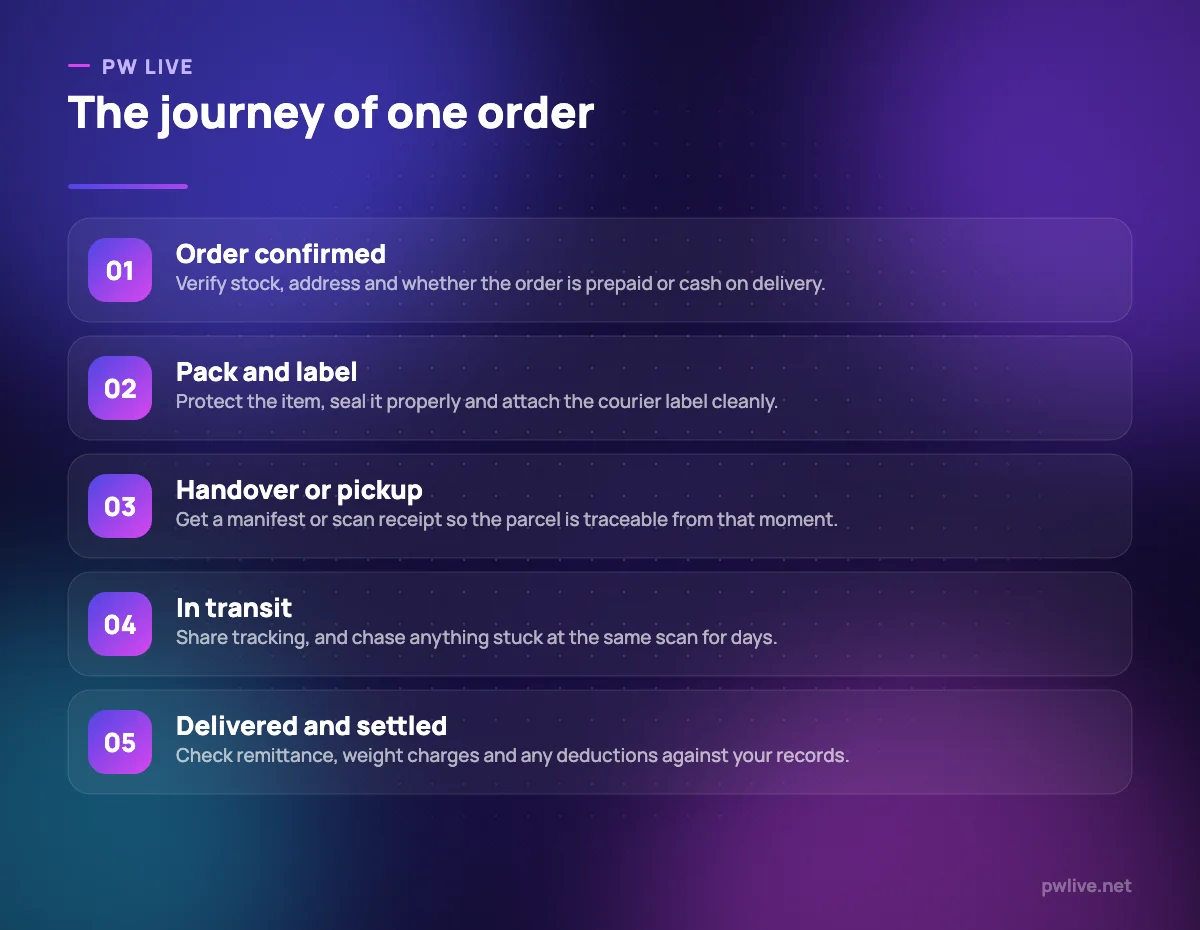
Pack like the parcel will be dropped
Assume every parcel is thrown into a sack, stacked under heavier boxes and handled by four people who have never seen your brand. Pack for that reality.
- Use a box or bag sized to the product, with filler so nothing moves when you shake it.
- Wrap anything fragile individually, and keep at least a couple of centimetres of cushioning on every side.
- Seal all openings with tape, including the seams, rather than a single strip across the top.
- Put liquids in a sealed inner bag before boxing.
- Attach the label flat, on the largest face, and cover it with clear tape so it survives rain.
- Keep the invoice inside the parcel where your category or platform requires it.
Take a photo of every packed and labelled parcel before handover. It takes seconds and settles most damage disputes.
Managing returns before they happen
Returns are the single biggest controllable cost in small e-commerce. A returned order can cost you forward shipping, reverse shipping, repackaging and sometimes an unsellable item.
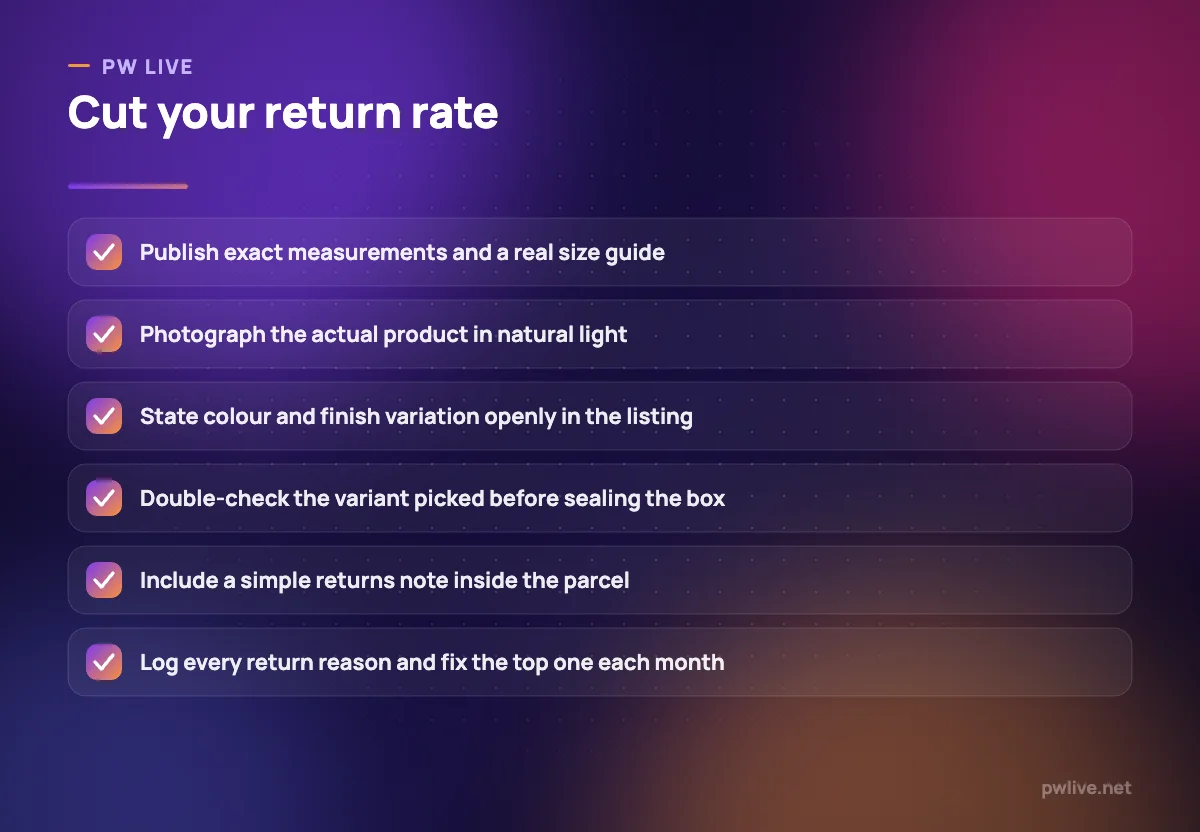
Most returns are caused at the listing stage. Wrong size, colour that looked different on screen, a feature the buyer assumed was included. That means the fix is editorial, not operational. Our guide to product descriptions that convert and taking good product photos with a phone both reduce returns directly, because they set accurate expectations.
Then build a process for the returns you do get:
- Publish a clear returns window and conditions before purchase, and honour whatever your platform mandates.
- Inspect returned goods on arrival and photograph the condition.
- Sort into resellable, repackable and write-off, and record which.
- Log the stated reason for every return in a simple sheet.
- Each month, look at the top reason and fix its cause.
That last step is what separates sellers whose return rate falls from those whose does not.
Cash on delivery: useful, and risky
Cash on delivery remains a significant part of Indian online retail, particularly outside metro areas and for first-time buyers who are not comfortable paying in advance. Offering it can widen your reach considerably.
It also carries costs a new seller often underestimates:
- A COD handling fee on every such order.
- Delayed cash, since remittance arrives days after delivery rather than at checkout.
- Refused deliveries, where the buyer declines the parcel and you pay shipping both ways for zero revenue.
- Higher working capital needs, because your money is tied up in stock and in transit.
Sensible ways to manage it:
- Confirm high-value or unusual COD orders with a quick message or call before dispatch.
- Set a value ceiling above which you only accept prepaid.
- Nudge buyers towards prepaid with a small discount or free shipping, and make UPI easy at checkout.
- Track your refused-delivery rate by pin code and region, and restrict COD where it is consistently bad.
Prepaid orders are simply better business. What digital payments growth means for small businesses covers the wider shift, and improving your checkout as described in how to reduce cart abandonment helps convert more buyers to prepaid.
Communicate, and half your support load disappears
Most customer anger in logistics is about silence, not delay. A buyer who knows their parcel is stuck is far calmer than one who has heard nothing.
Send a dispatch message with the tracking link. Send a short update if a parcel has not moved for several days. Reply to messages the same day, even if the answer is “I am chasing the courier”.
Keep a saved set of short replies for the five situations you face most: delayed, stuck in transit, delivery attempted, return requested, refund status. It saves hours a week.
Watch the numbers that actually move
Track a handful of logistics metrics monthly in a spreadsheet:
- Average shipping cost per delivered order
- Weight discrepancy charges, which is where couriers reweigh parcels and bill the difference
- Return rate by product
- COD share and refused-delivery rate
- Average days from order to delivery
Weight discrepancies are worth special attention. Weigh and measure your own packed parcels, keep a record, and dispute charges that do not match. Over a year the amounts are not trivial. For the broader financial view, see cash flow basics and unit economics explained.
Browse the e-commerce and retail archive for related guides, or build the operational side further through the productivity skill track.
Key takeaways
- Courier pricing is built from weight slabs, volumetric weight, zones and surcharges, so check current rates on your own courier’s rate card.
- Packaging size is a pricing decision; a smaller box can lower cost on every order.
- Most returns are caused by the listing, so accurate photos, measurements and honest descriptions are your cheapest fix.
- Log every return reason and fix the top one each month.
- COD widens reach but adds fees, delayed cash and refused deliveries, so set value limits and encourage prepaid.
- Track shipping cost per order, weight discrepancy charges and return rate, and dispute reweighing errors with your own records.
Frequently asked questions
Should I offer free shipping?
Free shipping usually lifts conversion, but the cost has to sit somewhere. Either build it into the product price or set a minimum order value above which shipping is free.
Who pays for a return?
It depends on the reason and the platform’s policy. Marketplaces generally require the seller to bear return costs for defective or wrongly sent items, while on your own site you decide and publish the rule in advance.
How do I handle a parcel that is lost in transit?
Raise a claim with the courier promptly, using your handover manifest and packing photo as evidence. Ship a replacement or refund the buyer without waiting for the claim to settle, because their trust is worth more than the item.
Can I refuse cash on delivery orders?
On your own website you set the rules, including a value ceiling or restricted pin codes. On marketplaces, COD availability is largely governed by the platform’s own policies, so check its current seller documentation.
Keep learning with PW Live
Browse every guide in E-commerce & Retail, or pick a skill track and follow the roadmap step by step.





Leave a Reply