

Most advice on how to write a cover letter assumes nobody reads them. Some recruiters skip them; many read the first two lines and stop if nothing there is specific. That is the real bar you are clearing, and it is a low one.
A cover letter is not a summary of your resume in paragraph form. It is the one place you can explain the things a resume cannot: why this company, why this switch, why this gap, and what you would actually do in the role.
This guide gives you a four-paragraph structure, adaptable templates, and the specific lines that make recruiters stop reading.
What a cover letter is for
Your resume answers “what have you done?” Your cover letter answers three different questions.
- Why us? Anyone can send a resume everywhere. A letter shows whether you chose this role.
- Why you, for this specific role? A resume lists everything. A letter argues for the two or three things that matter here.
- What is not obvious from the resume? A career change, a gap, a relocation, an unusual combination of skills, or a reason you are applying slightly below or above your level.
If your letter does not do at least two of those three, it is not adding anything and a recruiter will treat it accordingly.
The four-paragraph structure
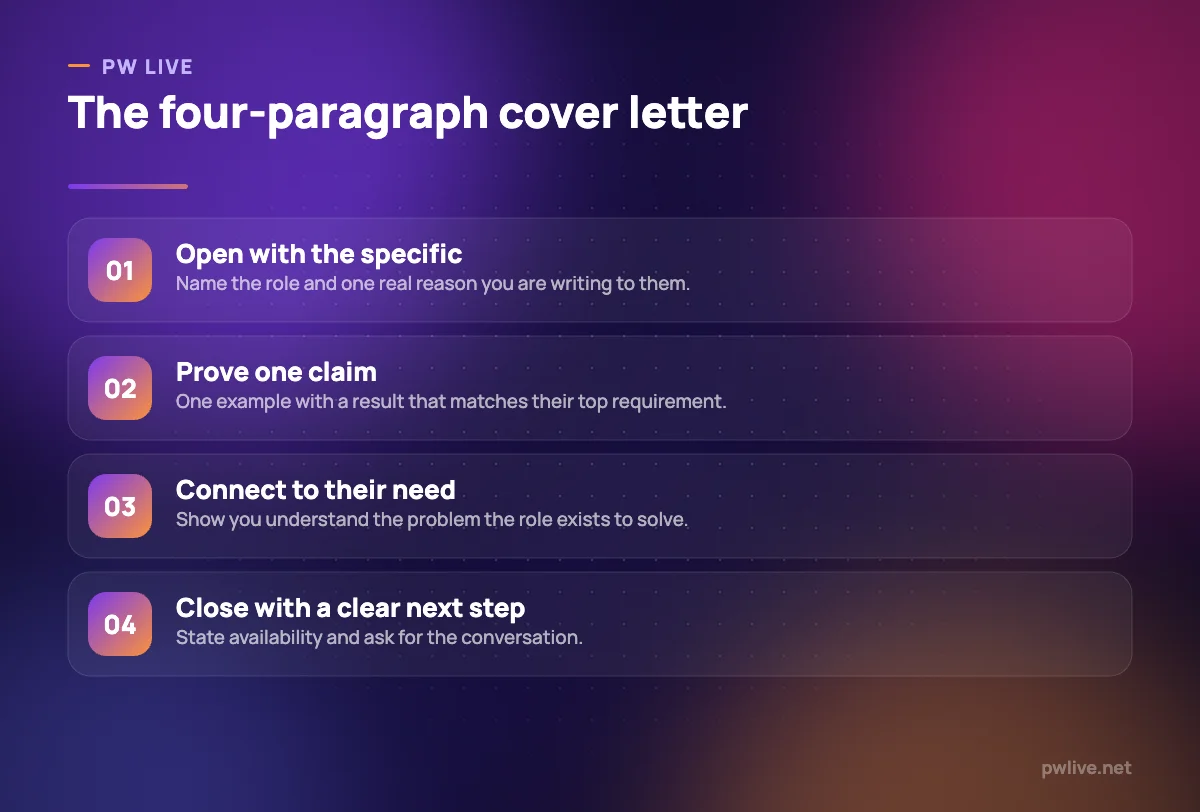
Keep the whole thing to roughly 200 to 300 words. It should fit on one screen without scrolling.
- The opening. Name the role and give one specific reason you are writing to this organisation. Skip “I am writing to apply for the post advertised on your website”, which tells them nothing they do not already know.
- The proof. Take the single most important requirement in the posting and give one example of you doing it, with the outcome. This is the paragraph that earns the interview.
- The connection. Show you understand what the role is actually for, and say what you would bring to it. Two or three sentences.
- The close. State your availability and ask for the conversation directly.
That is it. There is no fifth paragraph about your passion.
Write an opening that earns the second sentence
The first line decides whether the rest is read. It needs one concrete fact that could not appear in any other candidate’s letter.
Three approaches that work:
- The specific observation. “Your careers page mentions that the support team is moving from email to a ticketing system this year. I spent last summer doing exactly that migration for a small logistics company, and it is the kind of unglamorous work I enjoy.”
- The direct match. “I am applying for the junior data analyst role. Last term I built a dashboard for our department that replaced a manual weekly report, which is close to what the posting describes as the first project.”
- The honest connection. “I have been using your app since my second year, mostly for tracking lab work, and I noticed the export feature you added last month. I would like to apply for the frontend internship.”
Each one proves you looked. That alone puts you ahead of most of the pile.
Avoid opening with your own enthusiasm. “I am extremely excited about this opportunity” is a sentence every applicant writes and no recruiter believes.
Prove one claim properly
The middle of your letter should do one thing well rather than four things vaguely.
Find the requirement the posting emphasises most. Then write a short example in three beats: the situation, what you did, and what changed as a result.
“The posting asks for someone comfortable writing for a non-technical audience. In my last internship I rewrote the onboarding help articles for a payments product after sitting in on support calls to hear the actual questions customers asked. Support later told us the number of tickets about the setup step dropped noticeably over the following month.”
Two things make that work. It is specific, and it is honest about the limits of what is known. Writing “dropped noticeably” is better than inventing a percentage. If you do have a real figure, use it. If you do not, describe the direction of change instead of manufacturing precision.
Never inflate. Do not promote yourself from contributor to leader, do not turn a class project into a client engagement, and do not claim a tool you have only read about. Every claim in a cover letter is a question the interviewer may ask you to expand on, and the ones that cannot survive that are worse than saying nothing.
Adapt it without rewriting it each time
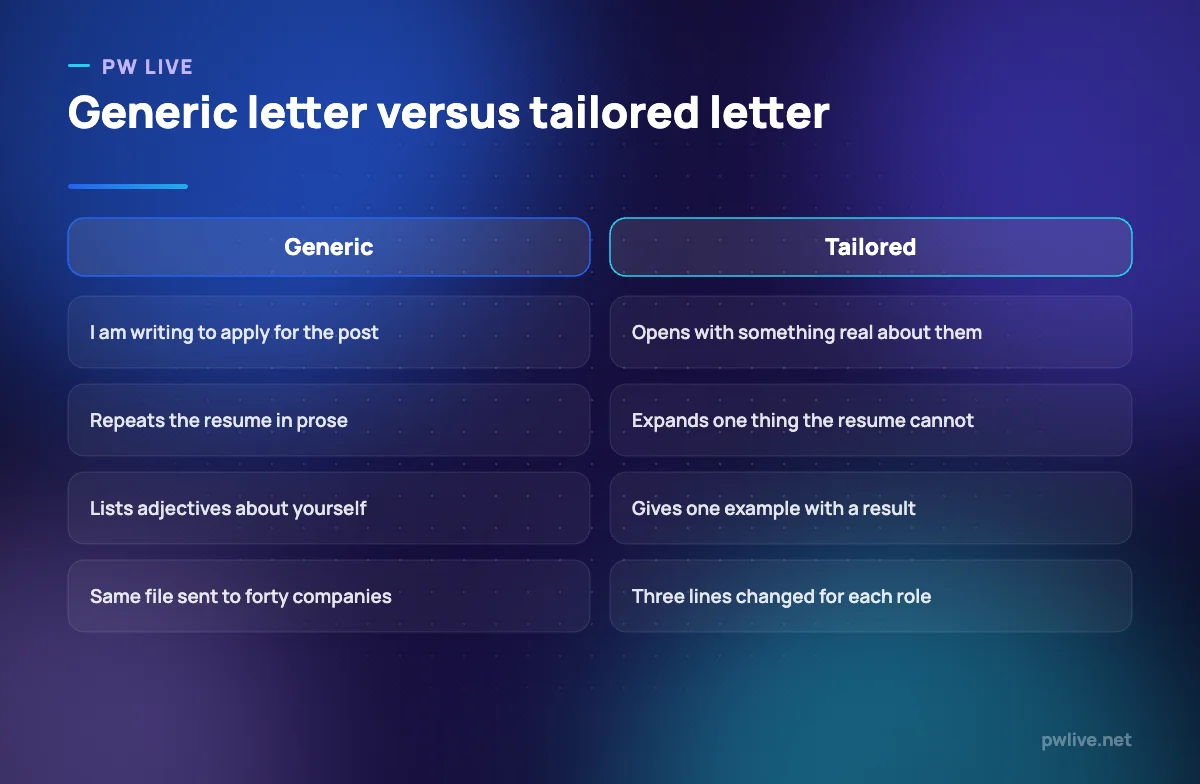
Tailoring does not mean starting from a blank page for every application. Build one strong base letter, then change three things per role.
- The opening sentence, with the company-specific detail
- The proof paragraph, choosing whichever of your examples best matches their top requirement
- The connection paragraph, referencing the specific problem or team named in the posting
Keep a document with four or five prepared proof paragraphs covering your best examples. Then each application is a fifteen-minute job rather than an hour.
Address it to a named person where you can find one, and use “Dear Hiring Team” where you cannot. Guessing a name wrongly is worse than not using one.
Handle the awkward things directly
A cover letter is the right place to address what a recruiter will otherwise wonder about. Handle it in one or two sentences, without apology, and move on.
- A gap. “I took eight months away from work to care for a family member. During that time I completed a data analysis course and built two projects, which are linked in my resume.”
- A career change. State what pulled you across and what you have already done about it. Our guide to switching careers without starting from zero covers how to frame this.
- Applying without every requirement. Name the gap honestly and show a comparable strength. “I have not used that framework, but I built a similar project in a related one and would expect to be productive quickly.”
- Relocating. Say plainly where you are moving to and when, so the recruiter does not assume a logistics problem.
Recruiters do not reject people for having ordinary life circumstances. They reject applications that leave unexplained questions.
Format and send it properly
The letter can be lost through presentation alone.
- Send it as a PDF unless the application asks for something else, so your formatting survives.
- Name the file clearly, such as
firstname-lastname-cover-letter.pdf. - If you are pasting into an email, put the letter in the body rather than attaching it, and use a subject line that names the role.
- Use plain formatting, no colour blocks or decorative fonts, and no photo unless it is specifically requested.
- Read it aloud once before sending. Every awkward sentence reveals itself when spoken.
Your resume and letter should agree with each other. Our guide to writing a resume that gets interviews when you have no experience covers the companion document, and the complete interview preparation checklist covers what comes next, since your letter often sets the first question you will be asked.
Writing clearly is a general professional skill and it improves everything you send. The communication skills track covers the wider set, our guide to writing content people actually read covers the mechanics of clear prose, and you will find more on the hiring process in our career and jobs section.
Key takeaways
- A cover letter should answer why this company, why you for this role, and anything the resume cannot explain.
- Keep it to four paragraphs and roughly 200 to 300 words on a single screen.
- Open with one concrete detail about the organisation, never with your own enthusiasm.
- Prove one claim with a real example and an honest outcome rather than inventing a number.
- Address gaps or changes directly in one or two sentences, without apologising for them.
Frequently asked questions
Do recruiters actually read cover letters?
Many read the first two lines and continue only if something specific holds them. That makes the opening sentence the highest-value part of the whole document.
How long should a cover letter be?
Around 200 to 300 words, fitting on one screen. A longer letter is not read more carefully; it is read less carefully.
Should I send one if the application says it is optional?
Yes, when you genuinely want the role and have something the resume does not show. It costs fifteen minutes and it separates you from applicants who skipped it.
Can I use the same cover letter for several companies?
Use the same base, but change the opening, the proof example and the paragraph about their needs. A letter that could have been sent to anyone reads exactly like one.
Keep learning with PW Live
Browse every guide in Career & Jobs, or pick a skill track and follow the roadmap step by step.





Leave a Reply